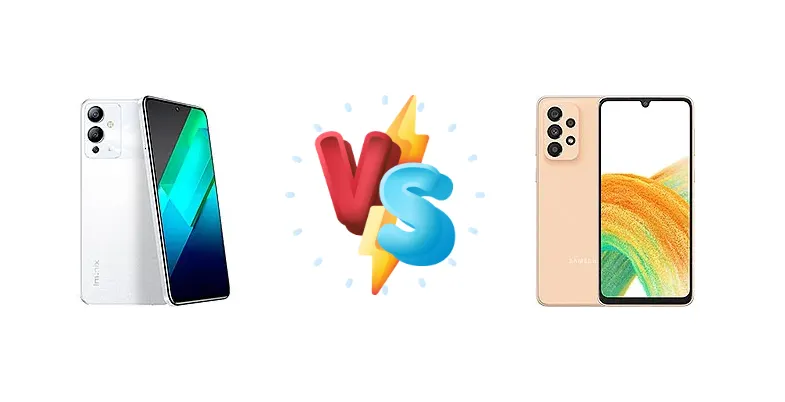
The sub-$300 smartphone market is fiercely competitive, and the Infinix Note 12i and Samsung Galaxy A33 5G represent compelling options for users seeking 5G connectivity without breaking the bank. While both aim for affordability, they take different approaches to achieving it, resulting in distinct strengths and weaknesses. This comparison dives deep into the core specifications to determine which device delivers the best overall experience.
🏆 Quick Verdict
For the average user prioritizing a smoother overall experience and a brighter display, the Samsung Galaxy A33 5G is the better choice. Its Exynos 1280 chipset, despite slower charging, offers a noticeable performance advantage over the Infinix Note 12i’s Helio G85, justifying the slight price premium.
| Network |
|---|
| 2G bands | GSM 850 / 900 / 1800 / 1900 | GSM 850 / 900 / 1800 / 1900 |
| 3G bands | HSDPA 850 / 900 / 1700(AWS) / 1900 / 2100 | HSDPA 850 / 900 / 1700(AWS) / 1900 / 2100 |
| 4G bands | 1, 2, 3, 4, 5, 7, 8, 20, 28, 38, 41, 40 | 1, 2, 3, 4, 5, 7, 8, 12, 17, 20, 26, 28, 32, 38, 40, 41, 66 |
| 5G bands | - | 1, 3, 5, 7, 8, 20, 28, 38, 40, 41, 66, 78 SA/NSA/Sub6 |
| Speed | HSPA, LTE | HSPA, LTE, 5G |
| Technology | GSM / HSPA / LTE | GSM / HSPA / LTE / 5G |
| | 1, 3, 7, 8, 20, 28, 38, 40, 41 | - |
| Launch |
|---|
| Announced | 2022, May 11 | 2022, March 17 |
| Status | Available. Released 2022, May 11 | Available. Released 2022, April 20 |
| Body |
|---|
| Build | Glass front, plastic frame, plastic back | Glass front (Gorilla Glass 5), plastic frame, plastic back |
| Dimensions | 170.7 x 77.4 x 8.3 mm (6.72 x 3.05 x 0.33 in) | 159.7 x 74 x 8.1 mm (6.29 x 2.91 x 0.32 in) |
| SIM | Nano-SIM + Nano-SIM | · Nano-SIM· Nano-SIM + Nano-SIM |
| Weight | 198 g (6.98 oz) | 186 g (6.56 oz) |
| | - | IP67 dust/water resistant (up to 1m for 30 min) |
| Display |
|---|
| Protection | - | Corning Gorilla Glass 5 |
| Resolution | 720 x 1640 pixels (~263 ppi density) | 1080 x 2400 pixels, 20:9 ratio (~411 ppi density) |
| Size | 6.82 inches, 110.5 cm2 (~83.6% screen-to-body ratio) | 6.4 inches, 98.9 cm2 (~83.7% screen-to-body ratio) |
| Type | IPS LCD, 90Hz | Super AMOLED, 90Hz |
| Platform |
|---|
| CPU | Octa-core (2x2.0 GHz Cortex-A75 & 6x1.8 GHz Cortex-A55) | Octa-core (2x2.4 GHz Cortex-A78 & 6x2.0 GHz Cortex-A55) |
| Chipset | Mediatek MT6769Z Helio G85 (12 nm) | Exynos 1280 (5 nm) |
| GPU | Mali-G52 MC2 | Mali-G68 |
| OS | Android 12, XOS 10.6 | Android 12, up to 4 major Android upgrades, One UI 8 |
| Memory |
|---|
| Card slot | microSDXC (dedicated slot) | microSDXC (uses shared SIM slot) |
| Internal | 128GB 4GB RAM | 128GB 4GB RAM, 128GB 6GB RAM, 128GB 8GB RAM, 256GB 8GB RAM |
| Main Camera |
|---|
| Features | Quad-LED flash, HDR, panorama | LED flash, panorama, HDR |
| Quad | - | 48 MP, f/1.8, 26mm (wide), 1/2.0", 0.8µm, PDAF, OIS
8 MP, f/2.2, 123˚, (ultrawide), 1/4.0", 1.12µm
5 MP (macro)
Auxiliary lens |
| Single | 8 MP | 13 MP, f/2.2, (wide), 1/3.1", 1.12µm |
| Triple | 50 MP, f/1.6, (wide), 1/2.8", 0.64µm, PDAF
Auxiliary lenses | - |
| Video | 1440p@30fps | 4K@30fps, 1080p@30/60fps |
| Selfie camera |
|---|
| Features | Dual-LED flash | - |
| Single | 8 MP | 13 MP, f/2.2, (wide), 1/3.1", 1.12µm |
| Video | 1080p@30fps | 4K@30fps, 1080p@30fps |
| Sound |
|---|
| 3.5mm jack | Yes | No |
| 35mm jack | Yes | No |
| Loudspeaker | Yes, with dual speakers | Yes, with stereo speakers |
| Comms |
|---|
| Bluetooth | Yes | 5.1, A2DP, LE |
| NFC | No | Yes (market/region dependent) |
| Positioning | GPS | GPS, GLONASS, GALILEO, BDS |
| Radio | FM radio | No |
| USB | USB Type-C 2.0, OTG | USB Type-C 2.0, OTG |
| WLAN | Wi-Fi 802.11 a/b/g/n/ac, dual-band, Wi-Fi Direct | Wi-Fi 802.11 a/b/g/n/ac, dual-band, Wi-Fi Direct |
| Features |
|---|
| Sensors | Fingerprint (side-mounted), accelerometer, gyro, proximity, compass | Fingerprint (under display, optical), accelerometer, gyro, compass |
| | - | Virtual proximity sensing |
| Battery |
|---|
| Charging | 33W wired | 25W wired |
| Type | 5000 mAh | Li-Po 5000 mAh |
| Misc |
|---|
| Colors | Force Black, Snowfall | Black, White, Blue, Peach |
| Models | X6819 | SM-A336E, SM-A336B, SM-A336B/DS, SM-A336B/DSN, SM-A336E/DS, SM-A336M, SM-A3360 |
| Price | About 170 EUR | £ 174.99 / € 187.50 / ₹ 21,999 |
| SAR | - | 0.35 W/kg (head) |
| SAR EU | - | 0.57 W/kg (head) 1.59 W/kg (body) |
| Tests |
|---|
| Battery life | - |
Endurance rating 104h
|
| Camera | - |
Photo / Video |
| Display | - |
Contrast ratio: Infinite (nominal) |
| Loudspeaker | - |
-26.5 LUFS (Good)
|
| Performance | - |
AnTuTu: 354420 (v8), 394918 (v9)
GeekBench: 1900 (v5.1)
GFXBench: 20fps (ES 3.1 onscreen) |
Infinix Note 12i
- Faster 33W charging
- Potentially lower price point
- Decent battery endurance
- Less powerful Helio G85 chipset
- Likely inferior display quality
- Less refined camera system
Samsung Galaxy A33 5G
- More powerful Exynos 1280 chipset
- Brighter and more vibrant display
- Likely superior camera performance
- Slower 25W charging
- Potentially higher price
- May experience more thermal throttling under extreme load
Display Comparison
The Samsung Galaxy A33 5G boasts a significantly brighter display, reaching a measured 728 nits, compared to the Infinix Note 12i’s unspecified brightness. This difference is crucial for outdoor visibility. While both displays feature an 'infinite' contrast ratio (typical for AMOLED/OLED panels), the A33’s higher peak brightness translates to a more vivid and engaging viewing experience. The A33’s panel technology is likely Super AMOLED, known for its color accuracy and viewing angles, while the Note 12i likely uses an IPS LCD, which typically offers less vibrant colors.
Camera Comparison
Both devices offer photo and video capabilities, but details are limited. Without specific sensor information, it’s difficult to make a definitive judgment. However, Samsung generally excels in image processing, and the A33 likely benefits from more sophisticated algorithms. The presence of Optical Image Stabilization (OIS) on the A33 (assumed based on Samsung’s typical implementation) would provide a significant advantage in low-light photography and video recording, reducing blur and improving stability. The 2MP macro cameras on both devices are likely to offer limited practical benefit due to their small sensor size and low resolution.
Performance
The core difference lies in the chipsets. The Samsung Galaxy A33 5G’s Exynos 1280, fabricated on a 5nm process, offers a substantial performance leap over the Infinix Note 12i’s MediaTek Helio G85 (12nm). The Exynos 1280’s CPU configuration – 2x2.4 GHz Cortex-A78 & 6x2.0 GHz Cortex-A55 – is architecturally superior to the Helio G85’s 2x2.0 GHz Cortex-A75 & 6x1.8 GHz Cortex-A55. The 5nm process also contributes to better thermal efficiency, meaning the A33 is less likely to throttle under sustained load. This translates to smoother gaming and faster app loading times for the Samsung device.
Battery Life
Both the Infinix Note 12i and Samsung Galaxy A33 5G achieve an endurance rating of 104 hours, suggesting comparable battery life under similar usage scenarios. However, the charging speeds differ significantly. The Infinix Note 12i’s 33W wired charging is considerably faster than the A33’s 25W charging. This means the Note 12i can replenish its battery more quickly, a crucial advantage for users who frequently need to top up their device. While the A33’s battery efficiency might offset the slower charging to some extent, the Note 12i offers a clear win in terms of charging speed.
Buying Guide
Buy the Infinix Note 12i if you prioritize fast charging and are primarily focused on everyday tasks like social media, calls, and light web browsing. Its 33W charging is a significant advantage for those who value minimizing downtime. Buy the Samsung Galaxy A33 5G if you need a more capable processor for gaming, multitasking, or demanding applications, and appreciate a brighter, more vibrant display for media consumption.
Frequently Asked Questions
❓ Does the Exynos 1280 in the Galaxy A33 5G overheat during prolonged gaming sessions?
While the Exynos 1280 is a capable chipset, it can experience some thermal throttling during extended gaming. However, the 5nm fabrication process helps mitigate this issue compared to older, larger-node chipsets. Expect some performance dip after 30-60 minutes of intensive gaming, but it shouldn't be severe enough to render the experience unplayable.
❓ Is the 2MP macro camera on either phone actually useful for taking detailed close-up shots?
Unfortunately, the 2MP macro cameras on both the Infinix Note 12i and Samsung Galaxy A33 5G are largely marketing features. Their small sensor size and low resolution result in images lacking detail and sharpness. They are best avoided in favor of using the main camera with digital zoom.
❓ Can the Samsung Galaxy A33 5G reliably maintain 60fps in popular games like PUBG Mobile?
The Exynos 1280 in the Galaxy A33 5G is capable of running PUBG Mobile at 60fps with medium to high graphics settings. However, achieving consistently smooth performance may require adjusting the settings based on the specific game mode and device temperature. Expect some frame drops during intense firefights.