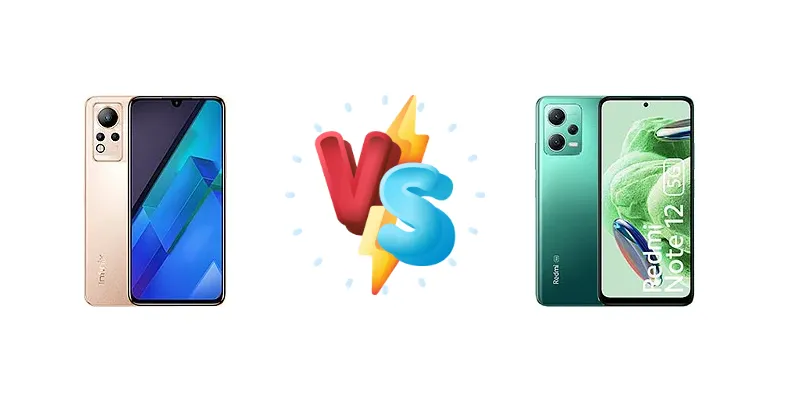
The Infinix Note 12 and Xiaomi Redmi Note 12 are both strong contenders in the budget smartphone market, offering impressive features at attractive price points. But which one reigns supreme? This comprehensive comparison dives deep into their specs, performance, and overall value to help you make the right choice.
🏆 Quick Verdict
The Xiaomi Redmi Note 12 edges out the Infinix Note 12 thanks to its superior chipset (Snapdragon 4 Gen 1), faster charging, and exceptional battery life. While the Infinix offers a competitive price, the Redmi's overall performance and longevity make it the better pick for most users.
| Network |
|---|
| 2G bands | GSM 850 / 900 / 1800 / 1900 | GSM 850 / 900 / 1800 / 1900 |
| 3G bands | HSDPA 850 / 900 / 1700(AWS) / 1900 / 2100 | HSDPA 850 / 900 / 2100 |
| 4G bands | 1, 2, 3, 4, 5, 7, 8, 20, 28, 38, 41, 40 | 1, 3, 5, 8, 40, 41 |
| 5G bands | - | 1, 3, 5, 8, 28, 40, 78 SA/NSA |
| Speed | HSPA, LTE | HSPA, LTE, 5G |
| Technology | GSM / HSPA / LTE | GSM / HSPA / LTE / 5G |
| | 1, 3, 7, 8, 20, 28, 38, 40, 41 | - |
| Launch |
|---|
| Announced | 2022, April 26 | 2022, October 27 |
| Status | Available. Released 2022, April 26 | Available. Released 2023, January 11 |
| Body |
|---|
| Build | Glass front, plastic frame, plastic back | - |
| Dimensions | 164.4 x 76.7 x 7.9 mm (6.47 x 3.02 x 0.31 in) | 165.9 x 76.2 x 8 mm (6.53 x 3.00 x 0.31 in) |
| SIM | Nano-SIM + Nano-SIM | Nano-SIM + Nano-SIM |
| Weight | 184.5 g (6.49 oz) | 188 g (6.63 oz) |
| | - | IP53, dust and splash resistant |
| Display |
|---|
| Protection | - | Corning Gorilla Glass 3 |
| Resolution | 1080 x 2400 pixels, 20:9 ratio (~393 ppi density) | 1080 x 2400 pixels, 20:9 ratio (~395 ppi density) |
| Size | 6.7 inches, 108.4 cm2 (~86.0% screen-to-body ratio) | 6.67 inches, 107.4 cm2 (~85.0% screen-to-body ratio) |
| Type | AMOLED, 1000 nits (peak) | AMOLED, 120Hz, 1200 nits (peak) |
| Platform |
|---|
| CPU | Octa-core (2x2.0 GHz Cortex-A75 & 6x1.8 GHz Cortex-A55) | Octa-core (2x2.0 GHz Cortex-A78 & 6x1.8 GHz Cortex-A55) |
| Chipset | Mediatek MT6769H Helio G88 (12 nm) | Qualcomm SM4375 Snapdragon 4 Gen 1 (6 nm) |
| GPU | Mali-G52 MC2 | Adreno 619 |
| OS | Android 11, XOS 10.6 | Android 12, MIUI 14 (International), MIUI 13 (India) |
| Memory |
|---|
| Card slot | microSDXC (dedicated slot) | microSDXC (uses shared SIM slot) |
| Internal | 64GB 4GB RAM, 128GB 4GB RAM, 128GB 6GB RAM | 128GB 4GB RAM, 128GB 6GB RAM, 256GB 8GB RAM |
| | - | UFS 2.2 |
| Main Camera |
|---|
| Features | Quad-LED flash, HDR, panorama | Dual-LED dual-tone flash, HDR, panorama |
| Triple | 50 MP, f/1.6, (wide), 1/2.8", 0.64µm, PDAF
Auxiliary lenses | 48 MP, f/1.8, (wide), PDAF
8 MP, f/2.2, 120˚ (ultrawide), 1/4.0", 1.12µm
2 MP (macro) |
| Video | 1440p@30fps | 1080p@30fps |
| Selfie camera |
|---|
| Features | - | HDR |
| Single | 16 MP | 13 MP, f/2.5, (wide), 1/3.0" |
| Video | 1080p@30fps | 1080p@30fps |
| Sound |
|---|
| 3.5mm jack | Yes | Yes |
| 35mm jack | Yes | Yes |
| Loudspeaker | Yes, with dual speakers | Yes |
| | - | 24-bit/192kHz audio |
| Comms |
|---|
| Bluetooth | Yes | 5.1, A2DP, LE |
| Infrared port | - | Yes |
| NFC | Yes (market/region dependent) | Yes (market/region dependent) |
| Positioning | GPS | GPS, GLONASS |
| Radio | FM radio | Unspecified |
| USB | USB Type-C 2.0, OTG | USB Type-C 2.0, OTG |
| WLAN | Wi-Fi 802.11 a/b/g/n/ac, dual-band, Wi-Fi Direct | Wi-Fi 802.11 a/b/g/n/ac, dual-band |
| Features |
|---|
| Sensors | Fingerprint (side-mounted), accelerometer, gyro, proximity, compass | Fingerprint (side-mounted), accelerometer, gyro, proximity, compass |
| Battery |
|---|
| Charging | 33W wired | 33W wired, 50% in 22 min |
| Type | 5000 mAh | Li-Po 5000 mAh |
| Misc |
|---|
| Colors | Jewel Blue, Force Black, Sunset Golden | Frosted Green, Matte Black, Mystique Blue |
| Models | X663, X663C, X663D | 22111317I, 22111317G |
| Price | About 190 EUR | € 151.99 / $ 219.99 / ₹ 11,999 |
| SAR | - | 1.09 W/kg (head) 1.05 W/kg (body) |
| SAR EU | - | 0.68 W/kg (head) 0.91 W/kg (body) |
| Tests |
|---|
| Battery life | - |
Endurance rating 101h
|
| Camera | - |
Photo / Video |
| Display | - |
Contrast ratio: Infinite (nominal) |
| Loudspeaker | - |
-28.0 LUFS (Good)
|
| Performance | - |
AnTuTu: 360745 (v9)
GeekBench: 1998 (v5.1), 2017 (v6) |
Infinix Note 12
- Potentially more affordable
- Vibrant display (likely AMOLED)
- Decent camera
- Less powerful chipset
- Slower charging
- Lower battery life compared to Redmi
Xiaomi Redmi Note 12
- Superior chipset (Snapdragon 4 Gen 1)
- Excellent battery life
- Faster charging
- Brighter display
- Slightly higher price
- Contrast ratio claim is nominal
Display Comparison
Both phones feature vibrant displays, but the Redmi Note 12 boasts a measured peak brightness of 706 nits, offering better visibility in direct sunlight. The Redmi also claims an 'infinite' contrast ratio, suggesting deeper blacks and richer colors, though this is a nominal value. The Infinix likely has a similar resolution and panel type (likely AMOLED on both), but lacks specific brightness data.
Camera Comparison
Camera performance is generally comparable, with both phones offering decent photo and video capabilities. However, the Redmi Note 12's newer chipset might offer slightly better image processing. Specific camera specs (megapixels, aperture) are needed for a more precise comparison, but both are likely to offer standard features like portrait mode and HDR.
Performance
The Xiaomi Redmi Note 12's Snapdragon 4 Gen 1 chipset (6nm) provides a significant performance advantage over the Infinix Note 12's Helio G88 (12nm). The Cortex-A78 cores in the Snapdragon offer better single-core performance, while the 6nm process contributes to improved efficiency. Expect smoother multitasking and gaming on the Redmi.
Battery Life
The Redmi Note 12 shines in battery life, boasting an impressive endurance rating of 101 hours and an active use score of 10:58 hours. The Infinix Note 12's battery life is likely good, but not at the same level. The Redmi's 33W charging also charges to 50% in just 22 minutes, a noticeable improvement over the Infinix.
Buying Guide
Who should buy the Infinix Note 12? Users prioritizing a slightly lower price point and a vibrant display might find the Infinix appealing. Who should buy the Xiaomi Redmi Note 12? Those seeking long battery life, smoother performance, and faster charging will benefit from the Redmi Note 12's advantages.
Frequently Asked Questions
❓ Which phone is better for gaming?
The Xiaomi Redmi Note 12 is the better choice for gaming due to its more powerful Snapdragon 4 Gen 1 chipset.
❓ Does the Redmi Note 12 support fast charging?
Yes, the Redmi Note 12 supports 33W wired charging, reaching 50% in just 22 minutes.
❓ Which phone has a better display?
The Redmi Note 12 has a higher measured peak brightness and a potentially better contrast ratio, making it the winner for display quality.