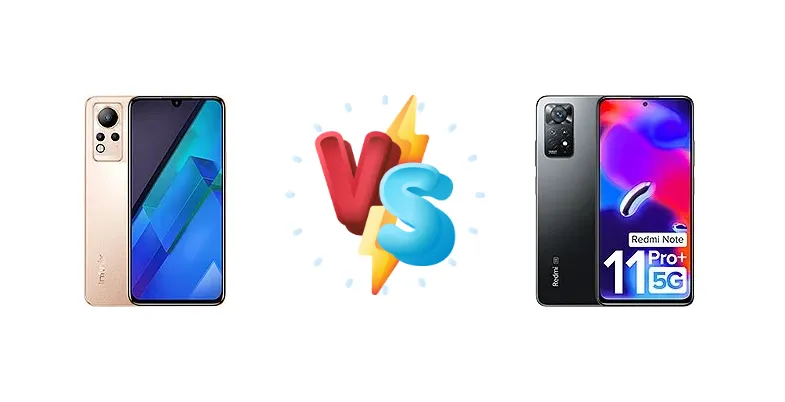
The sub-$300 smartphone market is fiercely competitive, and the Infinix Note 12 and Xiaomi Redmi Note 11 Pro+ 5G (India) represent compelling options. While both aim to deliver a feature-rich experience without breaking the bank, they take distinctly different approaches to achieving this goal, primarily through chipset choice and charging technology. This comparison dissects those differences to reveal which phone offers the best value.
🏆 Quick Verdict
For the average user prioritizing fast charging and 5G connectivity, the Xiaomi Redmi Note 11 Pro+ 5G (India) is the clear winner. Its Snapdragon 695 offers a more efficient architecture and 5G support, while the 67W charging significantly reduces downtime. However, the Infinix Note 12 remains a viable option for those on a tighter budget where charging speed isn't critical.
| Network |
|---|
| 2G bands | GSM 850 / 900 / 1800 / 1900 | GSM 850 / 900 / 1800 / 1900 |
| 3G bands | HSDPA 850 / 900 / 1700(AWS) / 1900 / 2100 | HSDPA 850 / 900 / 1900 / 2100 |
| 4G bands | 1, 2, 3, 4, 5, 7, 8, 20, 28, 38, 41, 40 | 1, 3, 5, 8, 40, 41 |
| 5G bands | - | 1, 3, 5, 8, 28, 40, 78 SA/NSA |
| Speed | HSPA, LTE | HSPA, LTE, 5G |
| Technology | GSM / HSPA / LTE | GSM / HSPA / LTE / 5G |
| | 1, 3, 7, 8, 20, 28, 38, 40, 41 | - |
| Launch |
|---|
| Announced | 2022, April 26 | 2022, March 09 |
| Status | Available. Released 2022, April 26 | Available. Released 2022, March 15 |
| Body |
|---|
| Build | Glass front, plastic frame, plastic back | Glass front (Gorilla Glass 5), glass back |
| Dimensions | 164.4 x 76.7 x 7.9 mm (6.47 x 3.02 x 0.31 in) | 164.2 x 76.1 x 8.1 mm (6.46 x 3.00 x 0.32 in) |
| SIM | Nano-SIM + Nano-SIM | Nano-SIM + Nano-SIM |
| Weight | 184.5 g (6.49 oz) | 202 g (7.13 oz) |
| Display |
|---|
| Protection | - | Corning Gorilla Glass 5 |
| Resolution | 1080 x 2400 pixels, 20:9 ratio (~393 ppi density) | 1080 x 2400 pixels, 20:9 ratio (~395 ppi density) |
| Size | 6.7 inches, 108.4 cm2 (~86.0% screen-to-body ratio) | 6.67 inches, 107.4 cm2 (~86.0% screen-to-body ratio) |
| Type | AMOLED, 1000 nits (peak) | Super AMOLED, 120Hz, 700 nits, 1200 nits (peak) |
| Platform |
|---|
| CPU | Octa-core (2x2.0 GHz Cortex-A75 & 6x1.8 GHz Cortex-A55) | Octa-core (2x2.2 GHz Kryo 660 Gold & 6x1.7 GHz Kryo 660 Silver) |
| Chipset | Mediatek MT6769H Helio G88 (12 nm) | Qualcomm SM6375 Snapdragon 695 5G (6 nm) |
| GPU | Mali-G52 MC2 | Adreno 619 |
| OS | Android 11, XOS 10.6 | Android 11, MIUI 13 |
| Memory |
|---|
| Card slot | microSDXC (dedicated slot) | microSDXC (uses shared SIM slot) |
| Internal | 64GB 4GB RAM, 128GB 4GB RAM, 128GB 6GB RAM | 64GB 6GB RAM, 128GB 6GB RAM, 128GB 8GB RAM, 256GB 8GB RAM |
| Main Camera |
|---|
| Features | Quad-LED flash, HDR, panorama | LED flash, HDR, panorama |
| Triple | 50 MP, f/1.6, (wide), 1/2.8", 0.64µm, PDAF
Auxiliary lenses | 108 MP, f/1.9, 26mm (wide), 1/1.52", 0.7µm, PDAF
8 MP, f/2.2, 118˚ (ultrawide)
2 MP (macro) |
| Video | 1440p@30fps | 1080p@30fps |
| Selfie camera |
|---|
| Single | 16 MP | 16 MP, f/2.5, (wide), 1/3.06" 1.0µm |
| Video | 1080p@30fps | 1080p@30fps |
| Sound |
|---|
| 3.5mm jack | Yes | - |
| 35mm jack | Yes | Yes |
| Loudspeaker | Yes, with dual speakers | Yes, with stereo speakers |
| Comms |
|---|
| Bluetooth | Yes | 5.1, A2DP, LE |
| Infrared port | - | Yes |
| NFC | Yes (market/region dependent) | No |
| Positioning | GPS | GPS, GLONASS, BDS, GALILEO |
| Radio | FM radio | Unspecified |
| USB | USB Type-C 2.0, OTG | USB Type-C 2.0, OTG |
| WLAN | Wi-Fi 802.11 a/b/g/n/ac, dual-band, Wi-Fi Direct | Wi-Fi 802.11 a/b/g/n/ac, dual-band, Wi-Fi Direct |
| Features |
|---|
| Sensors | Fingerprint (side-mounted), accelerometer, gyro, proximity, compass | Fingerprint (side-mounted), accelerometer, gyro, proximity, compass |
| Battery |
|---|
| Charging | 33W wired | 67W wired, PD3.0, QC3, 50% in 15 min, 100% in 42 min |
| Type | 5000 mAh | Li-Po 5000 mAh |
| Misc |
|---|
| Colors | Jewel Blue, Force Black, Sunset Golden | Mirage Blue, Phantom White, Stealth Black |
| Models | X663, X663C, X663D | 2201116SI |
| Price | About 190 EUR | About 250 EUR |
Infinix Note 12
- More affordable price point
- Sufficient for basic smartphone tasks
- Acceptable 33W charging
- Less efficient Helio G88 chipset
- No 5G connectivity
- Likely inferior camera performance
Xiaomi Redmi Note 11 Pro+ 5G (India)
- Faster and more efficient Snapdragon 695
- 67W fast charging with PD3.0/QC3 support
- 5G connectivity for future-proofing
- Higher price compared to the Infinix Note 12
- May still lack flagship-level performance
- Potential for software bloat (Xiaomi's MIUI)
Display Comparison
Neither device boasts a flagship-level display, but details beyond the provided specs are needed for a full assessment. Assuming both utilize IPS LCD panels (typical for this price bracket), the display experience will likely be similar in terms of color accuracy. However, the Redmi Note 11 Pro+ 5G's potential for a higher peak brightness, enabled by the more modern chipset's display controller, could offer better visibility in direct sunlight. Bezels are likely comparable, and without refresh rate data, it's difficult to assess smoothness.
Camera Comparison
Without camera sensor details, a direct comparison is limited. However, the Redmi Note 11 Pro+ 5G likely benefits from Qualcomm’s image signal processor (ISP), which generally delivers superior image processing compared to MediaTek’s equivalent. The Redmi’s chipset also supports more advanced camera features. While both phones likely include standard features like HDR and portrait mode, the Redmi’s processing capabilities will likely result in better dynamic range and detail in challenging lighting conditions. We can assume both will include a 2MP macro lens, which are generally of limited practical use.
Performance
The core difference lies in the chipsets. The Xiaomi Redmi Note 11 Pro+ 5G’s Qualcomm Snapdragon 695 (6nm) is built on a smaller, more efficient process node than the Infinix Note 12’s MediaTek Helio G88 (12nm). This translates to better thermal management and power efficiency for the Redmi, meaning less throttling during sustained tasks like gaming. While the Redmi’s CPU clocks slightly higher (2.2 GHz vs 2.0 GHz), the architectural improvements in the Kryo 660 cores provide a more noticeable performance boost in real-world applications. The Snapdragon 695 also unlocks 5G connectivity, a significant advantage for future-proofing. The Helio G88 is adequate for everyday tasks, but will struggle with demanding games and multitasking.
Battery Life
The Redmi Note 11 Pro+ 5G’s 67W charging is a game-changer. Xiaomi claims a 50% charge in 15 minutes and 100% in 42 minutes, drastically reducing downtime. The Infinix Note 12’s 33W charging, while respectable, pales in comparison. While battery capacity isn’t specified, the Snapdragon 695’s superior efficiency means the Redmi can likely achieve similar or better battery life with a comparable capacity. The faster charging speed of the Redmi is a significant advantage for users who frequently need to top up their phone throughout the day.
Buying Guide
Buy the Infinix Note 12 if you need a functional smartphone for everyday tasks and prioritize affordability above all else. Its Helio G88 chipset is sufficient for basic usage, and 33W charging is adequate for casual users. Buy the Xiaomi Redmi Note 11 Pro+ 5G (India) if you prefer a smoother, more future-proof experience with 5G connectivity, faster charging, and a more efficient processor for moderate gaming and multitasking.
Frequently Asked Questions
❓ Does the Snapdragon 695 in the Redmi Note 11 Pro+ 5G support carrier aggregation for improved 5G speeds in India?
Yes, the Snapdragon 695 supports carrier aggregation, which allows it to combine multiple 5G channels for faster and more stable data speeds. This is particularly beneficial in areas with strong 5G infrastructure and multiple carriers. However, actual speeds will depend on your carrier and network conditions.
❓ Is the 33W charging on the Infinix Note 12 enough for a full charge overnight, or will I need to top it up during the day?
33W charging on the Infinix Note 12 is sufficient for a full charge overnight, assuming you plug it in before going to bed. However, if you are a heavy user who frequently drains your battery throughout the day, you may need to top it up during lunch or in the evening to avoid running out of power.
❓ How does the gaming performance of the Helio G88 in the Infinix Note 12 compare to the Snapdragon 695 in the Redmi Note 11 Pro+ 5G for titles like PUBG Mobile and Call of Duty Mobile?
The Snapdragon 695 in the Redmi Note 11 Pro+ 5G will deliver a noticeably smoother gaming experience in titles like PUBG Mobile and Call of Duty Mobile. While the Helio G88 can run these games, you'll likely need to lower graphics settings and may experience occasional frame drops. The Snapdragon 695’s more powerful GPU and efficient architecture allow for higher frame rates and more stable performance.
❓ Does the Redmi Note 11 Pro+ 5G support VoWiFi (Wi-Fi Calling) in India, and is it compatible with all major carriers?
Yes, the Redmi Note 11 Pro+ 5G supports VoWiFi (Wi-Fi Calling) in India. However, compatibility with specific carriers can vary. It's recommended to check with your carrier to confirm if they support VoWiFi on the Redmi Note 11 Pro+ 5G.