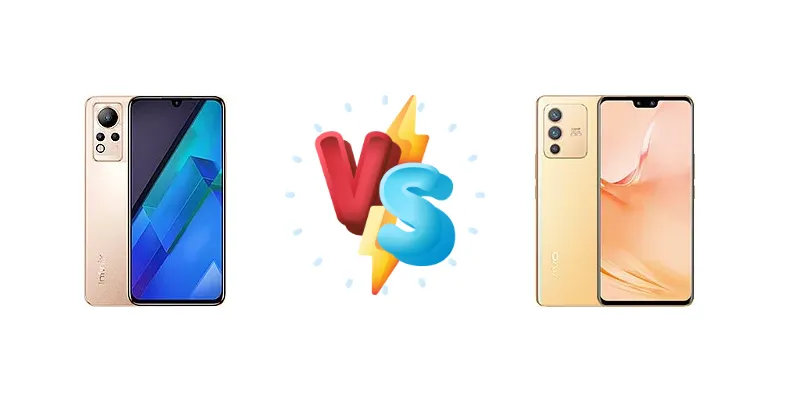
The mid-range smartphone market is fiercely competitive, and the vivo V23 Pro and Infinix Note 12 represent distinct approaches. The V23 Pro aims for a more premium experience with a powerful Dimensity 1200 chipset, while the Note 12 focuses on delivering solid gaming performance and value with the Helio G88. This comparison dissects their key differences to help you choose the right device.
🏆 Quick Verdict
For users prioritizing raw performance and a brighter display, the vivo V23 Pro is the clear winner. Its Dimensity 1200 chipset offers a significant leap over the Helio G88 in the Infinix Note 12. However, the Note 12 provides a compelling value proposition for budget-conscious gamers.
| Network |
|---|
| 2G bands | GSM 850 / 900 / 1800 / 1900 | GSM 850 / 900 / 1800 / 1900 |
| 3G bands | HSDPA 850 / 900 / 1700(AWS) / 1900 / 2100 | HSDPA 850 / 900 / 2100 |
| 4G bands | 1, 2, 3, 4, 5, 7, 8, 20, 28, 38, 41, 40 | 1, 3, 5, 8, 38, 40, 41 |
| 5G bands | - | 1, 3, 5, 8, 41, 77, 78 SA/NSA |
| Speed | HSPA, LTE | HSPA, LTE, 5G |
| Technology | GSM / HSPA / LTE | GSM / HSPA / LTE / 5G |
| | 1, 3, 7, 8, 20, 28, 38, 40, 41 | - |
| Launch |
|---|
| Announced | 2022, April 26 | 2022, January 05 |
| Status | Available. Released 2022, April 26 | Available. Released 2022, January 13 |
| Body |
|---|
| Build | Glass front, plastic frame, plastic back | Glass front (Schott Xensation α), glass back |
| Dimensions | 164.4 x 76.7 x 7.9 mm (6.47 x 3.02 x 0.31 in) | 159.5 x 73.3 x 7.4 mm (6.28 x 2.89 x 0.29 in) |
| SIM | Nano-SIM + Nano-SIM | Nano-SIM + Nano-SIM |
| Weight | 184.5 g (6.49 oz) | 171 g (6.03 oz) |
| Display |
|---|
| Protection | - | Schott Xensation α glass |
| Resolution | 1080 x 2400 pixels, 20:9 ratio (~393 ppi density) | 1080 x 2376 pixels (~398 ppi density) |
| Size | 6.7 inches, 108.4 cm2 (~86.0% screen-to-body ratio) | 6.56 inches, 104.6 cm2 (~89.5% screen-to-body ratio) |
| Type | AMOLED, 1000 nits (peak) | AMOLED, 90Hz, HDR10+ |
| Platform |
|---|
| CPU | Octa-core (2x2.0 GHz Cortex-A75 & 6x1.8 GHz Cortex-A55) | Octa-core (1x3.0 GHz Cortex-A78 & 3x2.6 GHz Cortex-A78 & 4x2.0 GHz Cortex-A55) |
| Chipset | Mediatek MT6769H Helio G88 (12 nm) | Mediatek Dimensity 1200 (6 nm) |
| GPU | Mali-G52 MC2 | Mali-G77 MC9 |
| OS | Android 11, XOS 10.6 | Android 12, Funtouch 12 |
| Memory |
|---|
| Card slot | microSDXC (dedicated slot) | No |
| Internal | 64GB 4GB RAM, 128GB 4GB RAM, 128GB 6GB RAM | 128GB 8GB RAM, 256GB 12GB RAM |
| Main Camera |
|---|
| Dual | - | 50 MP, f/2.0, (wide), AF
8 MP, f/2.3, 105˚ (ultrawide) |
| Features | Quad-LED flash, HDR, panorama | Dual-LED flash, HDR, panorama |
| Triple | 50 MP, f/1.6, (wide), 1/2.8", 0.64µm, PDAF
Auxiliary lenses | 108 MP, f/1.9, 26mm (wide), 1/1.52", 0.7µm PDAF
8 MP, f/2.2, 120˚, 16mm (ultrawide), 1/4.0", 1.12µm
2 MP (macro) |
| Video | 1440p@30fps | 4K@30fps, 1080p@30fps, gyro-EIS |
| Selfie camera |
|---|
| Dual | - | 50 MP, f/2.0, (wide), AF
8 MP, f/2.3, 105˚ (ultrawide) |
| Features | - | Dual-LED dual-tone flash, HDR |
| Single | 16 MP | - |
| Video | 1080p@30fps | 4K@30fps, 1080p@30fps |
| Sound |
|---|
| 3.5mm jack | Yes | No |
| 35mm jack | Yes | No |
| Loudspeaker | Yes, with dual speakers | Yes |
| Comms |
|---|
| Bluetooth | Yes | 5.2, A2DP, LE, aptX HD |
| NFC | Yes (market/region dependent) | No |
| Positioning | GPS | GPS, GLONASS, BDS, GALILEO, QZSS, NavIC |
| Radio | FM radio | No |
| USB | USB Type-C 2.0, OTG | USB Type-C, OTG |
| WLAN | Wi-Fi 802.11 a/b/g/n/ac, dual-band, Wi-Fi Direct | Wi-Fi 802.11 a/b/g/n/ac, dual-band, Wi-Fi Direct |
| Features |
|---|
| Sensors | Fingerprint (side-mounted), accelerometer, gyro, proximity, compass | Fingerprint (under display, optical), accelerometer, gyro, proximity, compass |
| | - | Color changing back panel when exposed to sunlight |
| Battery |
|---|
| Charging | 33W wired | 44W wired, 63% in 30 min |
| Type | 5000 mAh | 4300 mAh |
| Misc |
|---|
| Colors | Jewel Blue, Force Black, Sunset Golden | Sunshine Gold, Stardust Black |
| Models | X663, X663C, X663D | V2132 |
| Price | About 190 EUR | About 460 EUR |
| SAR | - | 1.22 W/kg (head) 0.63 W/kg (body) |
| Tests |
|---|
| Battery life | - |
Endurance rating 110h
|
| Camera | - |
Photo / Video |
| Display | - |
Contrast ratio: Infinite (nominal) |
| Loudspeaker | - |
-28.6 LUFS (Average)
|
| Performance | - |
AnTuTu: 635060 (v8), 716766 (v9)
GeekBench: 12377 (v4.4), 3021 (v5.1)
GFXBench: 45fps (ES 3.1 onscreen) |
Infinix Note 12
- Excellent gaming performance with Helio G88
- Competitive price point
- Decent battery life
- Less powerful chipset compared to the V23 Pro
- Display brightness likely lower than the V23 Pro
vivo V23 Pro
- Flagship-level performance with Dimensity 1200
- Significantly faster 44W charging
- Brighter and likely more vibrant display
- Higher price tag
- Potentially more heat generation under sustained load
Display Comparison
The vivo V23 Pro boasts a significantly brighter display, reaching a measured 798 nits, compared to the Infinix Note 12 (brightness data unavailable, assumed lower). This higher peak brightness translates to better visibility outdoors. While both displays have an 'infinite' contrast ratio (nominal), the V23 Pro’s superior brightness is a tangible benefit. The Note 12’s display specifications are less detailed, suggesting a more standard LCD panel, while the V23 Pro likely utilizes AMOLED technology for richer colors and deeper blacks.
Camera Comparison
Both phones feature photo and video capabilities, but detailed camera specs are limited. The V23 Pro likely benefits from the Dimensity 1200’s superior image signal processor (ISP), enabling faster processing and potentially better image quality. Without specific sensor details, it’s difficult to make a definitive judgment. However, the V23 Pro’s positioning suggests a more sophisticated camera system overall. The Note 12’s camera is likely focused on providing acceptable results for social media sharing, while the V23 Pro aims for a more refined photographic experience.
Performance
The core difference lies in the chipsets. The vivo V23 Pro’s Mediatek Dimensity 1200 (6nm) is a flagship-level processor featuring a 1x3.0 GHz Cortex-A78 core, 3x2.6 GHz Cortex-A78 cores, and 4x2.0 GHz Cortex-A55 cores. This configuration provides a substantial performance advantage over the Infinix Note 12’s Mediatek Helio G88 (12nm) with its 2x2.0 GHz Cortex-A75 and 6x1.8 GHz Cortex-A55 cores. The 6nm process node of the Dimensity 1200 also contributes to better thermal efficiency, reducing throttling during sustained workloads. The V23 Pro will handle demanding games and multitasking with ease, while the Note 12 is better suited for casual gaming and everyday tasks.
Battery Life
Both devices share an endurance rating of 110 hours, suggesting similar overall battery life despite the differing chipsets. However, the vivo V23 Pro’s 44W wired charging (63% in 30 minutes) is significantly faster than the Infinix Note 12’s 33W charging. This means the V23 Pro can be topped up more quickly, minimizing downtime. While the Note 12’s battery life is comparable, the faster charging of the V23 Pro offers a more convenient user experience.
Buying Guide
Buy the Infinix Note 12 if you need a capable gaming phone on a tight budget and prioritize long play sessions over absolute peak performance. Buy the vivo V23 Pro if you prefer a smoother, more responsive experience for demanding apps, enjoy a brighter and more vibrant display, and value faster charging speeds.
Frequently Asked Questions
❓ Does the Mediatek Dimensity 1200 in the vivo V23 Pro tend to overheat during prolonged gaming sessions?
While the Dimensity 1200 is a powerful chip, Mediatek has implemented thermal management features. However, sustained gaming at maximum settings can still generate heat. The V23 Pro’s thermal design will determine how effectively it dissipates this heat, but it’s likely to experience some throttling after extended play, though less so than the Helio G88 due to the 6nm process.
❓ Is the gaming experience on the Infinix Note 12 sufficient for popular titles like PUBG Mobile and Call of Duty Mobile?
The Helio G88 in the Infinix Note 12 is capable of running PUBG Mobile and Call of Duty Mobile, but you’ll likely need to lower the graphics settings to achieve a smooth frame rate. Expect medium settings to provide a balanced experience. The phone is well-suited for casual gaming, but demanding users may find its performance limiting.
❓ How does the charging speed difference impact daily use between the two phones?
The 44W charging on the V23 Pro allows for a significant top-up in a short amount of time – 63% in 30 minutes. This is ideal for users who frequently need to quickly recharge their phone. The Note 12’s 33W charging is slower, requiring more time to reach a full charge, which may be less convenient for those with limited downtime.