
Infinix Note 12 VIP vs. Xiaomi 12 Lite: A Deep Dive Comparison
| Phones Images | |||||
|---|---|---|---|---|---|
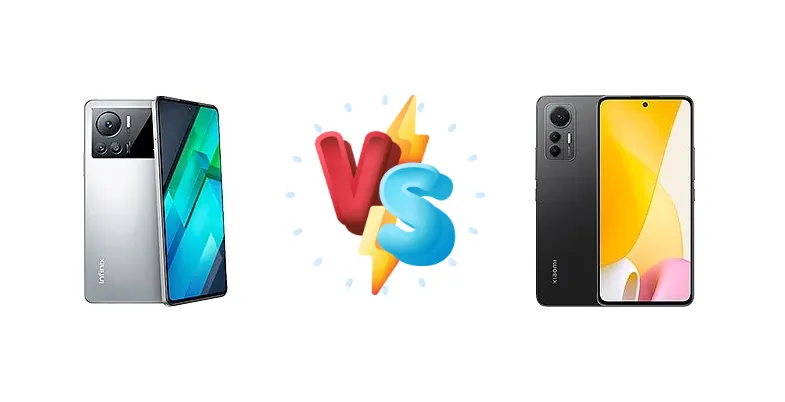
|
🏆 Quick Verdict
For the average user prioritizing speed and value, the Infinix Note 12 VIP emerges as the winner. Its 120W charging dramatically reduces downtime, and the Helio G96 provides sufficient performance for everyday tasks. However, the Xiaomi 12 Lite’s more efficient chipset and brighter display appeal to those valuing longevity and visual experience.
| PHONES | ||
|---|---|---|
| Phone Names | Infinix Note 12 VIP | Xiaomi 12 Lite |
| Network | ||
|---|---|---|
| 2G bands | GSM 850 / 900 / 1800 / 1900 | GSM 850 / 900 / 1800 / 1900 |
| 3G bands | HSDPA 850 / 900 / 1700(AWS) / 1900 / 2100 | HSDPA 850 / 900 / 1700(AWS) / 1900 / 2100 |
| 4G bands | 1, 2, 3, 4, 5, 7, 8, 20, 28, 28, 38, 40, 41 | 1, 2, 3, 4, 5, 7, 8, 12, 13, 17, 18, 19, 20, 26, 28, 32, 38, 40, 41, 42, 48, 66 |
| 5G bands | - | 1, 3, 5, 7, 8, 20, 28, 38, 40, 41, 66, 77, 78 SA/NSA |
| Speed | HSPA, LTE | HSPA, LTE, 5G |
| Technology | GSM / HSPA / LTE | GSM / HSPA / LTE / 5G |
| 1, 3, 7, 8, 20, 28 | - | |
| Launch | ||
|---|---|---|
| Announced | 2022, May 16 | 2022, July 09 |
| Status | Available. Released 2022, July 13 | Available. Released 2022, July 11 |
| Body | ||
|---|---|---|
| Build | Glass front, glass back, plastic frame | Glass front (Gorilla Glass 5), glass back, plastic frame |
| Dimensions | 163.5 x 76.7 x 7.9 mm (6.44 x 3.02 x 0.31 in) | 159.3 x 73.7 x 7.3 mm (6.27 x 2.90 x 0.29 in) |
| SIM | Nano-SIM + Nano-SIM | Nano-SIM + Nano-SIM |
| Weight | 199 g (7.02 oz) | 173 g (6.10 oz) |
| Display | ||
|---|---|---|
| Protection | - | Corning Gorilla Glass 5 |
| Resolution | 1080 x 2400 pixels, 20:9 ratio (~393 ppi density) | 1080 x 2400 pixels, 20:9 ratio (~402 ppi density) |
| Size | 6.7 inches, 108.4 cm2 (~86.4% screen-to-body ratio) | 6.55 inches, 103.6 cm2 (~88.2% screen-to-body ratio) |
| Type | AMOLED, 1B colors, 120Hz, 700 nits (peak) | AMOLED, 68B colors, 120Hz, Dolby Vision, HDR10+, 950 nits (peak) |
| Platform | ||
|---|---|---|
| CPU | Octa-core (2x2.05 GHz Cortex-A76 & 6x2.0 GHz Cortex-A55) | Octa-core (1x2.4 GHz Cortex-A78 & 3x2.2 GHz Cortex-A78 & 4x1.9 GHz Cortex-A55) |
| Chipset | Mediatek MT6781 Helio G96 (12 nm) | Qualcomm SM7325 Snapdragon 778G 5G (6 nm) |
| GPU | Mali-G57 MC2 | Adreno 642L |
| OS | Android 12, XOS 10.5 | Android 12, upgradable to Android 14, HyperOS |
| Memory | ||
|---|---|---|
| Card slot | microSDXC (dedicated slot) | No |
| Internal | 128GB 4GB RAM, 256GB 8GB RAM | 128GB 6GB RAM, 128GB 8GB RAM, 256GB 8GB RAM |
| UFS 2.2 | UFS 2.2 | |
| Main Camera | ||
|---|---|---|
| Features | Laser AF, Quad-LED flash, HDR, panorama | Dual-LED dual-tone flash, HDR, panorama |
| Single | 16 MP, (wide), 1/2.76", 1.12µm | 32 MP, f/2.5, (wide), 1/2.8", 0.8µm, AF |
| Triple | 108 MP, f/1.8, (wide), 1/1.67", 0.64µm, PDAF 13mm f/2.2, (ultrawide) Auxiliary lens | 108 MP, f/1.9, 26mm (wide), 1/1.52", 0.7µm, PDAF 8 MP, f/2.2, 120˚ (ultrawide), 1/4.0", 1.12µm 2 MP (macro) |
| Video | 1440p@30fps, 1080p@60fps | 4K@30fps, 1080p@30/60/120fps; gyro-EIS |
| Selfie camera | ||
|---|---|---|
| Features | Dual-LED flash | HDR, panorama |
| Single | 16 MP, (wide), 1/2.76", 1.12µm | 32 MP, f/2.5, (wide), 1/2.8", 0.8µm, AF |
| Video | 1440p@30fps, 1080p@30fps | 1080p@30/60fps, 720p@120fps |
| Sound | ||
|---|---|---|
| 3.5mm jack | Yes | No |
| 35mm jack | Yes | No |
| Loudspeaker | Yes, with dual speakers | Yes, with dual speakers |
| - | 24-bit/192kHz audio | |
| Comms | ||
|---|---|---|
| Bluetooth | Yes | 5.2, A2DP, LE, aptX HD, aptX Adaptive |
| Infrared port | - | Yes |
| NFC | Yes | Yes (market/region dependent) |
| Positioning | GPS | GPS (L1), GLONASS (G1), BDS (B1I+B1c), GALILEO (E1), QZSS (L1) |
| Radio | FM radio | No |
| USB | USB Type-C 2.0, OTG | USB Type-C 2.0, OTG |
| WLAN | Wi-Fi 802.11 a/b/g/n, dual-band, Wi-Fi Direct | Wi-Fi 802.11 a/b/g/n/ac/6, dual-band, Wi-Fi Direct |
| Features | ||
|---|---|---|
| Sensors | Fingerprint (side-mounted), accelerometer, gyro, proximity, compass | Fingerprint (under display, optical), accelerometer, gyro, compass |
| - | Virtual proximity sensing | |
| Battery | ||
|---|---|---|
| Charging | 120W wired, 100% in 17 min | 67W wired, PD3.0, QC4, 50% in 13 min |
| Type | 4500 mAh | Li-Po 4300 mAh |
| Misc | ||
|---|---|---|
| Colors | Cayenne grey, Force black | Black, Lite Green, Lite Pink |
| Models | X672 | 2203129G |
| Price | About 290 EUR | € 119.80 / $ 269.00 / £ 121.15 |
| SAR | - | 1.09 W/kg (head) 0.73 W/kg (body) |
| SAR EU | - | 0.60 W/kg (head) 1.00 W/kg (body) |
| Tests | ||
|---|---|---|
| Battery life | - | Endurance rating 100h |
| Camera | - | Photo / Video |
| Display | - | Contrast ratio: Infinite (nominal) |
| Loudspeaker | - | -25.2 LUFS (Very good) |
| Performance | - | AnTuTu: 528905 (v9) GeekBench: 2943 (v5.1) GFXBench: 29fps (ES 3.1 onscreen) |
Infinix Note 12 VIP
- Incredibly fast 120W charging
- Competitive price point
- Sufficient performance for everyday tasks
- Less refined design compared to the Xiaomi
- Potentially lower camera quality (due to lack of specs)
Xiaomi 12 Lite
- Brighter and potentially more color-accurate display
- More efficient Snapdragon 778G chipset
- Premium design and build quality
- Slower 67W charging
- Higher price compared to the Infinix
Display Comparison
The Xiaomi 12 Lite boasts a brighter display, reaching a measured 824 nits, which will provide superior visibility outdoors compared to the Infinix Note 12 VIP (brightness data unavailable). While the Infinix’s panel specifications are not provided, the Xiaomi’s ‘Infinite’ contrast ratio suggests a strong AMOLED experience. The Xiaomi 12 Lite’s focus on display quality is evident, catering to media consumption and gaming. The absence of LTPO technology on either device suggests neither offers adaptive refresh rate optimization for power saving.
Camera Comparison
Both devices offer photo and video capabilities, but detailed sensor information is lacking for the Infinix Note 12 VIP. The Xiaomi 12 Lite likely benefits from Qualcomm’s image signal processor (ISP) within the Snapdragon 778G, potentially delivering superior image processing and low-light performance. Without specific details on the Infinix’s main sensor size and aperture, it’s difficult to assess its camera capabilities accurately. It’s reasonable to assume the Xiaomi 12 Lite offers a more refined and consistent camera experience, especially in challenging lighting conditions. The inclusion of OIS on the Xiaomi would further enhance image and video stability.
Performance
The Xiaomi 12 Lite’s Qualcomm Snapdragon 778G 5G (6nm) holds a significant architectural advantage over the Infinix Note 12 VIP’s MediaTek Helio G96 (12nm). The 778G features a Cortex-A78 prime core clocked at 2.4 GHz, alongside three additional A78 cores, offering superior sustained performance and efficiency compared to the G96’s two Cortex-A76 cores at 2.05 GHz. This translates to smoother multitasking, faster app loading times, and better gaming performance on the Xiaomi, despite both devices likely featuring similar RAM configurations. The 6nm process node of the Snapdragon 778G also contributes to better thermal management, reducing the likelihood of performance throttling during extended use.
Battery Life
Both phones achieve a 100-hour endurance rating, suggesting similar overall battery life despite differing battery capacities (not specified for the Infinix). However, the charging speeds are drastically different. The Infinix Note 12 VIP’s 120W wired charging can fully charge the device in just 17 minutes, a significant advantage for users who prioritize quick top-ups. The Xiaomi 12 Lite’s 67W charging, while supporting PD3.0 and QC4, takes longer, reaching 50% charge in 13 minutes. This difference in charging speed is the most significant differentiator in the user experience, favoring the Infinix for those constantly on the go.
Buying Guide
Buy the Infinix Note 12 VIP if you need blazing-fast charging, prioritize minimizing downtime, and are comfortable with a less polished software experience. It’s ideal for users who frequently find themselves needing a quick power boost. Buy the Xiaomi 12 Lite if you prefer a more premium design, a brighter and potentially more color-accurate display, and a more efficient chipset that translates to potentially better battery life during moderate use.