
Infinix Note 12 Pro vs. Xiaomi Redmi Note 12 Pro: A Detailed Showdown
| Phones Images | |||||
|---|---|---|---|---|---|
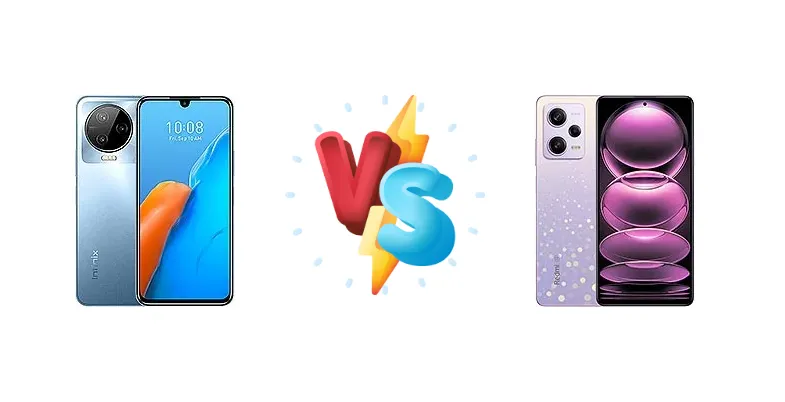
|
🏆 Quick Verdict
The Xiaomi Redmi Note 12 Pro edges out the Infinix Note 12 Pro thanks to its significantly faster charging, more powerful chipset, and brighter display. While the Infinix offers a competitive price, the Redmi's overall performance and features make it the better choice for most users.
| PHONES | ||
|---|---|---|
| Phone Names | Infinix Note 12 Pro | Xiaomi Redmi Note 12 Pro |
| Network | ||
|---|---|---|
| 2G bands | GSM 850 / 900 / 1800 / 1900 | GSM 850 / 900 / 1800 / 1900 |
| 3G bands | HSDPA 850 / 900 / 1700(AWS) / 1900 / 2100 | HSDPA 800 / 850 / 900 / 1900 / 2100 |
| 4G bands | 1, 2, 3, 4, 5, 7, 8, 20, 28, 38, 40, 41 | 1, 2, 3, 4, 5, 7, 8, 12, 13, 17, 18, 19, 20, 26, 28, 32, 38, 40, 41, 66 - International |
| 5G bands | - | 1, 3, 5, 7, 8, 20, 28, 38, 40, 41, 66, 77, 78 SA/NSA - International |
| Speed | HSPA, LTE | HSPA, LTE, 5G |
| Technology | GSM / HSPA / LTE | GSM / CDMA / HSPA / EVDO / LTE / 5G |
| - | 1, 3, 5, 8, 28, 38, 41, 77, 78 SA/NSA - China | |
| Launch | ||
|---|---|---|
| Announced | 2022, July 16 | 2022, October 27 |
| Status | Available. Released 2022, July 18 | Available. Released 2022, November 01 |
| Body | ||
|---|---|---|
| Build | Glass front, plastic frame, plastic back | Glass front (Gorilla Glass 5), glass back, plastic frame |
| Dimensions | 164.4 x 76.5 x 7.8 mm (6.47 x 3.01 x 0.31 in) | 163 x 76 x 8 mm (6.42 x 2.99 x 0.31 in) |
| SIM | Nano-SIM + Nano-SIM | Nano-SIM + Nano-SIM |
| Weight | 192 g (6.77 oz) | 187 g (6.60 oz) |
| - | IP53, dust and splash resistant | |
| Display | ||
|---|---|---|
| Protection | - | Corning Gorilla Glass 5 |
| Resolution | 1080 x 2400 pixels, 20:9 ratio (~393 ppi density) | 1080 x 2400 pixels, 20:9 ratio (~395 ppi density) |
| Size | 6.7 inches, 108.4 cm2 (~86.2% screen-to-body ratio) | 6.67 inches, 107.4 cm2 (~86.7% screen-to-body ratio) |
| Type | AMOLED | AMOLED, 1B colors, 120Hz, Dolby Vision, HDR10+, 500 nits (typ), 900 nits (HBM) |
| Platform | ||
|---|---|---|
| CPU | Octa-core (2x2.2 GHz Cortex-A76 & 6x2.0 GHz Cortex-A55) | Octa-core (2x2.6 GHz Cortex-A78 & 6x2.0 GHz Cortex-A55) |
| Chipset | Mediatek Helio G99 (6 nm) | Mediatek Dimensity 1080 (6 nm) |
| GPU | Mali-G57 MC2 | Mali-G68 MC4 |
| OS | Android 12, XOS 10.6 | Android 12, MIUI 13 |
| Memory | ||
|---|---|---|
| Card slot | microSDXC (dedicated slot) | No |
| Internal | 256GB 8GB RAM | 128GB 6GB RAM, 128GB 8GB RAM, 256GB 8GB RAM, 256GB 12GB RAM |
| - | UFS 2.2 | |
| Main Camera | ||
|---|---|---|
| Features | Quad-LED flash, HDR, panorama | Dual-LED dual-tone flash, HDR, panorama |
| Triple | 108 MP, f/1.8, (wide), 1/1.67", PDAF Auxiliary lenses | 50 MP, f/1.9, 24mm (wide), 1/1.56", 1.0µm, PDAF, OIS 8 MP, f/2.2, 120˚ (ultrawide), 1/4.0", 1.12µm 2 MP (macro) |
| Video | 1440p@30fps | 4K@30fps, 1080p@30/60/120fps, 720p@960fps |
| Selfie camera | ||
|---|---|---|
| Features | Dual-LED flash | HDR |
| Single | 16 MP, f/2.0, (wide) | 16 MP, f/2.5, (wide), 1/3.06", 1.0µm |
| Video | 1440p@30fps | 1080p@30/60fps |
| Sound | ||
|---|---|---|
| 3.5mm jack | Yes | Yes |
| 35mm jack | Yes | Yes |
| Loudspeaker | Yes, with dual speakers | Yes, with stereo speakers |
| - | 24-bit/192kHz audio | |
| Comms | ||
|---|---|---|
| Bluetooth | Yes | 5.2, A2DP, LE |
| Infrared port | - | Yes |
| NFC | Yes | Yes (market/region dependent) |
| Positioning | GPS | GPS (L1), GLONASS (G1), BDS (B1I+B1c), GALILEO (E1), QZSS (L1) |
| Radio | FM radio | No |
| USB | USB Type-C 2.0, OTG | USB Type-C 2.0, OTG |
| WLAN | Yes | Wi-Fi 802.11 a/b/g/n/ac/6, dual-band, Wi-Fi Direct |
| Features | ||
|---|---|---|
| Sensors | Fingerprint (side-mounted), accelerometer, proximity, gyro, compass | Fingerprint (side-mounted), accelerometer, gyro, proximity, compass |
| Battery | ||
|---|---|---|
| Charging | 33W wired | 67W wired, PD3.0, 50% in 15 min, 100% in 46 min |
| Type | 5000 mAh | Li-Po 5000 mAh |
| Misc | ||
|---|---|---|
| Colors | Volcanic Grey, Tuscany Blue, Alpine White | Frosted Blue (Sky Blue), Onyx Black (Midnight Black), Polar White, Stardust Purple |
| Models | X676B | 22101316C, 22101316I, 23013RK75C, 22101316G |
| Price | About 420 EUR | € 148.54 / $ 142.17 / £ 149.99 / ₹ 19,999 |
| SAR | - | 1.09 W/kg (head) 1.06 W/kg (body) |
| SAR EU | - | 0.99 W/kg (head) 0.99 W/kg (body) |
| Tests | ||
|---|---|---|
| Battery life | - | Endurance rating 97h |
| Camera | - | Photo / Video |
| Display | - | Contrast ratio: Infinite (nominal) |
| Loudspeaker | - | -26.6 LUFS (Good) |
| Performance | - | AnTuTu: 490526 (v9) GeekBench: 2209 (v5.1), 2372 (v6) GFXBench: 22fps (ES 3.1 onscreen) |
Infinix Note 12 Pro
- Competitive Price
- Decent Display
- Acceptable Performance
- Slower Charging
- Less Powerful Chipset
- Lower Brightness Display
Xiaomi Redmi Note 12 Pro
- Faster Charging (67W)
- More Powerful Chipset (Dimensity 1080)
- Brighter Display (890 nits)
- Excellent Battery Life
- Slightly Higher Price
- Camera performance needs further testing
Display Comparison
The Redmi Note 12 Pro boasts a significantly brighter display, reaching 890 nits compared to the Note 12 Pro's likely lower brightness (spec not provided, but generally lower than Redmi). The Redmi's 'Infinite' contrast ratio suggests excellent image quality. Both likely use AMOLED panels, offering vibrant colors and deep blacks, but the Redmi's brightness advantage is noticeable.
Camera Comparison
Both phones feature capable camera systems, but detailed camera comparisons require more in-depth testing. The Redmi Note 12 Pro likely has an edge due to its more powerful processor assisting with image processing. Both likely offer versatile camera setups with main, ultrawide, and macro lenses.
Performance
The Redmi Note 12 Pro's Dimensity 1080 chipset is noticeably more powerful than the Infinix Note 12 Pro's Helio G99. Expect smoother multitasking, faster app loading times, and better gaming performance on the Redmi. The Dimensity 1080's Cortex-A78 cores provide a significant boost over the Helio G99's Cortex-A76 cores.
Battery Life
The Redmi Note 12 Pro shines here. Its endurance rating of 97 hours is exceptional, and its 67W charging is a game-changer, reaching 50% in just 15 minutes and 100% in 46 minutes. The Infinix Note 12 Pro's 33W charging is slower, and its battery life, while decent, doesn't match the Redmi's impressive figures.
Buying Guide
Who should buy the Infinix Note 12 Pro? Budget-conscious users prioritizing a decent display and acceptable performance. Who should buy the Xiaomi Redmi Note 12 Pro? Users seeking faster charging, a more powerful processor, and a brighter, more vibrant display, even if it means spending a bit more.