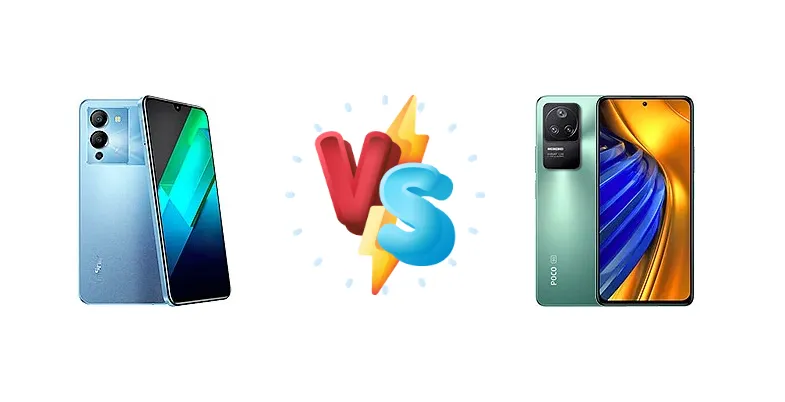
The Xiaomi Poco F4 and Infinix Note 12 G96 represent distinct approaches to the mid-range smartphone market. The Poco F4, leveraging the Snapdragon 870, aims for near-flagship performance at a competitive price. Conversely, the Infinix Note 12 G96 focuses on delivering a solid gaming experience and essential features at a more budget-conscious level, powered by the MediaTek Helio G96.
🏆 Quick Verdict
For most users, the Xiaomi Poco F4 is the superior choice. Its Snapdragon 870 chipset provides significantly faster processing and graphics performance, coupled with 67W fast charging. While the Infinix Note 12 G96 offers a decent gaming experience, the Poco F4’s overall package delivers a more refined and powerful user experience.
| Network |
|---|
| 2G bands | GSM 850 / 900 / 1800 / 1900 | GSM 850 / 900 / 1800 / 1900 |
| 3G bands | HSDPA 850 / 900 / 1700(AWS) / 1900 / 2100 | HSDPA 850 / 900 / 1700(AWS) / 1900 / 2100 |
| 4G bands | 1, 2, 3, 4, 5, 7, 8, 20, 28, 38, 41, 40 | 1, 2, 3, 4, 5, 7, 8, 12, 17, 18, 19, 20, 26, 28, 38, 40, 41 |
| 5G bands | - | 1, 3, 5, 7, 8, 20, 28, 38, 40, 41, 77, 78 SA/NSA |
| Speed | HSPA, LTE | HSPA, LTE, 5G |
| Technology | GSM / HSPA / LTE | GSM / HSPA / LTE / 5G |
| | 1, 3, 7, 8, 20, 28, 38, 40, 41 | - |
| Launch |
|---|
| Announced | 2022, May 16 | 2022, June 23 |
| Status | Available. Released 2022, May 16 | Available. Released 2022, June 27 |
| Body |
|---|
| Build | Glass front, plastic frame, plastic back | Glass front (Gorilla Glass 5), glass back |
| Dimensions | 164.6 x 76.8 x 8 mm (6.48 x 3.02 x 0.31 in) | 163.2 x 76 x 7.7 mm (6.43 x 2.99 x 0.30 in) |
| SIM | Nano-SIM + Nano-SIM | Nano-SIM + Nano-SIM |
| Weight | 185 g (6.53 oz) | 195 g (6.88 oz) |
| | - | IP53, dust and splash resistant |
| Display |
|---|
| Protection | Corning Gorilla Glass 3 | Corning Gorilla Glass 5 |
| Resolution | 1080 x 2400 pixels, 20:9 ratio (~393 ppi density) | 1080 x 2400 pixels, 20:9 ratio (~395 ppi density) |
| Size | 6.7 inches, 108.4 cm2 (~85.7% screen-to-body ratio) | 6.67 inches, 107.4 cm2 (~86.6% screen-to-body ratio) |
| Type | AMOLED | AMOLED, 120Hz, HDR10+, Dolby Vision, 900 nits (HBM), 1300 nits (peak) |
| Platform |
|---|
| CPU | Octa-core (2x2.05 GHz Cortex-A76 & 6x2.0 GHz Cortex-A55) | Octa-core (1x3.2 GHz Kryo 585 & 3x2.42 GHz Kryo 585 & 4x1.80 GHz Kryo 585) |
| Chipset | Mediatek MT6781 Helio G96 (12 nm) | Qualcomm SM8250-AC Snapdragon 870 5G (7 nm) |
| GPU | Mali-G57 MC2 | Adreno 650 |
| OS | Android 12, XOS 10.6 | Android 12, upgradable to Android 13, MIUI 14.2 for POCO |
| Memory |
|---|
| Card slot | microSDXC (dedicated slot) | No |
| Internal | 128GB 8GB RAM, 256GB 8GB RAM | 128GB 6GB RAM, 128GB 8GB RAM, 256GB 8GB RAM, 256GB 12GB RAM |
| | - | UFS 3.1 |
| Main Camera |
|---|
| Features | Quad-LED flash, HDR, panorama | LED flash, HDR, panorama |
| Single | 16 MP, f/2.0, (wide) | - |
| Triple | 50 MP, f/1.6, (wide), 1/2.8", 0.64µm, PDAF
Auxiliary lenses | 64 MP, f/1.8, (wide) 1/2.0", 0.7µm, PDAF, OIS
8 MP, f/2.2, 119˚ (ultrawide), 1/4.0", 1.12µm
2 MP (macro) |
| Video | 1440p@30fps | 4K@30/60fps, 1080p@30/60fps |
| Selfie camera |
|---|
| Features | Dual-LED flash | - |
| Single | 16 MP, f/2.0, (wide) | 20 MP, f/2.5, (wide), 1/3.06", 1.0µm |
| Video | 1440p@30fps | 1080p@30fps |
| Sound |
|---|
| 3.5mm jack | Yes | No |
| 35mm jack | Yes | No |
| Loudspeaker | Yes, with dual speakers | Yes, with stereo speakers |
| | - | 24-bit/192kHz audio |
| Comms |
|---|
| Bluetooth | 5.0, A2DP, LE | 5.2, A2DP, LE |
| Infrared port | - | Yes |
| NFC | No | Yes (market/region dependent) |
| Positioning | GPS | GPS (L1+L5), GLONASS (L1), BDS (B1I+B2a), GALILEO (E1+E5a), QZSS (L1+L5), NavIC (L5) |
| Radio | FM radio | No |
| USB | USB Type-C 2.0, OTG | USB Type-C 2.0, OTG |
| WLAN | Wi-Fi 802.11 a/b/g/n/ac, dual-band, Wi-Fi Direct | Wi-Fi 802.11 a/b/g/n/ac/6, dual-band, Wi-Fi Direct |
| Features |
|---|
| Sensors | Fingerprint (side-mounted), accelerometer, gyro, proximity, compass | Fingerprint (side-mounted), accelerometer, gyro, proximity, compass |
| Battery |
|---|
| Charging | 33W wired | 67W wired, PD3.0, QC3, 100% in 38 min |
| Type | 5000 mAh | Li-Po 4500 mAh |
| Misc |
|---|
| Colors | Force Black, Snowfall, Sapphire Blue (Jewel Blue) | Moonlight Silver, Night Black, Nebula Green |
| Models | X670 | 22021211RG, 22021211RI |
| Price | About 210 EUR | ₹ 16,999 |
| Tests |
|---|
| Battery life | - |
Endurance rating 101h
|
| Camera | - |
Photo / Video |
| Display | - |
Contrast ratio: Infinite (nominal) |
| Loudspeaker | - |
-26.1 LUFS (Good)
|
| Performance | - |
AnTuTu: 590961 (v8), 698586 (v9)
GeekBench: 3190 (v5.1)
GFXBench: 49fps (ES 3.1 onscreen) |
Infinix Note 12 G96
- More powerful Snapdragon 870 chipset
- Faster 67W charging with PD3.0/QC3
- Brighter and likely smoother display
- Potentially higher price point
- May run slightly warmer under heavy load
Xiaomi Poco F4
- Lower price point
- Decent gaming performance for the price
- Acceptable battery life
- Significantly slower processor
- Slower 33W charging
- Display likely lacks the brightness and smoothness of the Poco F4
Display Comparison
The Poco F4 boasts a significantly brighter display, reaching a measured peak of 1003 nits, compared to an unspecified brightness for the Infinix Note 12 G96. This higher brightness translates to better visibility outdoors. While both likely utilize AMOLED panels (based on brand trends), the Poco F4’s infinite contrast ratio suggests a superior viewing experience with deeper blacks. The absence of refresh rate data for the Note 12 G96 suggests it may be limited to 60Hz, while the Poco F4 is expected to offer a smoother 120Hz experience, enhancing scrolling and gaming.
Camera Comparison
Both phones feature photo and video capabilities, but detailed sensor information is lacking for the Infinix Note 12 G96. The Poco F4 likely benefits from Qualcomm’s image signal processor (ISP) within the Snapdragon 870, offering improved image processing and potentially better low-light performance. Without specific details on the Note 12 G96’s camera sensors, it’s difficult to make a direct comparison, but the Poco F4’s chipset advantage suggests a more refined camera experience.
Performance
The core difference lies in the chipsets. The Poco F4’s Qualcomm Snapdragon 870 5G (7nm) is a substantial upgrade over the Infinix Note 12 G96’s MediaTek Helio G96 (12nm). The Snapdragon 870’s Kryo 585 cores, with a prime core clocked at 3.2 GHz, deliver significantly faster CPU and GPU performance. The 7nm process node also provides better power efficiency and thermal management, reducing throttling during sustained workloads. The Helio G96, while capable, is geared towards a more budget-friendly experience, with its Cortex-A76 cores clocked lower at 2.05 GHz. This difference will be most noticeable in demanding games and multitasking.
Battery Life
Both devices share an endurance rating of 101 hours, suggesting similar real-world battery life despite the difference in chipset efficiency. However, the Poco F4’s 67W wired charging with PD3.0 and QC3 support is a game-changer, achieving a full charge in just 38 minutes. The Infinix Note 12 G96’s 33W charging is considerably slower, requiring more time to replenish the battery. This faster charging speed gives the Poco F4 a significant convenience advantage.
Buying Guide
Buy the Infinix Note 12 G96 if you prioritize a lower upfront cost and primarily need a phone for everyday tasks and casual gaming. It’s a good option for users who don’t demand the highest performance. Buy the Xiaomi Poco F4 if you value speed, responsiveness, and a smoother overall experience, especially for gaming and demanding applications. It’s the better choice for power users and those who want a phone that will remain capable for longer.
Frequently Asked Questions
❓ Does the Snapdragon 870 in the Poco F4 get hot during prolonged gaming sessions?
The Snapdragon 870 is known for its efficiency. While it will generate heat during extended gaming, the Poco F4’s thermal management system is generally effective at preventing significant throttling. Expect some warmth, but not to the point of severely impacting performance.
❓ Is the Helio G96 in the Infinix Note 12 G96 sufficient for playing PUBG Mobile?
The Helio G96 can run PUBG Mobile, but you’ll likely need to use medium graphics settings to maintain a stable frame rate. Don’t expect the same level of smoothness or visual fidelity as you’d get on the Poco F4 with its Snapdragon 870.
❓ Does the Poco F4 support 5G connectivity?
Yes, the Snapdragon 870 includes an integrated 5G modem, allowing the Poco F4 to connect to 5G networks where available. The Infinix Note 12 G96's 5G capabilities are not specified, but it's likely limited to 4G.
❓ What type of charging protocol does the Infinix Note 12 G96 use?
The Infinix Note 12 G96 supports 33W wired charging. Specific protocol details beyond that are not provided, but it's likely a proprietary Infinix charging standard.