
Infinix Note 12 G96 vs. Samsung Galaxy A73 5G: Which Mid-Range 5G Phone Reigns Supreme?
| Phones Images | |||||
|---|---|---|---|---|---|
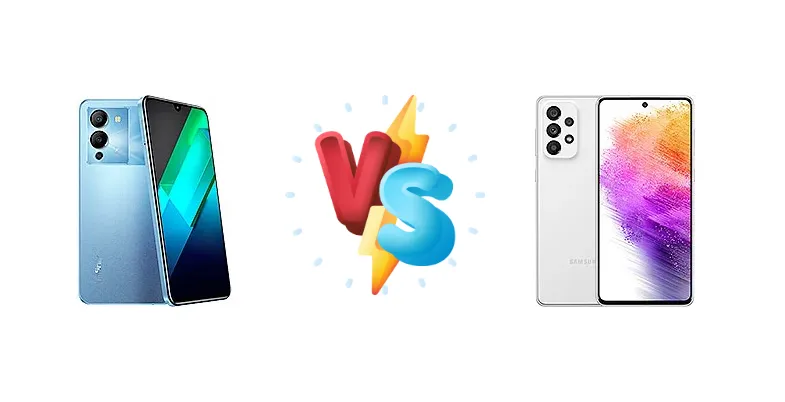
|
🏆 Quick Verdict
For the average user prioritizing consistent performance and a refined software experience, the Samsung Galaxy A73 5G is the better choice. Its Snapdragon 778G 5G chipset provides a noticeable advantage in demanding tasks and gaming, despite the Infinix Note 12 G96’s faster 33W charging.
| PHONES | ||
|---|---|---|
| Phone Names | Infinix Note 12 G96 | Samsung Galaxy A73 5G |
| Network | ||
|---|---|---|
| 2G bands | GSM 850 / 900 / 1800 / 1900 | GSM 850 / 900 / 1800 / 1900 |
| 3G bands | HSDPA 850 / 900 / 1700(AWS) / 1900 / 2100 | HSDPA 850 / 900 / 1700(AWS) / 1900 / 2100 |
| 4G bands | 1, 2, 3, 4, 5, 7, 8, 20, 28, 38, 41, 40 | 1, 2, 3, 4, 5, 7, 8, 12, 13, 17, 20, 26, 28, 32, 38, 40, 41, 66 |
| 5G bands | - | 1, 3, 5, 7, 28, 40, 41, 66, 78 SA/NSA/Sub6 |
| Speed | HSPA, LTE | HSPA, LTE, 5G |
| Technology | GSM / HSPA / LTE | GSM / HSPA / LTE / 5G |
| 1, 3, 7, 8, 20, 28, 38, 40, 41 | - | |
| Launch | ||
|---|---|---|
| Announced | 2022, May 16 | 2022, March 17 |
| Status | Available. Released 2022, May 16 | Available. Released 2022, April 22 |
| Body | ||
|---|---|---|
| Build | Glass front, plastic frame, plastic back | - |
| Dimensions | 164.6 x 76.8 x 8 mm (6.48 x 3.02 x 0.31 in) | 163.7 x 76.1 x 7.6 mm (6.44 x 3.00 x 0.30 in) |
| SIM | Nano-SIM + Nano-SIM | · Nano-SIM· Nano-SIM + Nano-SIM |
| Weight | 185 g (6.53 oz) | 181 g (6.38 oz) |
| - | IP67 dust/water resistant (up to 1m for 30 min) | |
| Display | ||
|---|---|---|
| Protection | Corning Gorilla Glass 3 | Corning Gorilla Glass 5 |
| Resolution | 1080 x 2400 pixels, 20:9 ratio (~393 ppi density) | 1080 x 2400 pixels, 20:9 ratio (~393 ppi density) |
| Size | 6.7 inches, 108.4 cm2 (~85.7% screen-to-body ratio) | 6.7 inches, 108.4 cm2 (~87.0% screen-to-body ratio) |
| Type | AMOLED | Super AMOLED Plus, 120Hz, 800 nits (HBM) |
| Platform | ||
|---|---|---|
| CPU | Octa-core (2x2.05 GHz Cortex-A76 & 6x2.0 GHz Cortex-A55) | Octa-core (1x2.4 GHz Cortex-A78 & 3x2.2 GHz Cortex-A78 & 4x1.9 GHz Cortex-A55) |
| Chipset | Mediatek MT6781 Helio G96 (12 nm) | Qualcomm SM7325 Snapdragon 778G 5G (6 nm) |
| GPU | Mali-G57 MC2 | Adreno 642L |
| OS | Android 12, XOS 10.6 | Android 12, up to 4 major Android upgrades, One UI 6.1 |
| Memory | ||
|---|---|---|
| Card slot | microSDXC (dedicated slot) | microSDXC (uses shared SIM slot) |
| Internal | 128GB 8GB RAM, 256GB 8GB RAM | 128GB 6GB RAM, 128GB 8GB RAM, 256GB 8GB RAM |
| Main Camera | ||
|---|---|---|
| Features | Quad-LED flash, HDR, panorama | LED flash, panorama, HDR |
| Quad | - | 108 MP, f/1.8, (wide), PDAF, OIS 12 MP, f/2.2, (ultrawide) 5 MP (macro) Auxiliary lens |
| Single | 16 MP, f/2.0, (wide) | 32 MP, f/2.2, 26mm (wide), 1/2.8", 0.8µm |
| Triple | 50 MP, f/1.6, (wide), 1/2.8", 0.64µm, PDAF Auxiliary lenses | - |
| Video | 1440p@30fps | 4K@30fps, 1080p@30/60fps; gyro-EIS |
| Selfie camera | ||
|---|---|---|
| Features | Dual-LED flash | HDR |
| Single | 16 MP, f/2.0, (wide) | 32 MP, f/2.2, 26mm (wide), 1/2.8", 0.8µm |
| Video | 1440p@30fps | 4K@30fps, 1080p@30fps |
| Sound | ||
|---|---|---|
| 3.5mm jack | Yes | No |
| 35mm jack | Yes | No |
| Loudspeaker | Yes, with dual speakers | Yes, with stereo speakers |
| Comms | ||
|---|---|---|
| Bluetooth | 5.0, A2DP, LE | 5.0, A2DP, LE |
| NFC | No | Yes (market/region dependent) |
| Positioning | GPS | GPS, GLONASS, GALILEO, BDS, QZSS |
| Radio | FM radio | Unspecified |
| USB | USB Type-C 2.0, OTG | USB Type-C 2.0, OTG |
| WLAN | Wi-Fi 802.11 a/b/g/n/ac, dual-band, Wi-Fi Direct | Wi-Fi 802.11 a/b/g/n/ac/6, dual-band, Wi-Fi Direct |
| Features | ||
|---|---|---|
| Sensors | Fingerprint (side-mounted), accelerometer, gyro, proximity, compass | Fingerprint (under display, optical), accelerometer, gyro, proximity, compass |
| Battery | ||
|---|---|---|
| Charging | 33W wired | 25W wired |
| Type | 5000 mAh | Li-Po 5000 mAh |
| Misc | ||
|---|---|---|
| Colors | Force Black, Snowfall, Sapphire Blue (Jewel Blue) | Gray, Mint, White |
| Models | X670 | SM-A736B, SM-A736B/DS |
| Price | About 210 EUR | About 600 EUR |
| SAR | - | 1.14 W/kg (head) |
| SAR EU | - | 1.28 W/kg (head) 1.42 W/kg (body) |
Infinix Note 12 G96
- Faster 33W wired charging
- Potentially more affordable price point
- May offer a larger internal storage option
- Less powerful chipset (Helio G96)
- Likely less refined software experience
- Potentially lower camera performance
Samsung Galaxy A73 5G
- More powerful and efficient Snapdragon 778G 5G
- Superior software experience and update commitment
- Likely better camera performance and image processing
- Slower 25W wired charging
- Potentially higher price point
- May have less internal storage in base configurations
Display Comparison
While both phones likely feature AMOLED displays (based on market segment), the specifics are crucial. The Galaxy A73 5G benefits from Samsung’s display expertise, potentially offering superior color accuracy and brightness. The Infinix Note 12 G96’s display specs are not provided, but given its price point, it likely targets a good, but not class-leading, visual experience. The A73’s potential for higher peak brightness will translate to better outdoor visibility. The A73 likely has a higher refresh rate as well, contributing to smoother scrolling and animations.
Camera Comparison
Without detailed camera specs, it’s difficult to make a definitive judgment. However, Samsung generally excels in image processing. The A73 likely features a more sophisticated image signal processor (ISP) within the Snapdragon 778G, resulting in better dynamic range and noise reduction. While the Infinix Note 12 G96 may offer a high megapixel count, sensor size and lens aperture are more critical. The A73’s potential for optical image stabilization (OIS) – a common feature in Samsung’s A-series – would provide a significant advantage in low-light photography and video recording. We can assume the A73 will have a more consistent and reliable camera experience.
Performance
The core difference lies in the chipsets. The Samsung Galaxy A73 5G’s Qualcomm Snapdragon 778G 5G (6nm) is a significant step up from the Infinix Note 12 G96’s MediaTek Helio G96 (12nm). The 6nm process node of the Snapdragon 778G offers superior power efficiency, leading to less thermal throttling during sustained workloads. The Snapdragon 778G’s CPU configuration – a 1x2.4 GHz Cortex-A78 prime core alongside 3x2.2 GHz Cortex-A78 cores – provides a substantial performance boost over the Helio G96’s 2x2.05 GHz Cortex-A76 and 6x2.0 GHz Cortex-A55 setup. This translates to faster app loading times, smoother multitasking, and a more enjoyable gaming experience on the A73.
Battery Life
The Infinix Note 12 G96’s 33W wired charging is faster than the Samsung Galaxy A73 5G’s 25W charging. This means quicker top-ups, which is beneficial for users who don’t have time for extended charging sessions. However, the Snapdragon 778G’s superior power efficiency may offset the A73’s slower charging speed in real-world usage. The A73’s more efficient chipset will draw less power during typical use, potentially resulting in comparable or even better battery life despite a potentially smaller battery capacity (spec not provided for either device).
Buying Guide
Buy the Infinix Note 12 G96 if you need a phone that prioritizes fast charging and are comfortable with a less polished software experience. It’s ideal for users who frequently top up their battery and don’t heavily rely on intensive applications. Buy the Samsung Galaxy A73 5G if you prefer a smoother, more responsive user experience, better long-term performance, and a more established brand with a stronger software update commitment. It’s the better option for gamers and power users.