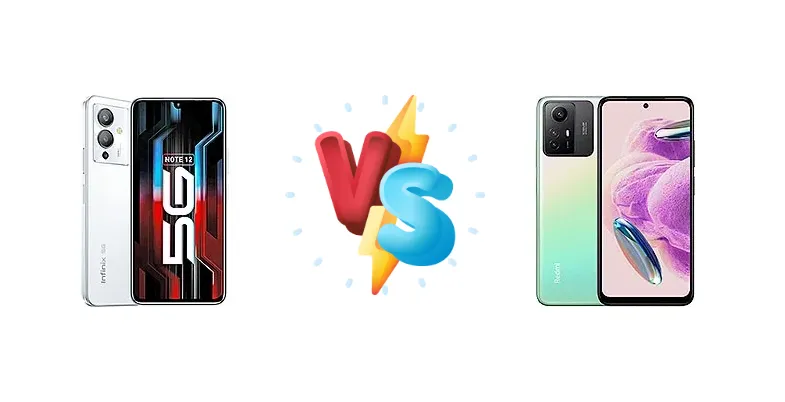
The budget smartphone market is fiercely competitive, and the Infinix Note 12 5G and Xiaomi Redmi Note 12S are two strong contenders. Both offer compelling features at an attractive price point, but which one reigns supreme? This comprehensive comparison will help you decide.
🏆 Quick Verdict
The Infinix Note 12 5G takes the edge thanks to its significantly faster Dimensity 810 chipset and 5G connectivity. While the Redmi Note 12S boasts a potentially better camera system, the Note 12 5G's performance advantage makes it the more versatile choice for most users.
| Network |
|---|
| 2G bands | GSM 850 / 900 / 1800 / 1900 | GSM 850 / 900 / 1800 / 1900 |
| 3G bands | HSDPA 850 / 900 / 2100 | HSDPA 850 / 900 / 2100 |
| 4G bands | 1, 3, 5, 7, 8, 20, 28, 38, 40, 41 | 1, 3, 5, 7, 8, 20, 28, 38, 40, 41 |
| 5G bands | 1, 3, 5, 7, 8, 20, 28, 38, 40, 41, 77, 78 | - |
| Speed | HSPA, LTE, 5G | HSPA, LTE |
| Technology | GSM / HSPA / LTE / 5G | GSM / HSPA / LTE |
| Launch |
|---|
| Announced | 2022, July 08 | 2023, March 06 |
| Status | Available. Released 2022, July 14 | Available. Released 2023, April 26 |
| Body |
|---|
| Build | Glass front, plastic frame, plastic back | - |
| Dimensions | 164.7 x 76.9 x 8 mm (6.48 x 3.03 x 0.31 in) | 159.9 x 73.9 x 8.1 mm (6.30 x 2.91 x 0.32 in) |
| SIM | Nano-SIM + Nano-SIM | Nano-SIM + Nano-SIM |
| Weight | 186 g (6.56 oz) | 176 g (6.21 oz) |
| Display |
|---|
| Protection | Corning Gorilla Glass 3 | - |
| Resolution | 1080 x 2400 pixels, 20:9 ratio (~393 ppi density) | 1080 x 2400 pixels, 20:9 ratio (~409 ppi density) |
| Size | 6.7 inches, 108.4 cm2 (~85.6% screen-to-body ratio) | 6.43 inches, 99.8 cm2 (~84.5% screen-to-body ratio) |
| Type | AMOLED | AMOLED, 90Hz, 700 nits (HBM), 1000 nits (peak) |
| Platform |
|---|
| CPU | Octa-core (2x2.4 GHz Cortex-A76 & 6x2.0 GHz Cortex-A55) | Octa-core (2x2.05 GHz Cortex-A76 & 6x2.0 GHz Cortex-A55) |
| Chipset | Mediatek Dimensity 810 (6 nm) | Mediatek MT6781 Helio G96 (12 nm) |
| GPU | Mali-G57 MC2 | Mali-G57 MC2 |
| OS | Android 12, XOS 10.6 | Android 13, MIUI 14 |
| Memory |
|---|
| Card slot | microSDXC (dedicated slot) | microSDXC (dedicated slot) |
| Internal | 64GB 6GB RAM | 64GB 6GB RAM, 128GB 6GB RAM, 256GB 8GB RAM |
| Main Camera |
|---|
| Features | Quad-LED flash, HDR, panorama | LED flash, HDR, panorama |
| Single | 16 MP, f/2.0, (wide) | - |
| Triple | 50 MP, f/1.6, 27mm (wide), 1/2.8", 0.64µm, PDAF
Auxiliary lenses | 108 MP, f/1.9, (wide), 1/1.52", 0.7µm, PDAF
8 MP, f/2.2, 118˚ (ultrawide), 1/4.0", 1.12µm
2 MP (macro) |
| Video | 1440p@30fps | 1080p@30fps |
| Selfie camera |
|---|
| Features | Dual-LED flash | - |
| Single | 16 MP, f/2.0, (wide) | 16 MP, f/2.4, (wide) |
| Video | 1440p@30fps | 1080p@30fps |
| Sound |
|---|
| 3.5mm jack | Yes | Yes |
| 35mm jack | Yes | Yes |
| Loudspeaker | Yes, with dual speakers | Yes, with stereo speakers |
| Comms |
|---|
| Bluetooth | 5.0, A2DP, LE | 5.2, A2DP, LE |
| Infrared port | - | Yes |
| NFC | No | Yes (market/region dependent) |
| Positioning | GPS | GPS (L1), GLONASS (G1), GALILEO (E1), BDS (B1) |
| Radio | Unspecified | Stereo FM radio, recording |
| USB | USB Type-C 2.0, OTG | USB Type-C 2.0 |
| WLAN | Wi-Fi 802.11 a/b/g/n | Wi-Fi 802.11 a/b/g/n/ac, dual-band |
| Features |
|---|
| Sensors | Fingerprint (side-mounted), accelerometer, gyro, proximity, compass | Fingerprint (side-mounted), accelerometer, gyro, proximity, compass |
| Battery |
|---|
| Charging | 33W wired | 33W wired |
| Type | 5000 mAh | Li-Po 5000 mAh |
| Misc |
|---|
| Colors | Black, White | Onyx Black, Ice Blue, Pearl Green |
| Models | X671 | 2303CRA44A, 23030RAC7Y, 2303ERA42L |
| Price | About 190 EUR | € 122.47 / $ 149.99 / £ 229.89 |
Infinix Note 12 5G
- Faster Processor (Dimensity 810)
- 5G Connectivity
- Smooth 120Hz Display
- Good Value for Money
- Camera may not be as good as Redmi Note 12S
- Design might be less premium
Xiaomi Redmi Note 12S
- Potentially Better Camera (108MP)
- Good Display Quality
- Reliable Brand
- Sleek Design
- Slower Processor (Helio G96)
- No 5G
- Performance limitations with demanding apps
Display Comparison
Both phones feature a 6.67-inch FHD+ AMOLED display with a 120Hz refresh rate, offering vibrant colors and smooth scrolling. The Infinix might have slightly better brightness, but the difference is minimal. Both offer excellent viewing experiences for the price.
Camera Comparison
The Redmi Note 12S is expected to have a slight edge in camera quality, particularly in well-lit conditions. It typically features a 108MP main sensor, while the Infinix Note 12 5G has a 50MP main sensor. Both offer decent ultrawide and macro lenses, but the Redmi's image processing might be slightly better. Low-light performance is likely comparable.
Performance
This is where the Infinix Note 12 5G shines. The Dimensity 810 chipset is considerably more powerful than the Helio G96. Expect noticeably faster app loading times, smoother gaming, and better overall responsiveness on the Infinix. The Redmi Note 12S will handle everyday tasks well, but will struggle with demanding games.
Battery Life
Both phones pack a 5000mAh battery, promising all-day battery life. Charging speeds are identical at 33W wired, so expect similar charging times. Battery optimization will play a key role in real-world usage, and both are likely to perform similarly.
Buying Guide
The Infinix Note 12 5G is ideal for users who prioritize performance, future-proofing with 5G, and smooth multitasking. The Xiaomi Redmi Note 12S is a great pick for those heavily focused on photography and videography, and who don't necessarily need 5G.
Frequently Asked Questions
❓ Which phone is better for gaming?
The Infinix Note 12 5G is significantly better for gaming due to its more powerful chipset.
❓ Does the Redmi Note 12S support 5G?
No, the Redmi Note 12S does not support 5G connectivity.
❓ Which phone has better software support?
Xiaomi generally offers better and longer software support than Infinix, though both brands are improving.