
Infinix Note 12 5G vs Xiaomi Redmi Note 12 Pro: A Detailed Showdown
| Phones Images | |||||
|---|---|---|---|---|---|
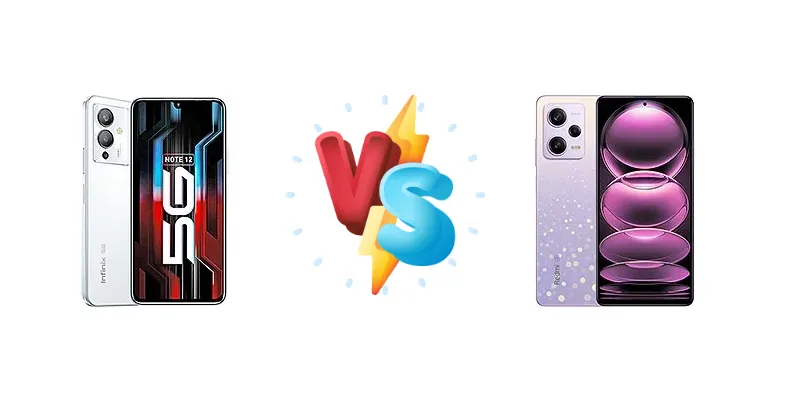
|
🏆 Quick Verdict
The Xiaomi Redmi Note 12 Pro emerges as the overall winner thanks to its significantly faster charging, brighter display, and slightly more powerful chipset. While the Infinix Note 12 5G is a solid option, the Redmi Note 12 Pro offers a more premium experience and better value for money.
| PHONES | ||
|---|---|---|
| Phone Names | Infinix Note 12 5G | Xiaomi Redmi Note 12 Pro |
| Network | ||
|---|---|---|
| 2G bands | GSM 850 / 900 / 1800 / 1900 | GSM 850 / 900 / 1800 / 1900 |
| 3G bands | HSDPA 850 / 900 / 2100 | HSDPA 800 / 850 / 900 / 1900 / 2100 |
| 4G bands | 1, 3, 5, 7, 8, 20, 28, 38, 40, 41 | 1, 2, 3, 4, 5, 7, 8, 12, 13, 17, 18, 19, 20, 26, 28, 32, 38, 40, 41, 66 - International |
| 5G bands | 1, 3, 5, 7, 8, 20, 28, 38, 40, 41, 77, 78 | 1, 3, 5, 7, 8, 20, 28, 38, 40, 41, 66, 77, 78 SA/NSA - International |
| Speed | HSPA, LTE, 5G | HSPA, LTE, 5G |
| Technology | GSM / HSPA / LTE / 5G | GSM / CDMA / HSPA / EVDO / LTE / 5G |
| - | 1, 3, 5, 8, 28, 38, 41, 77, 78 SA/NSA - China | |
| Launch | ||
|---|---|---|
| Announced | 2022, July 08 | 2022, October 27 |
| Status | Available. Released 2022, July 14 | Available. Released 2022, November 01 |
| Body | ||
|---|---|---|
| Build | Glass front, plastic frame, plastic back | Glass front (Gorilla Glass 5), glass back, plastic frame |
| Dimensions | 164.7 x 76.9 x 8 mm (6.48 x 3.03 x 0.31 in) | 163 x 76 x 8 mm (6.42 x 2.99 x 0.31 in) |
| SIM | Nano-SIM + Nano-SIM | Nano-SIM + Nano-SIM |
| Weight | 186 g (6.56 oz) | 187 g (6.60 oz) |
| - | IP53, dust and splash resistant | |
| Display | ||
|---|---|---|
| Protection | Corning Gorilla Glass 3 | Corning Gorilla Glass 5 |
| Resolution | 1080 x 2400 pixels, 20:9 ratio (~393 ppi density) | 1080 x 2400 pixels, 20:9 ratio (~395 ppi density) |
| Size | 6.7 inches, 108.4 cm2 (~85.6% screen-to-body ratio) | 6.67 inches, 107.4 cm2 (~86.7% screen-to-body ratio) |
| Type | AMOLED | AMOLED, 1B colors, 120Hz, Dolby Vision, HDR10+, 500 nits (typ), 900 nits (HBM) |
| Platform | ||
|---|---|---|
| CPU | Octa-core (2x2.4 GHz Cortex-A76 & 6x2.0 GHz Cortex-A55) | Octa-core (2x2.6 GHz Cortex-A78 & 6x2.0 GHz Cortex-A55) |
| Chipset | Mediatek Dimensity 810 (6 nm) | Mediatek Dimensity 1080 (6 nm) |
| GPU | Mali-G57 MC2 | Mali-G68 MC4 |
| OS | Android 12, XOS 10.6 | Android 12, MIUI 13 |
| Memory | ||
|---|---|---|
| Card slot | microSDXC (dedicated slot) | No |
| Internal | 64GB 6GB RAM | 128GB 6GB RAM, 128GB 8GB RAM, 256GB 8GB RAM, 256GB 12GB RAM |
| - | UFS 2.2 | |
| Main Camera | ||
|---|---|---|
| Features | Quad-LED flash, HDR, panorama | Dual-LED dual-tone flash, HDR, panorama |
| Single | 16 MP, f/2.0, (wide) | - |
| Triple | 50 MP, f/1.6, 27mm (wide), 1/2.8", 0.64µm, PDAF Auxiliary lenses | 50 MP, f/1.9, 24mm (wide), 1/1.56", 1.0µm, PDAF, OIS 8 MP, f/2.2, 120˚ (ultrawide), 1/4.0", 1.12µm 2 MP (macro) |
| Video | 1440p@30fps | 4K@30fps, 1080p@30/60/120fps, 720p@960fps |
| Selfie camera | ||
|---|---|---|
| Features | Dual-LED flash | HDR |
| Single | 16 MP, f/2.0, (wide) | 16 MP, f/2.5, (wide), 1/3.06", 1.0µm |
| Video | 1440p@30fps | 1080p@30/60fps |
| Sound | ||
|---|---|---|
| 3.5mm jack | Yes | Yes |
| 35mm jack | Yes | Yes |
| Loudspeaker | Yes, with dual speakers | Yes, with stereo speakers |
| - | 24-bit/192kHz audio | |
| Comms | ||
|---|---|---|
| Bluetooth | 5.0, A2DP, LE | 5.2, A2DP, LE |
| Infrared port | - | Yes |
| NFC | No | Yes (market/region dependent) |
| Positioning | GPS | GPS (L1), GLONASS (G1), BDS (B1I+B1c), GALILEO (E1), QZSS (L1) |
| Radio | Unspecified | No |
| USB | USB Type-C 2.0, OTG | USB Type-C 2.0, OTG |
| WLAN | Wi-Fi 802.11 a/b/g/n | Wi-Fi 802.11 a/b/g/n/ac/6, dual-band, Wi-Fi Direct |
| Features | ||
|---|---|---|
| Sensors | Fingerprint (side-mounted), accelerometer, gyro, proximity, compass | Fingerprint (side-mounted), accelerometer, gyro, proximity, compass |
| Battery | ||
|---|---|---|
| Charging | 33W wired | 67W wired, PD3.0, 50% in 15 min, 100% in 46 min |
| Type | 5000 mAh | Li-Po 5000 mAh |
| Misc | ||
|---|---|---|
| Colors | Black, White | Frosted Blue (Sky Blue), Onyx Black (Midnight Black), Polar White, Stardust Purple |
| Models | X671 | 22101316C, 22101316I, 23013RK75C, 22101316G |
| Price | About 190 EUR | € 148.54 / $ 142.17 / £ 149.99 / ₹ 19,999 |
| SAR | - | 1.09 W/kg (head) 1.06 W/kg (body) |
| SAR EU | - | 0.99 W/kg (head) 0.99 W/kg (body) |
| Tests | ||
|---|---|---|
| Battery life | - | Endurance rating 97h |
| Camera | - | Photo / Video |
| Display | - | Contrast ratio: Infinite (nominal) |
| Loudspeaker | - | -26.6 LUFS (Good) |
| Performance | - | AnTuTu: 490526 (v9) GeekBench: 2209 (v5.1), 2372 (v6) GFXBench: 22fps (ES 3.1 onscreen) |
Infinix Note 12 5G
- More affordable
- 5G Connectivity
- Decent Battery Life
- Slower Charging
- Less Powerful Chipset
- Dimmer Display
Xiaomi Redmi Note 12 Pro
- Faster Charging (67W)
- Brighter Display
- More Powerful Chipset (Dimensity 1080)
- Excellent Battery Life
- Slightly More Expensive
- Nominal Contrast Ratio Claim
Display Comparison
The Redmi Note 12 Pro boasts a significant advantage with its 890 nits max brightness, offering better visibility in direct sunlight. Its 'Infinite' contrast ratio (though nominal) suggests excellent image quality. The Infinix Note 12 5G's display is likely adequate but lacks the same punch and vibrancy. Expect richer colors and deeper blacks on the Redmi.
Camera Comparison
While both phones offer capable camera systems, the Redmi Note 12 Pro likely holds an edge. The Dimensity 1080 generally supports better image processing capabilities. Expect improved dynamic range, detail, and low-light performance on the Redmi. Specific camera specs (megapixels, aperture) would be needed for a more precise comparison, but the chipset advantage suggests a better camera experience overall.
Performance
The Redmi Note 12 Pro's Dimensity 1080 chipset provides a noticeable performance boost over the Dimensity 810 in the Infinix Note 12 5G. Expect smoother multitasking, faster app loading times, and better gaming performance on the Redmi. Both phones utilize octa-core CPUs, but the Cortex-A78 cores in the Redmi offer superior single-core performance.
Battery Life
Both phones offer excellent battery life, with the Redmi Note 12 Pro demonstrating an impressive endurance rating of 97 hours. The Infinix Note 12 5G also provides solid battery performance. However, the Redmi Note 12 Pro's 67W charging is a game-changer, allowing for a 50% charge in just 15 minutes and a full charge in 46 minutes – a significant advantage over the Infinix's 33W charging.
Buying Guide
The Infinix Note 12 5G is a good choice for users prioritizing 5G connectivity and a more budget-friendly price. The Xiaomi Redmi Note 12 Pro is ideal for those who value fast charging, a vibrant display, and a slightly more powerful processor for smoother performance and better camera capabilities.