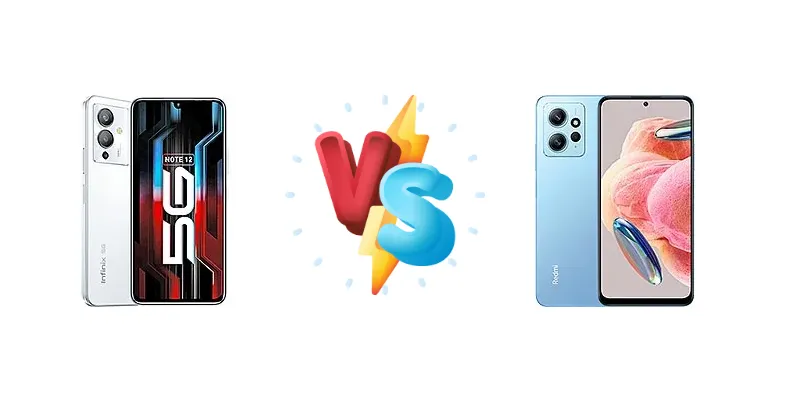
The mid-range smartphone market is fiercely competitive, and the Infinix Note 12 5G and Xiaomi Redmi Note 12 4G are two strong contenders. Both offer compelling features at attractive price points, but cater to slightly different needs. Let's dive into a detailed comparison to help you decide which one is right for you.
🏆 Quick Verdict
The Infinix Note 12 5G takes the lead for users prioritizing 5G connectivity and a slightly more powerful processor. However, the Redmi Note 12 4G boasts exceptional battery life and a potentially brighter display, making it a strong choice for those valuing longevity and media consumption.
| Network |
|---|
| 2G bands | GSM 850 / 900 / 1800 / 1900 | GSM 850 / 900 / 1800 / 1900 |
| 3G bands | HSDPA 850 / 900 / 2100 | HSDPA 850 / 900 / 2100 |
| 4G bands | 1, 3, 5, 7, 8, 20, 28, 38, 40, 41 | 1, 3, 5, 7, 8, 20, 28, 38, 40, 41 |
| 5G bands | 1, 3, 5, 7, 8, 20, 28, 38, 40, 41, 77, 78 | - |
| Speed | HSPA, LTE, 5G | HSPA, LTE, 5G |
| Technology | GSM / HSPA / LTE / 5G | GSM / HSPA / LTE |
| Launch |
|---|
| Announced | 2022, July 08 | 2023, March 23 |
| Status | Available. Released 2022, July 14 | Available. Released 2023, March 30 |
| Body |
|---|
| Build | Glass front, plastic frame, plastic back | Glass front (Gorilla Glass 3), plastic frame, plastic back |
| Dimensions | 164.7 x 76.9 x 8 mm (6.48 x 3.03 x 0.31 in) | 165.7 x 76 x 7.9 mm (6.52 x 2.99 x 0.31 in) |
| SIM | Nano-SIM + Nano-SIM | Nano-SIM + Nano-SIM |
| Weight | 186 g (6.56 oz) | 183.5 g (6.49 oz) |
| | - | IP53, dust and splash resistant |
| Display |
|---|
| Protection | Corning Gorilla Glass 3 | Corning Gorilla Glass 3 |
| Resolution | 1080 x 2400 pixels, 20:9 ratio (~393 ppi density) | 1080 x 2400 pixels, 20:9 ratio (~395 ppi density) |
| Size | 6.7 inches, 108.4 cm2 (~85.6% screen-to-body ratio) | 6.67 inches, 107.4 cm2 (~85.3% screen-to-body ratio) |
| Type | AMOLED | AMOLED, 120Hz, 450 nits (typ), 700 nits (HBM), 1200 nits (peak) |
| Platform |
|---|
| CPU | Octa-core (2x2.4 GHz Cortex-A76 & 6x2.0 GHz Cortex-A55) | Octa-core (4x2.8 GHz Cortex-A73 & 4x1.9 GHz Cortex-A53) |
| Chipset | Mediatek Dimensity 810 (6 nm) | Qualcomm SM6225 Snapdragon 685 (6 nm) |
| GPU | Mali-G57 MC2 | Adreno 610 |
| OS | Android 12, XOS 10.6 | Android 13, upgradable to Android 14, HyperOS |
| Memory |
|---|
| Card slot | microSDXC (dedicated slot) | microSDXC (dedicated slot) |
| Internal | 64GB 6GB RAM | 64GB 4GB RAM, 64GB 6GB RAM, 128GB 4GB RAM, 128GB 6GB RAM, 128GB 8GB RAM, 256GB 8GB RAM |
| | - | UFS 2.2 |
| Main Camera |
|---|
| Features | Quad-LED flash, HDR, panorama | LED flash, HDR, panorama |
| Single | 16 MP, f/2.0, (wide) | - |
| Triple | 50 MP, f/1.6, 27mm (wide), 1/2.8", 0.64µm, PDAF
Auxiliary lenses | 50 MP, f/1.8, (wide), 1/2.76", 0.64µm, PDAF
8 MP, f/2.2, 120˚ (ultrawide), 1/4.0", 1.12µm
2 MP (macro) |
| Video | 1440p@30fps | 1080p@30fps |
| Selfie camera |
|---|
| Features | Dual-LED flash | HDR |
| Single | 16 MP, f/2.0, (wide) | 13 MP, f/2.5, (wide), 1/3.0" |
| Video | 1440p@30fps | 1080p@30fps |
| Sound |
|---|
| 3.5mm jack | Yes | Yes |
| 35mm jack | Yes | Yes |
| Loudspeaker | Yes, with dual speakers | Yes |
| Comms |
|---|
| Bluetooth | 5.0, A2DP, LE | 5.0, A2DP, LE |
| Infrared port | - | Yes |
| NFC | No | Yes (market/region dependent) |
| Positioning | GPS | GPS, GLONASS, GALILEO |
| Radio | Unspecified | Unspecified |
| USB | USB Type-C 2.0, OTG | USB Type-C 2.0, OTG |
| WLAN | Wi-Fi 802.11 a/b/g/n | Wi-Fi 802.11 a/b/g/n/ac, dual-band |
| Features |
|---|
| Sensors | Fingerprint (side-mounted), accelerometer, gyro, proximity, compass | Fingerprint (side-mounted), accelerometer, gyro, proximity, compass |
| Battery |
|---|
| Charging | 33W wired | 33W wired |
| Type | 5000 mAh | Li-Po 5000 mAh |
| Misc |
|---|
| Colors | Black, White | Onyx Gray, Mint Green, Ice Blue |
| Models | X671 | 23021RAAEG, 23021RAA2Y, 23027RAD4I, 23028RA60L |
| Price | About 190 EUR | £ 189.99 / € 107.98 / ₹ 9,998 |
| SAR | - | 1.09 W/kg (head) 0.89 W/kg (body) |
| SAR EU | - | 0.90 W/kg (head) 0.99 W/kg (body) |
| Tests |
|---|
| Battery life | - |
Endurance rating 117h
|
| Camera | - |
Photo / Video |
| Display | - |
Contrast ratio: Infinite (nominal) |
| Loudspeaker | - |
-27.9 LUFS (Good)
|
| Performance | - |
AnTuTu: 319219 (v9)
GeekBench: 1797 (v5.1), 1341 (v6)
GFXBench: 7.5fps (ES 3.1 onscreen) |
Infinix Note 12 5G
- 5G Connectivity
- More Powerful Processor (Dimensity 810)
- Potentially Better Camera ISP
- Sleek Design
- Potentially Shorter Battery Life
- Less Information on Display Brightness
Xiaomi Redmi Note 12 4G
- Exceptional Battery Life (117h Endurance Rating)
- Bright Display (744 nits)
- Reliable Performance for Everyday Tasks
- Xiaomi's Software Optimization
- No 5G Connectivity
- Less Powerful Processor (Snapdragon 685)
- Potentially Less Gaming Performance
Display Comparison
Both phones feature AMOLED displays, offering vibrant colors and deep blacks. The Redmi Note 12 4G is reported to have a measured peak brightness of 744 nits, potentially offering better outdoor visibility. While the contrast ratio is listed as 'infinite' for the Redmi, this is a nominal value and doesn't necessarily translate to a significantly better viewing experience. The Infinix Note 12 5G's display is likely very good, but specific brightness figures are harder to find.
Camera Comparison
Camera performance is a key area where detailed comparisons are difficult without extensive testing. Both phones feature a multi-lens setup, likely including a primary sensor, ultrawide, and potentially a macro lens. The Infinix's Dimensity 810 chipset often includes a capable image signal processor (ISP), potentially leading to slightly better image processing. However, Xiaomi's software optimization is generally excellent, so the Redmi could still deliver impressive results.
Performance
The Infinix Note 12 5G's Mediatek Dimensity 810 chipset provides a noticeable performance advantage over the Redmi Note 12 4G's Snapdragon 685. The Dimensity 810's Cortex-A76 cores offer better single-core performance, making it better suited for demanding apps and games. The Redmi's Snapdragon 685 is still capable for everyday tasks, but may struggle with more intensive workloads.
Battery Life
The Xiaomi Redmi Note 12 4G shines in this category. Its endurance rating of 117 hours is exceptional, suggesting significantly longer battery life than the Infinix Note 12 5G. While the Infinix has a decent battery capacity, the Redmi's efficiency likely contributes to its superior longevity.
Buying Guide
The Infinix Note 12 5G is ideal for users who want 5G capabilities, enjoy gaming, and need a responsive experience. The Xiaomi Redmi Note 12 4G is perfect for those prioritizing long battery life, a vibrant display for media, and a reliable, everyday smartphone experience without needing 5G.
Frequently Asked Questions
❓ Does the Infinix Note 12 5G support 5G?
Yes, the Infinix Note 12 5G is designed for 5G connectivity, offering faster download and upload speeds where available.
❓ Which phone has better battery life?
The Xiaomi Redmi Note 12 4G has a significantly better endurance rating (117 hours) and is expected to offer longer battery life than the Infinix Note 12 5G.