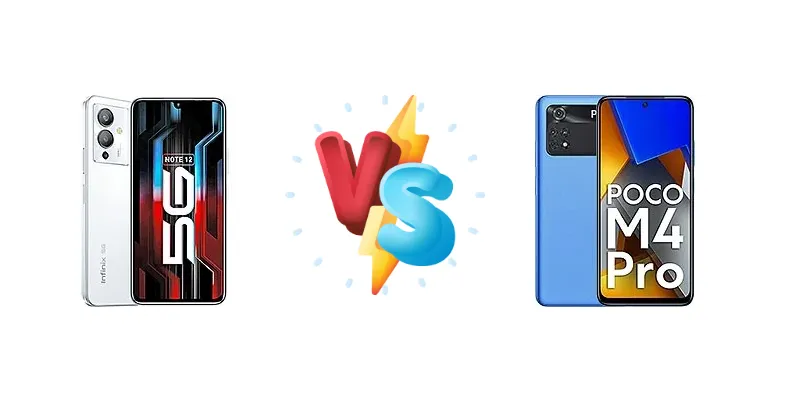
The mid-range smartphone market is fiercely competitive, offering incredible value for your money. Today, we're pitting two popular contenders against each other: the Infinix Note 12 5G and the Xiaomi Poco M4 Pro. Both promise impressive features, but which one truly reigns supreme?
🏆 Quick Verdict
The Poco M4 Pro edges out the Infinix Note 12 5G thanks to its faster charging, brighter display, and slightly more efficient chipset. While the Note 12 5G offers 5G connectivity, the Poco M4 Pro provides a more well-rounded experience for most users.
| Network |
|---|
| 2G bands | GSM 850 / 900 / 1800 / 1900 | GSM 850 / 900 / 1800 / 1900 |
| 3G bands | HSDPA 850 / 900 / 2100 | HSDPA 850 / 900 / 1700(AWS) / 1900 / 2100 - International |
| 4G bands | 1, 3, 5, 7, 8, 20, 28, 38, 40, 41 | 1, 2, 3, 4, 5, 7, 8, 20, 28, 38, 40, 41 - International |
| 5G bands | 1, 3, 5, 7, 8, 20, 28, 38, 40, 41, 77, 78 | - |
| Speed | HSPA, LTE, 5G | HSPA, LTE |
| Technology | GSM / HSPA / LTE / 5G | GSM / HSPA / LTE |
| | - | 1, 3, 5, 8, 40, 41 - India |
| Launch |
|---|
| Announced | 2022, July 08 | 2022, February 28 |
| Status | Available. Released 2022, July 14 | Available. Released 2022, March 16 |
| Body |
|---|
| Build | Glass front, plastic frame, plastic back | Glass front (Gorilla Glass 3), plastic frame, plastic back |
| Dimensions | 164.7 x 76.9 x 8 mm (6.48 x 3.03 x 0.31 in) | 159.9 x 73.9 x 8.1 mm (6.30 x 2.91 x 0.32 in) |
| SIM | Nano-SIM + Nano-SIM | Nano-SIM + Nano-SIM |
| Weight | 186 g (6.56 oz) | 179.5 g (6.31 oz) |
| | - | IP53, dust and splash resistant |
| Display |
|---|
| Protection | Corning Gorilla Glass 3 | Corning Gorilla Glass 3 |
| Resolution | 1080 x 2400 pixels, 20:9 ratio (~393 ppi density) | 1080 x 2400 pixels, 20:9 ratio (~409 ppi density) |
| Size | 6.7 inches, 108.4 cm2 (~85.6% screen-to-body ratio) | 6.43 inches, 99.8 cm2 (~84.5% screen-to-body ratio) |
| Type | AMOLED | AMOLED, 90Hz, 700 nits, 1000 nits (peak) |
| Platform |
|---|
| CPU | Octa-core (2x2.4 GHz Cortex-A76 & 6x2.0 GHz Cortex-A55) | Octa-core (2x2.05 GHz Cortex-A76 & 6x2.0 GHz Cortex-A55) |
| Chipset | Mediatek Dimensity 810 (6 nm) | Mediatek MT6781 Helio G96 (12 nm) |
| GPU | Mali-G57 MC2 | Mali-G57 MC2 |
| OS | Android 12, XOS 10.6 | Android 11, MIUI 13 for POCO |
| Memory |
|---|
| Card slot | microSDXC (dedicated slot) | microSDXC (dedicated slot) |
| Internal | 64GB 6GB RAM | 64GB 6GB RAM, 128GB 6GB RAM, 128GB 8GB RAM, 256GB 8GB RAM |
| | - | UFS 2.2 |
| Main Camera |
|---|
| Features | Quad-LED flash, HDR, panorama | LED flash, HDR, panorama |
| Single | 16 MP, f/2.0, (wide) | 16 MP, f/2.5, (wide), 1/3.06" 1.0µm |
| Triple | 50 MP, f/1.6, 27mm (wide), 1/2.8", 0.64µm, PDAF
Auxiliary lenses | 64 MP, f/1.8, 26mm (wide), 0.7µm, PDAF
8 MP, f/2.2, 118˚ (ultrawide), 1/4.0", 1.12µm
2 MP (macro) |
| Video | 1440p@30fps | 1080p@30fps |
| Selfie camera |
|---|
| Features | Dual-LED flash | HDR |
| Single | 16 MP, f/2.0, (wide) | 16 MP, f/2.5, (wide), 1/3.06" 1.0µm |
| Video | 1440p@30fps | 1080p@30fps |
| Sound |
|---|
| 3.5mm jack | Yes | Yes |
| 35mm jack | Yes | Yes |
| Loudspeaker | Yes, with dual speakers | Yes, with stereo speakers |
| | - | 24-bit/192kHz audio |
| Comms |
|---|
| Bluetooth | 5.0, A2DP, LE | 5.0, A2DP, LE |
| Infrared port | - | Yes |
| NFC | No | Yes |
| Positioning | GPS | GPS, GLONASS, BDS, GALILEO |
| Radio | Unspecified | FM radio, recording |
| USB | USB Type-C 2.0, OTG | USB Type-C 2.0, OTG |
| WLAN | Wi-Fi 802.11 a/b/g/n | Wi-Fi 802.11 a/b/g/n/ac, dual-band, Wi-Fi Direct |
| Features |
|---|
| Sensors | Fingerprint (side-mounted), accelerometer, gyro, proximity, compass | Fingerprint (side-mounted), accelerometer, gyro, compass |
| | - | Virtual proximity sensing |
| Battery |
|---|
| Charging | 33W wired | 33W wired, PD3.0, QC3, 100% in 58 min |
| Type | 5000 mAh | Li-Po 5000 mAh |
| Misc |
|---|
| Colors | Black, White | Power Black, Cool Blue, Poco Yellow |
| Models | X671 | MZB0B5VIN, 2201117PI, 2201117PG |
| Price | About 190 EUR | € 100.18 |
| SAR | - | 0.85 W/kg (head) 0.85 W/kg (body) |
| SAR EU | - | 0.59 W/kg (head) 0.84 W/kg (body) |
| Tests |
|---|
| Battery life | - |
Endurance rating 126h
|
| Camera | - |
Photo / Video |
| Display | - |
Contrast ratio: Infinite (nominal) |
| Loudspeaker | - |
-25.2 LUFS (Very good)
|
| Performance | - |
AnTuTu: 318444 (v9)
GeekBench: 1836 (v5.1)
GFXBench: 12fps (ES 3.1 onscreen) |
Infinix Note 12 5G
- 5G Connectivity
- Modern Chipset (Dimensity 810)
- Sleek Design
- Lower Display Brightness
- Slower Charging
- Potentially Shorter Battery Life
Xiaomi Poco M4 Pro
- Brighter Display
- Faster Charging (PD3.0, QC3)
- Excellent Battery Life
- Efficient Chipset
- Older Chipset (Helio G96)
- No 5G
Display Comparison
The Poco M4 Pro boasts a significantly brighter display at 737 nits (measured) compared to the Note 12 5G's likely lower brightness. While both offer vibrant colors and decent resolution, the Poco's superior brightness makes it more comfortable to use outdoors. The Poco M4 Pro's 'infinite' contrast ratio is a nominal claim, but suggests good contrast.
Camera Comparison
Both phones feature capable camera systems, but detailed camera comparisons require more in-depth testing. The Poco M4 Pro likely offers slightly better image processing and low-light performance. Both offer standard photo and video capabilities.
Performance
The Infinix Note 12 5G's Dimensity 810 offers a slight edge in raw processing power over the Poco M4 Pro's Helio G96. However, the Poco's more efficient chipset and optimized software often translate to smoother everyday performance. Both phones handle typical tasks and moderate gaming well.
Battery Life
The Poco M4 Pro shines in battery life, boasting an impressive endurance rating of 126 hours. While the Note 12 5G has a decent battery, it doesn't match the Poco's longevity. The Poco M4 Pro's 33W charging with PD3.0, QC3 support, and 58-minute full charge time is a significant advantage.
Buying Guide
The Infinix Note 12 5G is ideal for users prioritizing 5G connectivity and a slightly more modern chipset. The Xiaomi Poco M4 Pro is a better choice for those seeking a brighter display, faster charging, and excellent battery life without breaking the bank.
Frequently Asked Questions
❓ Does the Infinix Note 12 5G support 5G?
Yes, the Infinix Note 12 5G is designed for 5G connectivity, offering faster download and upload speeds where available.
❓ Which phone is better for gaming?
While both are capable, the Poco M4 Pro's efficient chipset and potentially better thermal management might provide a slightly smoother gaming experience, especially for extended sessions.