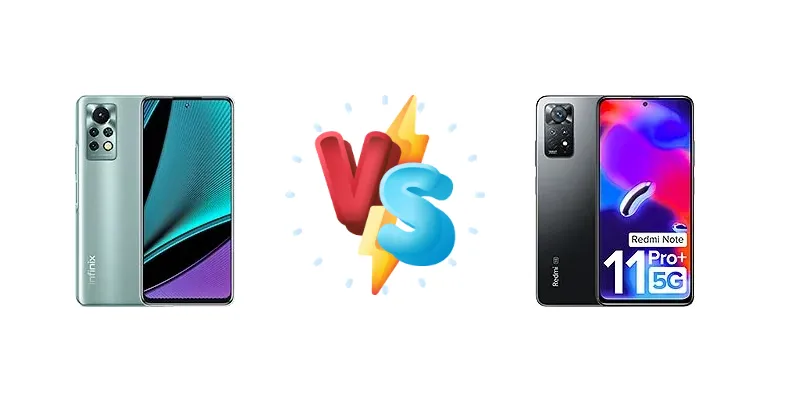
The sub-$300 smartphone market is fiercely competitive, and the Infinix Note 11s and Xiaomi Redmi Note 11 Pro+ 5G (India) represent compelling options. While both aim to deliver a feature-rich experience without breaking the bank, they take distinctly different approaches to achieving that goal. The Redmi prioritizes 5G connectivity and rapid charging, while the Infinix focuses on a balanced feature set at an aggressive price point. This comparison dissects their key differences to determine which device best suits your needs.
🏆 Quick Verdict
For the average user prioritizing speed and convenience, the Xiaomi Redmi Note 11 Pro+ 5G (India) is the better choice. Its Snapdragon 695 chipset, built on a more efficient 6nm process, and blazing-fast 67W charging offer a noticeable advantage. However, the Infinix Note 11s remains a strong contender for budget-conscious buyers who don't need 5G or the fastest charging.
| Network |
|---|
| 2G bands | GSM 850 / 900 / 1800 / 1900 | GSM 850 / 900 / 1800 / 1900 - SIM 1 & SIM 2 |
| 3G bands | HSDPA 850 / 900 / 1700(AWS) / 1900 / 2100 | HSDPA 850 / 900 / 1900 / 2100 |
| 4G bands | 1, 2, 3, 4, 5, 7, 8, 20, 28, 38, 41, 40 | 1, 3, 5, 8, 40, 41 |
| 5G bands | - | 1, 3, 5, 8, 28, 40, 78 SA/NSA |
| Speed | HSPA, LTE | HSPA, LTE-A (CA), 5G |
| Technology | GSM / HSPA / LTE | GSM / HSPA / LTE / 5G |
| | 1, 3, 7, 8, 20, 28 | - |
| Launch |
|---|
| Announced | 2021, November 08 | 2022, March 09 |
| Status | Available. Released 2021, November 08 | Available. Released 2022, March 15 |
| Body |
|---|
| Build | Glass front, plastic frame, plastic back | Glass front (Gorilla Glass 5), glass back |
| Dimensions | 173.1 x 78.4 x 8.7 mm (6.81 x 3.09 x 0.34 in) | 164.2 x 76.1 x 8.1 mm (6.46 x 3.00 x 0.32 in) |
| SIM | Nano-SIM + Nano-SIM | Hybrid Dual SIM (Nano-SIM, dual stand-by) |
| Weight | - | 202 g (7.13 oz) |
| | - | IP53, dust and splash resistant |
| Display |
|---|
| Protection | - | Corning Gorilla Glass 5 |
| Resolution | 1080 x 2460 pixels (~387 ppi density) | 1080 x 2400 pixels, 20:9 ratio (~395 ppi density) |
| Size | 6.95 inches, 114.7 cm2 (~84.5% screen-to-body ratio) | 6.67 inches, 107.4 cm2 (~86.0% screen-to-body ratio) |
| Type | IPS LCD, 120Hz | Super AMOLED, 120Hz, 700 nits, 1200 nits (peak) |
| Platform |
|---|
| CPU | Octa-core (2x2.05 GHz Cortex-A76 & 6x2.0 GHz Cortex-A55) | Octa-core (2x2.2 GHz Kryo 660 Gold & 6x1.7 GHz Kryo 660 Silver) |
| Chipset | Mediatek MT6781 Helio G96 (12 nm) | Qualcomm SM6375 Snapdragon 695 5G (6 nm) |
| GPU | Mali-G57 MC2 | Adreno 619 |
| OS | Android 11, XOS 10 | Android 11, MIUI 13 |
| Memory |
|---|
| Card slot | microSDXC (dedicated slot) | microSDXC (uses shared SIM slot) |
| Internal | 64GB 4GB RAM, 64GB 6GB RAM, 128GB 4GB RAM, 128GB 6GB RAM, 128GB 8GB RAM | 64GB 6GB RAM, 128GB 6GB RAM, 128GB 8GB RAM, 256GB 8GB RAM |
| | UFS 2.2 | UFS 2.2 |
| Main Camera |
|---|
| Features | Quad-LED flash, HDR, panorama | LED flash, HDR, panorama |
| Single | 16 MP | - |
| Triple | 50 MP, f/1.6, (wide), PDAF
2 MP (macro)
Auxiliary lens | 108 MP, f/1.9, 26mm (wide), 1/1.52", 0.7µm, PDAF
8 MP, f/2.2, 118˚ (ultrawide)
2 MP, f/2.4, (macro) |
| Video | 1440p@30fps | 1080p@30fps |
| Selfie camera |
|---|
| Single | 16 MP | 16 MP, f/2.5, (wide), 1/3.06" 1.0µm |
| Video | 1080p@30fps | 1080p@30fps |
| Sound |
|---|
| 3.5mm jack | Yes | Yes |
| 35mm jack | Yes | - |
| Loudspeaker | Yes, with dual speakers | Yes, with stereo speakers |
| | - | 24-bit/192kHz audio |
| Comms |
|---|
| Bluetooth | Yes | 5.1, A2DP, LE |
| Infrared port | - | Yes |
| NFC | No | No |
| Positioning | GPS | GPS, GLONASS, BDS, GALILEO |
| Radio | FM radio | Unspecified |
| USB | USB Type-C 2.0, OTG | USB Type-C 2.0, OTG |
| WLAN | Wi-Fi 802.11 a/b/g/n/ac, dual-band, Wi-Fi Direct | Wi-Fi 802.11 a/b/g/n/ac, dual-band, Wi-Fi Direct |
| Features |
|---|
| Sensors | Fingerprint (side-mounted), accelerometer, gyro, proximity, compass | Fingerprint (side-mounted), accelerometer, gyro, proximity, compass |
| Battery |
|---|
| Charging | 33W wired | 67W wired, PD3.0, QC3, 50% in 15 min, 100% in 42 min (advertised) |
| Type | 5000 mAh | Li-Po 5000 mAh, non-removable |
| Misc |
|---|
| Colors | Haze Green, Mithril Gray, Symphony Cyan | Mirage Blue, Phantom White, Stealth Black |
| Models | X698 | 2201116SI |
| Price | About 180 EUR | About 250 EUR |
Infinix Note 11s
- Aggressive pricing offers excellent value.
- Decent all-around performance for everyday tasks.
- Reliable MediaTek Helio G96 chipset.
- Slower 33W charging compared to the Redmi.
- Less efficient chipset may lead to more heat.
Xiaomi Redmi Note 11 Pro+ 5G (India)
- Blazing-fast 67W charging for minimal downtime.
- More efficient Snapdragon 695 5G chipset.
- 5G connectivity for future-proofing.
- Higher price point than the Infinix Note 11s.
- May not offer a significantly better camera experience.
Display Comparison
Neither device boasts a top-tier display, but they differ in their strengths. While both likely utilize IPS LCD panels (data not provided), the focus here is on the overall user experience. The absence of high refresh rate or LTPO technology on either phone means they won't deliver the buttery-smooth scrolling found on more expensive devices. Bezels are likely comparable, typical for this price segment. Color accuracy is expected to be adequate, but not professional-grade.
Camera Comparison
Without detailed camera specs beyond the main sensors, a direct comparison is challenging. However, the Redmi Note 11 Pro+ 5G (India) likely benefits from Qualcomm's image signal processor (ISP), which generally delivers better image processing and noise reduction. The Helio G96's ISP is capable, but typically lags behind Qualcomm's offerings. The absence of Optical Image Stabilization (OIS) on either device suggests image stabilization will rely on software algorithms, potentially resulting in softer images in low-light conditions. The usefulness of the often-included 2MP macro cameras on both phones is questionable; they rarely deliver significant improvements over the main sensor.
Performance
The core difference lies in the chipsets. The Xiaomi Redmi Note 11 Pro+ 5G (India) utilizes the Qualcomm Snapdragon 695 5G (6nm), while the Infinix Note 11s features the MediaTek Helio G96 (12nm). The 6nm process of the Snapdragon 695 translates to significantly better power efficiency and thermal management. This means the Redmi is less likely to throttle under sustained load, offering more consistent performance during gaming or demanding tasks. The Snapdragon's Kryo 660 Gold cores, clocked at 2.2 GHz, also provide a performance edge over the Helio G96's Cortex-A76 cores at 2.05 GHz. While both phones likely feature similar RAM configurations, the Snapdragon's superior architecture will yield a more responsive user experience.
Battery Life
The Redmi Note 11 Pro+ 5G (India) truly shines with its 67W wired charging, capable of reaching 50% charge in just 15 minutes and 100% in 42 minutes (advertised). This is a massive advantage over the Infinix Note 11s' 33W charging. While the Infinix's battery capacity is unknown, the Redmi's faster charging mitigates the impact of a potentially smaller battery. The Snapdragon 695's 6nm efficiency also contributes to better battery life, offsetting any capacity differences. For users who frequently find themselves needing a quick top-up, the Redmi is the clear winner.
Buying Guide
Buy the Infinix Note 11s if you need a reliable all-rounder with a decent camera and don't require 5G connectivity or ultra-fast charging. It's ideal for everyday tasks, social media, and casual gaming. Buy the Xiaomi Redmi Note 11 Pro+ 5G (India) if you prioritize future-proofing with 5G, demand significantly faster charging speeds, and are willing to spend a bit more for improved performance and efficiency.
Frequently Asked Questions
❓ Does the Snapdragon 695 in the Redmi Note 11 Pro+ 5G (India) offer a noticeable gaming improvement over the Helio G96 in the Infinix Note 11s?
Yes, the Snapdragon 695's more efficient architecture and higher clock speeds provide a tangible performance boost in gaming. While neither phone is a dedicated gaming device, the Redmi will handle demanding titles with higher frame rates and less thermal throttling, resulting in a smoother and more consistent gaming experience.
❓ How much faster is the 67W charging on the Redmi Note 11 Pro+ 5G (India) in real-world use compared to the 33W charging on the Infinix Note 11s?
The 67W charging on the Redmi is significantly faster. Xiaomi advertises 0-100% in 42 minutes, while the Infinix Note 11s will likely take over an hour and a half. This means you can get a substantial charge in a short amount of time with the Redmi, ideal for users who are always on the go.
❓ Is the 5G connectivity on the Redmi Note 11 Pro+ 5G (India) a significant benefit if 5G coverage is limited in my area?
Currently, if 5G coverage is sparse, the benefit is minimal. However, purchasing the Redmi Note 11 Pro+ 5G (India) future-proofs your device for when 5G networks become more widespread. It also supports 4G LTE, so you won't lose connectivity in areas without 5G.