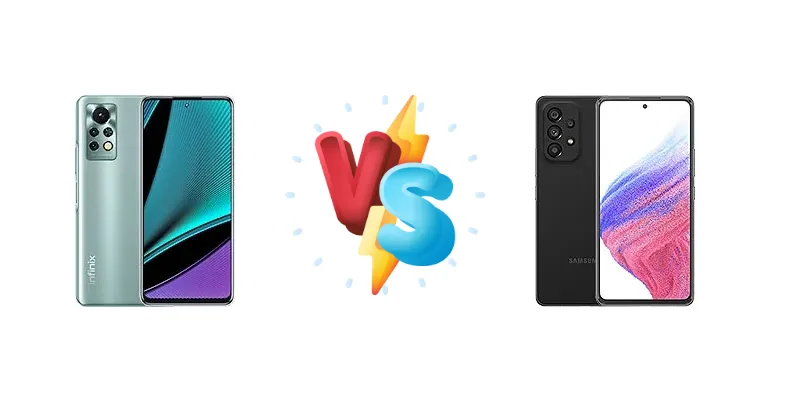
The Infinix Note 11s and Samsung Galaxy A53 5G represent distinct approaches to the mid-range smartphone market. The Note 11s aggressively targets gamers and value-seekers, while the A53 5G aims for a more balanced, all-around experience with Samsung’s established brand and software ecosystem. This comparison dissects their key differences to help you choose the right device.
🏆 Quick Verdict
For the average user prioritizing a polished experience and reliable software updates, the Samsung Galaxy A53 5G is the better choice. However, gamers and those on a tight budget will find the Infinix Note 11s offers compelling performance for the price, despite some compromises.
| Network |
|---|
| 2G bands | GSM 850 / 900 / 1800 / 1900 | GSM 850 / 900 / 1800 / 1900 |
| 3G bands | HSDPA 850 / 900 / 1700(AWS) / 1900 / 2100 | HSDPA 850 / 900 / 1700(AWS) / 1900 / 2100 |
| 4G bands | 1, 2, 3, 4, 5, 7, 8, 20, 28, 38, 41, 40 | 1, 2, 3, 4, 5, 7, 12, 14, 20, 29, 30, 38, 39, 40, 41, 46, 48, 66 - SM-A536U |
| 5G bands | - | 2, 5, 41, 66, 77, 78 SA/NSA/Sub6/mmWave - SM-A536U |
| Speed | HSPA, LTE | HSPA, LTE, 5G |
| Technology | GSM / HSPA / LTE | GSM / HSPA / LTE / 5G |
| | 1, 3, 7, 8, 20, 28 | 2, 5, 48, 66, 77, 78, 260, 261 SA/NSA/Sub6/mmWave - SM-A536V |
| Launch |
|---|
| Announced | 2021, November 08 | 2022, March 17 |
| Status | Available. Released 2021, November 08 | Available. Released 2022, March 24 |
| Body |
|---|
| Build | Glass front, plastic frame, plastic back | Glass front (Gorilla Glass 5), plastic frame, plastic back |
| Dimensions | 173.1 x 78.4 x 8.7 mm (6.81 x 3.09 x 0.34 in) | 159.6 x 74.8 x 8.1 mm (6.28 x 2.94 x 0.32 in) |
| SIM | Nano-SIM + Nano-SIM | · Nano-SIM· Nano-SIM + Nano-SIM |
| Weight | - | 189 g (6.67 oz) |
| | - | IP67 dust/water resistant (up to 1m for 30 min) |
| Display |
|---|
| Protection | - | Corning Gorilla Glass 5 |
| Resolution | 1080 x 2460 pixels (~387 ppi density) | 1080 x 2400 pixels, 20:9 ratio (~405 ppi density) |
| Size | 6.95 inches, 114.7 cm2 (~84.5% screen-to-body ratio) | 6.5 inches, 102.0 cm2 (~85.4% screen-to-body ratio) |
| Type | IPS LCD, 120Hz | Super AMOLED, 120Hz, 800 nits (HBM) |
| Platform |
|---|
| CPU | Octa-core (2x2.05 GHz Cortex-A76 & 6x2.0 GHz Cortex-A55) | Octa-core (2x2.4 GHz Cortex-A78 & 6x2.0 GHz Cortex-A55) |
| Chipset | Mediatek MT6781 Helio G96 (12 nm) | Exynos 1280 (5 nm) |
| GPU | Mali-G57 MC2 | Mali-G68 |
| OS | Android 11, XOS 10 | Android 12, up to 4 major Android upgrades, One UI 8 |
| Memory |
|---|
| Card slot | microSDXC (dedicated slot) | microSDXC (uses shared SIM slot) |
| Internal | 64GB 4GB RAM, 64GB 6GB RAM, 128GB 4GB RAM, 128GB 6GB RAM, 128GB 8GB RAM | 128GB 4GB RAM, 128GB 6GB RAM, 128GB 8GB RAM, 256GB 6GB RAM, 256GB 8GB RAM |
| | UFS 2.2 | - |
| Main Camera |
|---|
| Features | Quad-LED flash, HDR, panorama | LED flash, panorama, HDR |
| Quad | - | 64 MP, f/1.8, 26mm (wide), 1/1.7X", 0.8µm, PDAF, OIS
12 MP, f/2.2, 123˚ (ultrawide), 1.12µm
5 MP (macro)
Auxiliary lens |
| Single | 16 MP | 32 MP, f/2.2, 26mm (wide), 1/2.8", 0.8µm |
| Triple | 50 MP, f/1.6, (wide), PDAF
2 MP (macro)
Auxiliary lens | - |
| Video | 1440p@30fps | 4K@30fps, 1080p@30/60fps; gyro-EIS |
| Selfie camera |
|---|
| Features | - | HDR |
| Single | 16 MP | 32 MP, f/2.2, 26mm (wide), 1/2.8", 0.8µm |
| Video | 1080p@30fps | 4K@30fps, 1080p@30fps |
| Sound |
|---|
| 3.5mm jack | Yes | No |
| 35mm jack | Yes | No |
| Loudspeaker | Yes, with dual speakers | Yes, with stereo speakers |
| Comms |
|---|
| Bluetooth | Yes | 5.1, A2DP, LE |
| NFC | No | Yes (market/region dependent) |
| Positioning | GPS | GPS, GLONASS, GALILEO, BDS |
| Radio | FM radio | No |
| USB | USB Type-C 2.0, OTG | USB Type-C 2.0, OTG |
| WLAN | Wi-Fi 802.11 a/b/g/n/ac, dual-band, Wi-Fi Direct | Wi-Fi 802.11 a/b/g/n/ac, dual-band, Wi-Fi Direct |
| Features |
|---|
| Sensors | Fingerprint (side-mounted), accelerometer, gyro, proximity, compass | Fingerprint (under display, optical), accelerometer, gyro, compass, barometer (market/region dependent) |
| | - | Virtual proximity sensing |
| Battery |
|---|
| Charging | 33W wired | 25W wired |
| Type | 5000 mAh | Li-Po 5000 mAh |
| Misc |
|---|
| Colors | Haze Green, Mithril Gray, Symphony Cyan | Black, White, Blue, Peach |
| Models | X698 | SM-A536B, SM-A536B/DS, SM-A536U, SM-A536U1, SM-A5360, SM-A536E, SM-A536E/DS, SM-A536V, SM-A536W, SM-A536N, SM-S536DL |
| Price | About 180 EUR | $ 151.42 / £ 185.00 / € 169.14 |
| SAR | - | 0.75 W/kg (head) 1.58 W/kg (body) |
| SAR EU | - | 0.89 W/kg (head) 1.60 W/kg (body) |
| Tests |
|---|
| Battery life | - |
Endurance rating 113h
|
| Camera | - |
Photo / Video |
| Display | - |
Contrast ratio: Infinite (nominal) |
| Loudspeaker | - |
-26.5 LUFS (Good)
|
| Performance | - |
AnTuTu: 329802 (v8), 379313 (v9)
GeekBench: 1891 (v5.1)
GFXBench: 19fps (ES 3.1 onscreen) |
Infinix Note 11s
- Faster 33W charging for quicker top-ups.
- Potentially better value for money.
- Likely optimized for gaming performance.
- Less efficient chipset (12nm vs 5nm).
- Potentially inferior camera performance.
- Less refined software experience.
Samsung Galaxy A53 5G
- Brighter and more vibrant display.
- More powerful and efficient Exynos 1280 chipset.
- Samsung’s One UI software and long-term support.
- Slower 25W charging.
- Higher price point.
- May experience more bloatware.
Display Comparison
The Samsung Galaxy A53 5G boasts a significantly brighter display, reaching a measured 830 nits, compared to the Infinix Note 11s’ unspecified peak brightness. This makes the A53 far more usable outdoors under direct sunlight. While both likely utilize AMOLED panels, Samsung’s ‘Infinite’ contrast ratio suggests superior black levels. The A53’s display is likely to offer a more vibrant and visually appealing experience, though the Note 11s may have a higher refresh rate (a common feature in this price bracket, though not specified in the data).
Camera Comparison
Both devices are listed as having Photo/Video capabilities, but detailed sensor information is missing for the Infinix Note 11s. The Samsung Galaxy A53 5G likely features a more sophisticated camera system, benefiting from Samsung’s image processing algorithms and potentially offering features like optical image stabilization (OIS). The A53’s larger sensor (likely) and wider aperture will capture more light, resulting in better low-light performance. The Note 11s may rely on software enhancements to compensate for a potentially less capable sensor, but is likely to fall short of the A53’s overall image quality.
Performance
The Exynos 1280 (5nm) in the Galaxy A53 5G holds a clear architectural advantage over the MediaTek Helio G96 (12nm) in the Infinix Note 11s. The 5nm process allows for greater transistor density and improved power efficiency, translating to sustained performance and less thermal throttling. The A53’s CPU, with its Cortex-A78 cores clocked at 2.4GHz, outperforms the Note 11s’ Cortex-A76 cores at 2.05GHz in demanding tasks. While both phones feature an octa-core configuration with similar Cortex-A55 efficiency cores, the A53’s superior chipset provides a noticeable edge in gaming and multitasking.
Battery Life
Both phones share an endurance rating of 113 hours, suggesting comparable battery life in typical usage scenarios. However, the Infinix Note 11s’ 33W charging significantly outpaces the Samsung Galaxy A53 5G’s 25W charging. This means the Note 11s will recharge much faster, minimizing downtime. While the A53’s battery optimization may contribute to similar overall endurance, the Note 11s offers a more convenient charging experience.
Buying Guide
Buy the Infinix Note 11s if you need a phone primarily for gaming and media consumption on a limited budget, and are comfortable with a less refined software experience. Buy the Samsung Galaxy A53 5G if you prefer a more premium build quality, a brighter display, Samsung’s One UI software, and a more consistent camera experience, even if it means paying a premium.
Frequently Asked Questions
❓ Does the Exynos 1280 in the Galaxy A53 5G tend to overheat during prolonged gaming sessions?
The Exynos 1280’s 5nm process helps mitigate thermal throttling, but it can still get warm during extended gaming. Samsung’s software includes thermal management features to prevent overheating, but performance may be slightly reduced after prolonged use. The Note 11s, while less powerful, may also throttle due to its less efficient chipset.
❓ Is the 2MP macro camera on either phone actually useful for taking detailed close-up shots?
Generally, 2MP macro cameras on phones in this price range offer limited detail and image quality. They are often included for marketing purposes but rarely deliver truly impressive macro photography. The A53’s overall camera system is likely to produce better results even when attempting close-up shots without using the dedicated macro lens.
❓ Can the Infinix Note 11s reliably run demanding games like PUBG Mobile at 60fps?
The Infinix Note 11s, with its Helio G96 chipset, can likely run PUBG Mobile at 60fps with medium graphics settings. However, expect some frame drops during intense action sequences due to thermal throttling. The A53 5G will provide a smoother and more consistent gaming experience at higher settings.
❓ How does Samsung's software update policy compare to Infinix's for these models?
Samsung provides a significantly longer and more reliable software update policy. The Galaxy A53 5G is guaranteed several years of Android OS updates and security patches. Infinix’s update support is typically shorter and less consistent, which is a key consideration for long-term usability.