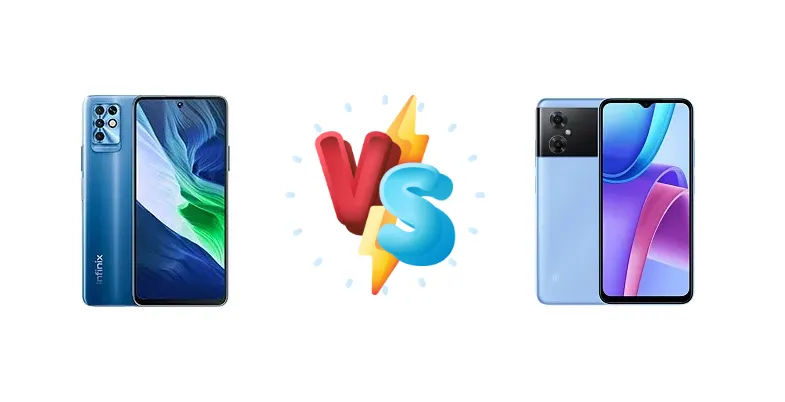
Both the Infinix Note 11i and Xiaomi Redmi Note 11R target the competitive sub-$200 smartphone market. While both offer similar feature sets – large displays, multiple cameras, and long-lasting batteries – they diverge significantly in their core processing power, making one a better choice for performance-minded users.
🏆 Quick Verdict
For the average user prioritizing everyday tasks, the Infinix Note 11i offers a solid experience. However, the Xiaomi Redmi Note 11R emerges as the winner, thanks to its more efficient Dimensity 700 chipset, which provides a tangible boost in performance and future-proofing for gaming and demanding applications.
| Network |
|---|
| 2G bands | GSM 850 / 900 / 1800 / 1900 | GSM 850 / 900 / 1800 / 1900 |
| 3G bands | HSDPA 900 / 2100 | HSDPA 850 / 900 / 1900 / 2100 |
| 4G bands | 1, 3, 7, 8, 20, 28 | 1, 3, 5, 7, 8, 34, 38, 39, 40, 41 |
| 5G bands | - | 1, 5, 8, 28, 41, 78 |
| Speed | HSPA, LTE | HSPA, LTE, 5G |
| Technology | GSM / HSPA / LTE | GSM / CDMA / HSPA / LTE / 5G |
| | - | CDMA 800 |
| Launch |
|---|
| Announced | 2021, November 15 | 2022, September 30 |
| Status | Available. Released 2021, November 15 | Available. Released 2022, September 30 |
| Body |
|---|
| Build | Glass front, plastic frame, plastic back | Glass front, plastic frame, plastic back |
| Dimensions | 173.2 x 78.7 x 8.8 mm (6.82 x 3.10 x 0.35 in) | 164 x 76.1 x 8.9 mm (6.46 x 3.00 x 0.35 in) |
| SIM | Nano-SIM + Nano-SIM | Nano-SIM + Nano-SIM |
| Weight | - | 201 g (7.09 oz) |
| Display |
|---|
| Resolution | 1080 x 2460 pixels (~387 ppi density) | 1080 x 2408 pixels, 20:9 ratio (~401 ppi density) |
| Size | 6.95 inches, 114.7 cm2 (~84.2% screen-to-body ratio) | 6.58 inches, 104.3 cm2 (~83.6% screen-to-body ratio) |
| Type | IPS LCD | IPS LCD, 90Hz, 400 nits (typ) |
| Platform |
|---|
| CPU | Octa-core (2x2.0 GHz Cortex-A75 & 6x1.8 GHz Cortex-A55) | Octa-core (2x2.2 GHz Cortex-A76 & 6x2.0 GHz Cortex-A55) |
| Chipset | Mediatek MT6769Z Helio G85 (12 nm) | Mediatek Dimensity 700 (7 nm) |
| GPU | Mali-G52 MC2 | Mali-G57 MC2 |
| OS | Android 11, XOS 7.6 | Android 12, MIUI 13 |
| Memory |
|---|
| Card slot | microSDXC (dedicated slot) | microSDXC (dedicated slot) |
| Internal | 64GB 4GB RAM | 128GB 4GB RAM, 128GB 6GB RAM, 128GB 8GB RAM |
| | eMMC 5.1 | UFS 2.2 |
| Main Camera |
|---|
| Dual | - | 13 MP, f/2.2, (wide), PDAF
Auxiliary lens |
| Features | Quad-LED flash, HDR, panorama | LED flash, HDR, panorama |
| Single | 16 MP | - |
| Triple | 48 MP, f/1.8, PDAF
2 MP (macro)
Auxiliary lens | - |
| Video | 1440p@30fps, 1080p@30fps | 1080p@30fps |
| Selfie camera |
|---|
| Features | - | HDR |
| Single | 16 MP | 5 MP, f/2.2, (wide) |
| Video | 1080p@30fps | 1080p@30fps |
| Sound |
|---|
| 3.5mm jack | Yes | Yes |
| 35mm jack | Yes | Yes |
| Loudspeaker | Yes, with dual speakers | Yes |
| | - | 24-bit/192kHz audio |
| Comms |
|---|
| Bluetooth | Yes | 5.1, A2DP, LE |
| Infrared port | - | Yes |
| NFC | No | No |
| Positioning | GPS | GPS, GLONASS, GALILEO, BDS |
| Radio | FM radio | No |
| USB | USB Type-C 2.0, OTG | USB Type-C 2.0, OTG |
| WLAN | Wi-Fi 802.11 a/b/g/n/ac, dual-band | Wi-Fi 802.11 a/b/g/n/ac, dual-band, Wi-Fi Direct |
| Features |
|---|
| Sensors | Fingerprint (side-mounted), accelerometer, gyro, proximity, compass | Fingerprint (side-mounted), accelerometer, proximity, compass |
| Battery |
|---|
| Charging | 18W wired | 18W wired |
| Type | 5000 mAh | Li-Po 5000 mAh |
| Misc |
|---|
| Colors | Black, Blue, Green | Black, Blue, Gray |
| Models | - | 22095RA98C |
| Price | About 140 EUR | About 160 EUR |
Infinix Note 11i
- Potentially lower price point
- Adequate for basic smartphone tasks
- Likely similar battery life with light usage
- Inferior chipset performance (Helio G85)
- Less efficient power consumption
- May struggle with demanding games
Xiaomi Redmi Note 11R
- Superior chipset performance (Dimensity 700)
- More efficient power consumption
- Better gaming and multitasking capabilities
- Potentially slightly higher price
- Similar camera performance to Note 11i in ideal conditions
- 18W charging isn't particularly fast
Display Comparison
Neither device boasts a standout display. Both likely utilize IPS LCD panels, a common choice in this price bracket. The key difference lies under the hood: display driver efficiency. While specific brightness nits aren't provided, the Redmi Note 11R's Dimensity 700 likely allows for more efficient display power management, potentially leading to slightly better battery life during prolonged screen-on time. Bezels are expected to be comparable, and color accuracy will likely be standard for the segment – adequate, but not color-critical.
Camera Comparison
Without detailed sensor information, a direct camera comparison is difficult. However, the Redmi Note 11R likely benefits from the more powerful ISP (Image Signal Processor) integrated within the Dimensity 700 chipset. This allows for faster image processing, better noise reduction, and improved dynamic range. While both phones likely feature a primary camera and multiple auxiliary lenses (often including a 2MP macro), the Redmi’s ISP will likely extract more detail and clarity from the main sensor. Expect similar performance in good lighting conditions, but the Redmi will pull ahead in low-light scenarios.
Performance
The performance gap is the defining characteristic of this comparison. The Xiaomi Redmi Note 11R’s Mediatek Dimensity 700 (7nm) significantly outperforms the Infinix Note 11i’s Mediatek Helio G85 (12nm). The 7nm process node is inherently more efficient, generating less heat and allowing for sustained performance. Furthermore, the Dimensity 700 utilizes Cortex-A76 cores clocked at 2.2 GHz, compared to the Helio G85’s Cortex-A75 cores at 2.0 GHz. This translates to a noticeable improvement in app launch times, smoother multitasking, and a more enjoyable gaming experience. The Redmi Note 11R will handle graphically intensive games at higher settings with less stuttering.
Battery Life
Both devices feature 18W wired charging, suggesting similar charging speeds – approximately 2-3 hours for a full charge. While battery capacity isn't specified, the Dimensity 700’s superior power efficiency in the Redmi Note 11R will likely result in longer real-world battery life. The 7nm process allows the phone to accomplish the same tasks using less power, offsetting any potential capacity difference. Users who frequently game or use demanding apps will see a more significant benefit from the Redmi’s efficiency.
Buying Guide
Buy the Infinix Note 11i if you prioritize a slightly lower initial cost and primarily use your phone for basic tasks like calling, texting, social media, and light web browsing. Buy the Xiaomi Redmi Note 11R if you value smoother multitasking, better gaming performance, and a more responsive user experience, even if it means spending a bit more upfront.
Frequently Asked Questions
❓ Will the Redmi Note 11R's Dimensity 700 handle popular games like PUBG Mobile and Call of Duty Mobile smoothly?
Yes, the Dimensity 700 is capable of running PUBG Mobile and Call of Duty Mobile at medium to high settings with stable frame rates. While it won't deliver a flagship-level gaming experience, it provides a significantly smoother and more enjoyable experience compared to the Helio G85 in the Infinix Note 11i.
❓ Is the 18W charging on both phones considered fast charging in 2024?
No, 18W charging is relatively slow by 2024 standards. While it will adequately charge the phones overnight, it will take approximately 2-3 hours to fully charge from 0 to 100%. Faster charging technologies (33W or higher) are becoming increasingly common in this price segment.
❓ How does the difference in CPU architecture (Cortex-A75 vs Cortex-A76) impact real-world performance?
The Cortex-A76 cores in the Redmi Note 11R are a generation newer and more efficient than the Cortex-A75 cores in the Infinix Note 11i. This translates to better single-core performance, which is crucial for responsive app launches and smoother overall system operation. The A76 also handles instruction processing more efficiently, contributing to the overall performance advantage.