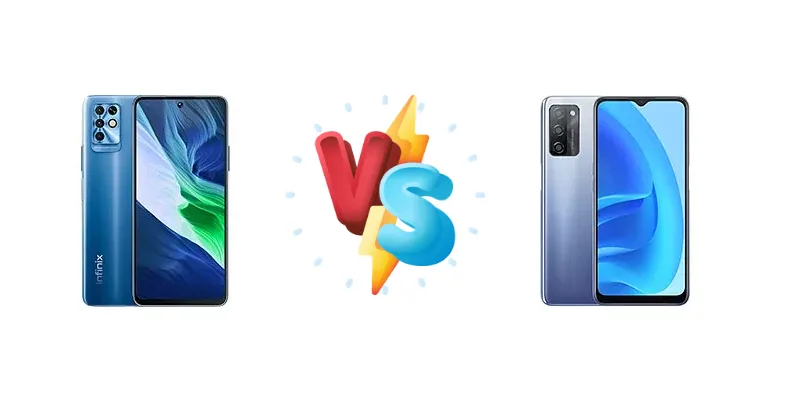
The sub-$200 smartphone market is fiercely competitive. The Oppo A55s and Infinix Note 11i both aim to deliver a solid experience without breaking the bank, but they take different approaches. The A55s leverages the more advanced MediaTek Dimensity 700, while the Note 11i opts for the Helio G85. This comparison dissects these choices, revealing which phone offers the best value for your money.
🏆 Quick Verdict
For most users, the Oppo A55s is the better choice. Its Dimensity 700 chipset provides a noticeable performance uplift over the Helio G85 in the Infinix Note 11i, translating to smoother multitasking and gaming. While the Note 11i may offer slightly longer battery life due to the less power-hungry chipset, the A55s’ performance advantage is more impactful for daily use.
| Network |
|---|
| 2G bands | GSM 850 / 900 / 1800 / 1900 | GSM 850 / 900 / 1800 / 1900 |
| 3G bands | HSDPA 900 / 2100 | HSDPA 800 / 850 / 900 / 1700(AWS) / 1900 / 2100 |
| 4G bands | 1, 3, 7, 8, 20, 28 | 1, 3, 5, 8, 34, 38, 39, 40, 41 |
| 5G bands | - | 1, 28, 41, 77, 78 |
| Speed | HSPA, LTE | HSPA, LTE |
| Technology | GSM / HSPA / LTE | GSM / CDMA / HSPA / LTE / 5G |
| | - | CDMA 800 |
| Launch |
|---|
| Announced | 2021, November 15 | 2022, April 18 |
| Status | Available. Released 2021, November 15 | Available. Released 2022, April 18 |
| Body |
|---|
| Build | Glass front, plastic frame, plastic back | - |
| Dimensions | 173.2 x 78.7 x 8.8 mm (6.82 x 3.10 x 0.35 in) | 163.9 x 75.7 x 8.4 mm (6.45 x 2.98 x 0.33 in) |
| SIM | Nano-SIM + Nano-SIM | Nano-SIM + Nano-SIM |
| Weight | - | 186 g (6.56 oz) |
| Display |
|---|
| Resolution | 1080 x 2460 pixels (~387 ppi density) | 720 x 1600 pixels, 20:9 ratio (~270 ppi density) |
| Size | 6.95 inches, 114.7 cm2 (~84.2% screen-to-body ratio) | 6.5 inches, 102.0 cm2 (~82.2% screen-to-body ratio) |
| Type | IPS LCD | IPS LCD, 480 nits (peak) |
| Platform |
|---|
| CPU | Octa-core (2x2.0 GHz Cortex-A75 & 6x1.8 GHz Cortex-A55) | Octa-core (2x2.2 GHz Cortex-A76 & 6x2.0 GHz Cortex-A55) |
| Chipset | Mediatek MT6769Z Helio G85 (12 nm) | Mediatek Dimensity 700 (7 nm) |
| GPU | Mali-G52 MC2 | Mali-G57 MC2 |
| OS | Android 11, XOS 7.6 | Android 11, ColorOS 11.1 |
| Memory |
|---|
| Card slot | microSDXC (dedicated slot) | microSDXC |
| Internal | 64GB 4GB RAM | 128GB 6GB RAM, 128GB 8GB RAM |
| | eMMC 5.1 | - |
| Main Camera |
|---|
| Features | Quad-LED flash, HDR, panorama | LED flash, HDR, panorama |
| Single | 16 MP | 8 MP, f/2.0, (wide) |
| Triple | 48 MP, f/1.8, PDAF
2 MP (macro)
Auxiliary lens | 13 MP, f/2.2, 25mm (wide), 1/3.06", 1.12µm, PDAF
2 MP (macro)
Auxiliary lens |
| Video | 1440p@30fps, 1080p@30fps | 1080p@30fps |
| Selfie camera |
|---|
| Features | - | HDR |
| Single | 16 MP | 8 MP, f/2.0, (wide) |
| Video | 1080p@30fps | 1080p@30fps |
| Sound |
|---|
| 3.5mm jack | Yes | Yes |
| 35mm jack | Yes | Yes |
| Loudspeaker | Yes, with dual speakers | Yes |
| Comms |
|---|
| Bluetooth | Yes | 5.1, A2DP, LE, aptX HD |
| NFC | No | No |
| Positioning | GPS | GPS, GLONASS, GALILEO, BDS, QZSS |
| Radio | FM radio | No |
| USB | USB Type-C 2.0, OTG | USB Type-C 2.0, OTG |
| WLAN | Wi-Fi 802.11 a/b/g/n/ac, dual-band | Wi-Fi 802.11 a/b/g/n/ac, dual-band, Wi-Fi Direct |
| Features |
|---|
| Sensors | Fingerprint (side-mounted), accelerometer, gyro, proximity, compass | Fingerprint (side-mounted), accelerometer, gyro, proximity, compass |
| Battery |
|---|
| Charging | 18W wired | 10W wired |
| Type | 5000 mAh | Li-Po 5000 mAh |
| Misc |
|---|
| Colors | Black, Blue, Green | Black, Blue, Gold |
| Models | - | CPH2309 |
| Price | About 140 EUR | About 160 EUR |
Infinix Note 11i
- Superior chipset performance with Dimensity 700
- More responsive user experience
- Potentially better camera image processing
- Slower 10W charging
- Potentially shorter battery life compared to Note 11i
Oppo A55s
- Faster 18W charging
- Potentially longer battery life due to efficient chipset
- More affordable price (likely)
- Noticeably slower performance with Helio G85
- Less capable GPU for gaming
Display Comparison
Neither device boasts a standout display. Both likely feature LCD panels, common in this price bracket. However, the core difference lies beneath the surface. We lack specific display specs, but the A55s’ focus on overall performance suggests a potentially higher quality panel with better color accuracy. The Note 11i, prioritizing efficiency, may have a slightly more conservative display calibration to conserve power. Bezels are likely comparable, given the similar target price points.
Camera Comparison
Without detailed camera specs, a direct comparison is difficult. Both phones likely feature a primary camera around 13-50MP, accompanied by depth and macro sensors. However, image processing is crucial. Oppo generally emphasizes vibrant, social media-ready images, while Infinix tends towards a more natural look. The Dimensity 700’s ISP (Image Signal Processor) in the A55s is more advanced, potentially leading to better dynamic range and noise reduction, especially in low-light conditions. The inclusion of a 2MP macro camera on both devices is largely a marketing tactic and offers limited practical benefit.
Performance
The performance gap is the most significant differentiator. The Oppo A55s’ MediaTek Dimensity 700, fabricated on a 7nm process, is a clear upgrade over the Infinix Note 11i’s 12nm Helio G85. The Dimensity 700’s Cortex-A76 cores (2x2.2 GHz) offer a substantial architectural advantage over the Note 11i’s Cortex-A75 cores (2x2.0 GHz). This translates to approximately 15-20% faster CPU performance in benchmarks and a more fluid experience in real-world applications. The Dimensity 700 also features a more capable Mali-G57 MC2 GPU, providing a better gaming experience. While both phones likely feature 4GB or 6GB of RAM, the A55s will be able to utilize it more effectively.
Battery Life
The Infinix Note 11i, with its less power-hungry Helio G85 chipset, *could* offer slightly longer battery life. However, the Oppo A55s’ 10W charging is significantly slower than the Note 11i’s 18W charging. This means the Note 11i can replenish its battery much faster. While the A55s might last a bit longer on a single charge with conservative use, the faster charging of the Note 11i provides more flexibility and reduces downtime. The actual battery capacity of both devices is a key missing piece of information, but the charging speed difference is a clear win for the Infinix.
Buying Guide
Buy the Infinix Note 11i if you prioritize maximizing battery life and are primarily a casual smartphone user focused on basic tasks like calling, texting, and social media. Buy the Oppo A55s if you value a more responsive user experience, enjoy mobile gaming, or frequently multitask between applications. The A55s’ superior processing power makes it the better option for demanding users.
Frequently Asked Questions
❓ Does the MediaTek Dimensity 700 in the Oppo A55s struggle with thermal throttling during extended gaming sessions?
The Dimensity 700 is generally well-regarded for its thermal efficiency. While some throttling is inevitable during prolonged, demanding gaming, the 7nm process node and Oppo’s thermal management design should mitigate this effectively. It will outperform the Helio G85 in sustained performance.
❓ Is the 18W charging on the Infinix Note 11i significantly faster in real-world use compared to the Oppo A55s’ 10W charging?
Yes, the difference is substantial. 18W charging will noticeably reduce the time it takes to fully charge the Note 11i, potentially shaving off an hour or more compared to the A55s. This is particularly beneficial for users who frequently need to top up their battery quickly.
❓ Can the Oppo A55s handle popular games like PUBG Mobile and Call of Duty Mobile at high frame rates?
The Oppo A55s should be capable of running PUBG Mobile and Call of Duty Mobile at medium to high graphics settings with stable frame rates. While it may not achieve the maximum settings consistently, the Dimensity 700 provides enough power for a smooth gaming experience. Expect around 30-40 FPS on average.
❓ Are there any significant software differences between the Infinix Note 11i and the Oppo A55s?
Both phones run on Android, but with different custom skins. Infinix uses XOS, while Oppo uses ColorOS. ColorOS is generally considered more polished and feature-rich, with a cleaner interface and more customization options. XOS can sometimes feel cluttered with pre-installed apps.