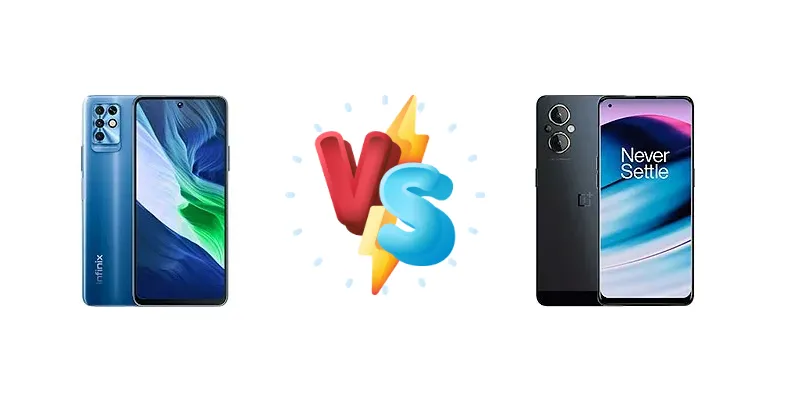
The sub-$300 5G smartphone market is fiercely competitive. The Infinix Note 11i and OnePlus Nord N20 5G both aim to deliver 5G connectivity and a solid smartphone experience without breaking the bank. However, they take different approaches, with the Nord N20 5G leveraging Qualcomm’s Snapdragon 695 while the Note 11i relies on MediaTek’s Helio G85. This comparison dissects their key differences to help you choose the right device.
🏆 Quick Verdict
For most users, the OnePlus Nord N20 5G emerges as the better choice. Its more efficient Snapdragon 695 chipset, coupled with faster 33W charging and a brighter display, provides a smoother and more enjoyable experience despite sharing the same endurance rating as the Note 11i. The Note 11i remains a viable option for those prioritizing absolute lowest cost.
| Network |
|---|
| 2G bands | GSM 850 / 900 / 1800 / 1900 | GSM 850 / 900 / 1800 / 1900 |
| 3G bands | HSDPA 900 / 2100 | HSDPA 850 / 900 / 1700(AWS) / 1900 / 2100 |
| 4G bands | 1, 3, 7, 8, 20, 28 | 1, 2, 3, 4, 5, 7, 8, 12, 13, 17, 20, 25, 26, 28, 38, 39, 40, 41, 66, 71 |
| 5G bands | - | 2, 25, 41, 66, 71 SA/NSA |
| Speed | HSPA, LTE | HSPA 42.2/5.76 Mbps, LTE Cat15 800/200 Mbps, 5G |
| Technology | GSM / HSPA / LTE | GSM / HSPA / LTE / 5G |
| Launch |
|---|
| Announced | 2021, November 15 | 2022, April 28 |
| Status | Available. Released 2021, November 15 | Available. Released 2022, April 28 |
| Body |
|---|
| Build | Glass front, plastic frame, plastic back | Glass front (Schott Xensation Up), plastic frame, plastic back |
| Dimensions | 173.2 x 78.7 x 8.8 mm (6.82 x 3.10 x 0.35 in) | 159.9 x 73.2 x 7.5 mm (6.30 x 2.88 x 0.30 in) |
| SIM | Nano-SIM + Nano-SIM | Nano-SIM |
| Weight | - | 173 g (6.10 oz) |
| Display |
|---|
| Protection | - | Schott Xensation Up |
| Resolution | 1080 x 2460 pixels (~387 ppi density) | 1080 x 2400 pixels, 20:9 ratio (~409 ppi density) |
| Size | 6.95 inches, 114.7 cm2 (~84.2% screen-to-body ratio) | 6.43 inches, 99.8 cm2 (~85.3% screen-to-body ratio) |
| Type | IPS LCD | AMOLED |
| | - | Always-on display |
| Platform |
|---|
| CPU | Octa-core (2x2.0 GHz Cortex-A75 & 6x1.8 GHz Cortex-A55) | Octa-core (2x2.2 GHz Kryo 660 Gold & 6x1.7 GHz Kryo 660 Silver) |
| Chipset | Mediatek MT6769Z Helio G85 (12 nm) | Qualcomm SM6375 Snapdragon 695 5G (6 nm) |
| GPU | Mali-G52 MC2 | Adreno 619 |
| OS | Android 11, XOS 7.6 | Android 11, OxygenOS 11 |
| Memory |
|---|
| Card slot | microSDXC (dedicated slot) | microSDXC (dedicated slot) |
| Internal | 64GB 4GB RAM | 128GB 6GB RAM |
| | eMMC 5.1 | UFS 2.2 |
| Main Camera |
|---|
| Features | Quad-LED flash, HDR, panorama | LED flash, HDR, panorama |
| Single | 16 MP | 16 MP, f/2.4, (wide) |
| Triple | 48 MP, f/1.8, PDAF
2 MP (macro)
Auxiliary lens | 64 MP, f/1.8, (wide), PDAF
2 MP (macro)
Auxiliary lens |
| Video | 1440p@30fps, 1080p@30fps | 1080p@30fps |
| Selfie camera |
|---|
| Features | - | HDR |
| Single | 16 MP | 16 MP, f/2.4, (wide) |
| Video | 1080p@30fps | 1080p@30fps |
| Sound |
|---|
| 3.5mm jack | Yes | Yes |
| 35mm jack | Yes | Yes |
| Loudspeaker | Yes, with dual speakers | Yes |
| Comms |
|---|
| Bluetooth | Yes | 5.1, A2DP, LE |
| NFC | No | Yes |
| Positioning | GPS | GPS (L1+L5), GLONASS, GALILEO, BDS |
| Radio | FM radio | No |
| USB | USB Type-C 2.0, OTG | USB Type-C 2.0, OTG |
| WLAN | Wi-Fi 802.11 a/b/g/n/ac, dual-band | Wi-Fi 802.11 a/b/g/n/ac, dual-band, Wi-Fi Direct |
| Features |
|---|
| Sensors | Fingerprint (side-mounted), accelerometer, gyro, proximity, compass | Fingerprint (under display, optical), accelerometer, gyro, proximity, compass, barometer |
| Battery |
|---|
| Charging | 18W wired | 33W wired |
| Type | 5000 mAh | Li-Po 4500 mAh |
| Misc |
|---|
| Colors | Black, Blue, Green | Blue |
| Models | - | GN2200, CPH2459 |
| Price | About 140 EUR | About 120 EUR |
| Tests |
|---|
| Battery life | - |
Endurance rating 129h
|
| Display | - |
Contrast ratio: Infinite (nominal) |
| Performance | - |
AnTuTu: 316974 (v8), 380672 (v9)
GeekBench: 1945 (v5.1)
GFXBench: 16fps (ES 3.1 onscreen) |
Infinix Note 11i
- Lower price point makes it accessible.
- Functional 5G connectivity.
- Decent battery endurance.
- Less powerful processor.
- Slower charging speed.
- Likely lower display brightness.
OnePlus Nord N20 5G
- More efficient Snapdragon 695 chipset.
- Faster 33W charging.
- Brighter display for better visibility.
- Slightly higher price.
- May not offer significantly longer battery life despite efficiency gains.
- Software update support may be limited.
Display Comparison
The OnePlus Nord N20 5G boasts a significantly brighter display, reaching a measured 647 nits, compared to an unspecified brightness for the Infinix Note 11i. This translates to better outdoor visibility. While both displays are described as having an 'infinite' contrast ratio (typical for OLED/AMOLED panels), the higher peak brightness of the Nord N20 5G is a tangible advantage. The absence of refresh rate information for the Note 11i suggests it likely operates at a standard 60Hz, while the Nord N20 5G’s panel is likely optimized for smooth scrolling and animations.
Camera Comparison
Without detailed camera specs beyond the main sensors, a direct comparison is difficult. However, the Snapdragon 695 typically offers superior image signal processing (ISP) capabilities compared to the Helio G85. This means the Nord N20 5G is likely to produce better-quality photos, especially in challenging lighting conditions. The absence of OIS information for both devices suggests neither prioritizes optical image stabilization, relying instead on software-based stabilization. The usefulness of any secondary cameras (often 2MP macro/depth sensors) on either device is questionable.
Performance
The core difference lies in the chipsets. The OnePlus Nord N20 5G’s Qualcomm Snapdragon 695 (6nm) is built on a more advanced manufacturing process than the MediaTek Helio G85 (12nm) in the Infinix Note 11i. This 6nm process yields better power efficiency and thermal performance. The Snapdragon 695 features Kryo 660 Gold cores clocked at 2.2 GHz, outperforming the Helio G85’s 2.0 GHz Cortex-A75 cores. While both are octa-core CPUs, the Snapdragon 695’s architecture and process node provide a clear performance advantage, particularly in sustained workloads and gaming. The Note 11i will handle everyday tasks, but the Nord N20 5G will feel snappier and more responsive.
Battery Life
Both phones share an endurance rating of 129 hours, suggesting similar real-world battery life despite the difference in chipset efficiency. However, the OnePlus Nord N20 5G’s 33W wired charging is significantly faster than the Infinix Note 11i’s 18W charging. This translates to a much quicker 0-100% charge time, reducing downtime. While the Note 11i might offer comparable battery longevity, the Nord N20 5G’s faster charging is a significant convenience factor.
Buying Guide
Buy the Infinix Note 11i if you need a functional 5G smartphone on the absolute tightest budget and aren't concerned with peak performance or display quality. Buy the OnePlus Nord N20 5G if you prefer a more refined experience with a brighter screen, faster charging, and a more modern, efficient processor that will likely offer better long-term software support.
Frequently Asked Questions
❓ Will the Helio G85 in the Infinix Note 11i struggle with demanding games like PUBG or Call of Duty?
The Helio G85 can run PUBG and Call of Duty, but you'll likely need to lower graphics settings to achieve a smooth frame rate. The Snapdragon 695 in the Nord N20 5G offers a more comfortable gaming experience with higher settings and more consistent performance.
❓ How long does it *actually* take to fully charge the Infinix Note 11i with its 18W charger?
Expect a full charge from 0-100% on the Infinix Note 11i to take around 2.5 to 3 hours with the included 18W charger. The OnePlus Nord N20 5G’s 33W charging significantly reduces this time, typically completing a full charge in around 1 hour and 15 minutes.
❓ Does the OnePlus Nord N20 5G support carrier aggregation for improved 5G speeds?
Yes, the Snapdragon 695 supports carrier aggregation, which allows the phone to combine multiple 5G channels for faster and more reliable data speeds, provided your carrier supports it. The Note 11i's 5G capabilities are less well-defined, and may not offer the same level of aggregation support.