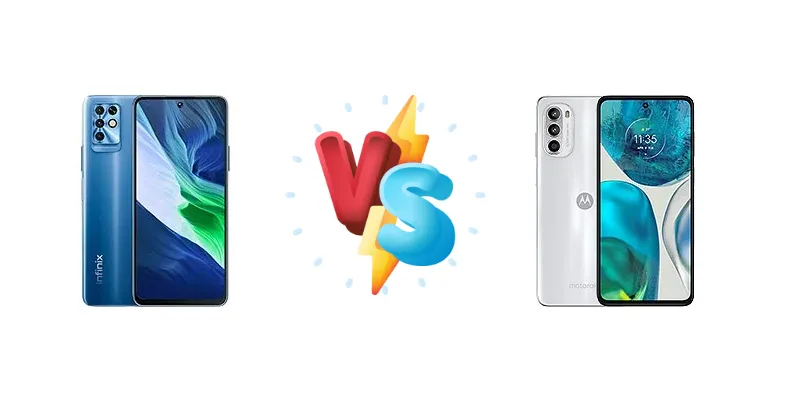
The sub-$200 smartphone market is fiercely competitive. The Infinix Note 11i and Motorola Moto G52 both aim to deliver a compelling experience without breaking the bank, but they take different approaches. The Note 11i prioritizes raw processing power with its Helio G85, while the Moto G52 focuses on efficiency and faster charging with the Snapdragon 680. This comparison dives deep into the specifics to determine which phone offers the best value.
🏆 Quick Verdict
For the average user prioritizing all-day battery life and quicker charging, the Motorola Moto G52 is the better choice. Its Snapdragon 680, built on a more efficient 6nm process, provides adequate performance while the 30W charging significantly reduces downtime. While the Infinix Note 11i offers a slightly more powerful CPU, the G52’s efficiency and charging speed are more impactful in daily use.
| Network |
|---|
| 2G bands | GSM 850 / 900 / 1800 / 1900 | GSM 850 / 900 / 1800 / 1900 |
| 3G bands | HSDPA 900 / 2100 | HSDPA 850 / 900 / 1700(AWS) / 1900 / 2100 |
| 4G bands | 1, 3, 7, 8, 20, 28 | LTE |
| Speed | HSPA, LTE | HSPA, LTE |
| Technology | GSM / HSPA / LTE | GSM / HSPA / LTE |
| Launch |
|---|
| Announced | 2021, November 15 | 2022, April 12 |
| Status | Available. Released 2021, November 15 | Available. Released 2022, April 20 |
| Body |
|---|
| Build | Glass front, plastic frame, plastic back | - |
| Dimensions | 173.2 x 78.7 x 8.8 mm (6.82 x 3.10 x 0.35 in) | 160.1 x 74.5 x 8 mm (6.30 x 2.93 x 0.31 in) |
| SIM | Nano-SIM + Nano-SIM | Nano-SIM + Nano-SIM |
| Weight | - | 169 g (5.96 oz) |
| | - | Water-repellent design |
| Display |
|---|
| Resolution | 1080 x 2460 pixels (~387 ppi density) | 1080 x 2400 pixels, 20:9 ratio (~402 ppi density) |
| Size | 6.95 inches, 114.7 cm2 (~84.2% screen-to-body ratio) | 6.6 inches, 103.6 cm2 (~86.9% screen-to-body ratio) |
| Type | IPS LCD | AMOLED, 90Hz |
| Platform |
|---|
| CPU | Octa-core (2x2.0 GHz Cortex-A75 & 6x1.8 GHz Cortex-A55) | Octa-core (4x2.4 GHz Kryo 265 Gold & 4x1.9 GHz Kryo 265 Silver) |
| Chipset | Mediatek MT6769Z Helio G85 (12 nm) | Qualcomm SM6225 Snapdragon 680 4G (6 nm) |
| GPU | Mali-G52 MC2 | Adreno 610 |
| OS | Android 11, XOS 7.6 | Android 12, planned upgrade to Android 13 |
| Memory |
|---|
| Card slot | microSDXC (dedicated slot) | microSDXC (uses shared SIM slot) |
| Internal | 64GB 4GB RAM | 64GB 4GB RAM, 128GB 4GB RAM, 128GB 6GB RAM, 256GB 6GB RAM |
| | eMMC 5.1 | - |
| Main Camera |
|---|
| Features | Quad-LED flash, HDR, panorama | LED flash, HDR, panorama |
| Single | 16 MP | - |
| Triple | 48 MP, f/1.8, PDAF
2 MP (macro)
Auxiliary lens | 50 MP, f/1.8 (wide), 1/2.76", 0.64µm, PDAF
8 MP, f/2.2, 118˚ (ultrawide), 1/4.0", 1.12µm
2 MP (macro) |
| Video | 1440p@30fps, 1080p@30fps | 1080p@30fps |
| Selfie camera |
|---|
| Single | 16 MP | 16 MP, f/2.5, (wide), 1.0µm |
| Video | 1080p@30fps | 1080p@30fps |
| Sound |
|---|
| 3.5mm jack | Yes | Yes |
| 35mm jack | Yes | Yes |
| Loudspeaker | Yes, with dual speakers | Yes, with stereo speakers |
| Comms |
|---|
| Bluetooth | Yes | 5.0, A2DP, LE |
| NFC | No | Yes (market/region dependent) |
| Positioning | GPS | GPS, GLONASS, GALILEO |
| Radio | FM radio | Unspecified |
| USB | USB Type-C 2.0, OTG | USB Type-C 2.0 |
| WLAN | Wi-Fi 802.11 a/b/g/n/ac, dual-band | Wi-Fi 802.11 a/b/g/n/ac, dual-band, Wi-Fi Direct |
| Features |
|---|
| Sensors | Fingerprint (side-mounted), accelerometer, gyro, proximity, compass | Fingerprint (side-mounted), accelerometer, gyro, proximity, compass |
| Battery |
|---|
| Charging | 18W wired | 30W wired |
| Type | 5000 mAh | Li-Po 5000 mAh |
| Misc |
|---|
| Colors | Black, Blue, Green | Charcoal Gray, Porcelain White |
| Models | - | XT2221-1, XT2221-2 |
| Price | About 140 EUR | About 470 EUR |
Infinix Note 11i
- Potentially higher peak CPU performance for demanding tasks.
- May offer a slightly more aggressive gaming experience.
- Competitive price point.
- Less power-efficient chipset (12nm process).
- Slower 18W charging.
- Potential for more thermal throttling under sustained load.
Motorola Moto G52
- More power-efficient chipset (6nm process).
- Faster 30W wired charging.
- Likely better sustained performance due to thermal efficiency.
- Slightly lower peak CPU clock speed.
- May not be ideal for hardcore gamers.
- Potentially higher price compared to the Note 11i.
Display Comparison
Neither device boasts a flagship-level display. While specific display specs (resolution, brightness) are missing, the core difference lies in the chipsets powering them. Display quality will likely be similar, leaning towards adequate for the price point. Bezels are expected to be comparable, typical of this segment. Color accuracy will likely be standard, requiring calibration for professional use.
Camera Comparison
Without detailed camera specs beyond the chipsets, a direct comparison is limited. However, the Snapdragon 680 typically offers superior image signal processing (ISP) capabilities compared to the Helio G85. This translates to better dynamic range, noise reduction, and overall image quality, particularly in challenging lighting conditions. The absence of information regarding sensor sizes and apertures makes a definitive statement impossible, but Motorola’s image processing algorithms generally favor a more natural look, while Infinix tends towards more saturated colors.
Performance
The core battleground is the chipset. The Motorola Moto G52’s Qualcomm Snapdragon 680, fabricated on a 6nm process, offers a significant advantage in power efficiency compared to the Infinix Note 11i’s MediaTek Helio G85 (12nm). While the Helio G85’s Cortex-A75 cores reach 2.0 GHz, providing a theoretical CPU performance boost, the Snapdragon 680’s Kryo 265 Gold cores at 2.4 GHz, coupled with the more efficient node, translate to better sustained performance and less thermal throttling. This means the Moto G52 will likely maintain higher frame rates for longer during gaming. The 6nm process also contributes to lower power consumption, extending battery life.
Battery Life
The Motorola Moto G52’s 30W wired charging is a clear advantage over the Infinix Note 11i’s 18W charging. This faster charging speed significantly reduces the time spent tethered to a wall outlet. While battery capacity isn’t specified, the Snapdragon 680’s superior efficiency means the Moto G52 will likely deliver longer battery life on a single charge, even with a potentially smaller battery capacity. The 12nm Helio G85 in the Note 11i will consume more power, requiring more frequent charging.
Buying Guide
Buy the Infinix Note 11i if you frequently engage in graphically demanding tasks like mobile gaming and need the slight CPU performance edge. Its Helio G85 offers a higher clock speed for those intensive applications. Buy the Motorola Moto G52 if you prioritize battery life, fast charging, and a smoother, more consistent experience for everyday tasks like browsing, social media, and streaming. The Snapdragon 680’s efficiency and 30W charging make it ideal for users on the go.
Frequently Asked Questions
❓ Will the Snapdragon 680 in the Moto G52 struggle with graphically intensive games like PUBG Mobile?
While not a flagship gaming chip, the Snapdragon 680 is capable of running PUBG Mobile at medium settings with stable frame rates. The 6nm process helps prevent significant throttling, ensuring a playable experience. However, users seeking maximum graphical fidelity may need to lower settings.
❓ How long does it realistically take to fully charge the Infinix Note 11i with its 18W charging?
Expect a full charge from 0% to 100% on the Infinix Note 11i to take approximately 2.5 to 3 hours with the included 18W charger. This is significantly slower than the Moto G52’s 30W charging.
❓ Is the difference in CPU clock speed between the Helio G85 and Snapdragon 680 noticeable in everyday tasks?
For typical smartphone usage – browsing, social media, video streaming – the difference in CPU clock speed is unlikely to be noticeable. The Snapdragon 680’s efficiency and optimized architecture provide a smoother overall experience, even if it has a slightly lower peak clock speed.
❓ Does the Motorola Moto G52 support VoLTE and VoWiFi?
While not explicitly stated in the provided data, Motorola generally includes VoLTE (Voice over LTE) and VoWiFi (Voice over Wi-Fi) support in their smartphones, including the Moto G52, to ensure compatibility with modern networks. However, carrier support is also required.