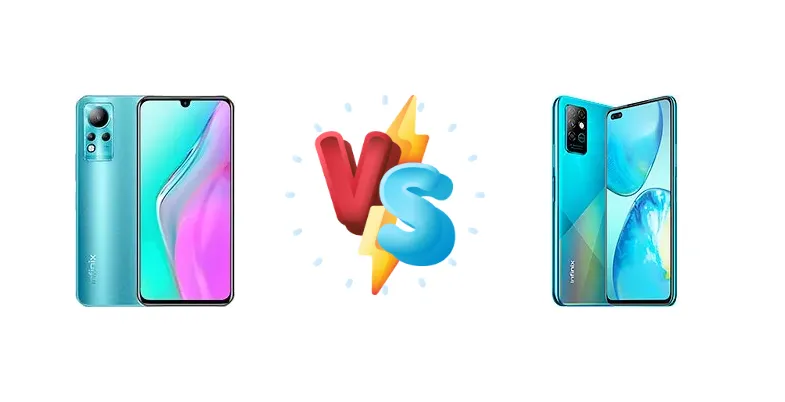
The Infinix Note series is known for offering impressive features at affordable prices. The Note 11 and Note 8 are both strong contenders in the budget smartphone market, but which one reigns supreme? Let's dive into a detailed comparison to help you decide.
🏆 Quick Verdict
The Infinix Note 11 takes the win thanks to its significantly faster charging, slightly improved chipset, and potentially better display. While the Note 8 remains a solid budget option, the Note 11 offers a noticeable upgrade for a reasonable price increase.
| Network |
|---|
| 2G bands | GSM 850 / 900 / 1800 / 1900 | GSM 850 / 900 / 1800 / 1900 |
| 3G bands | HSDPA 850 / 900 / 1700(AWS) / 1900 / 2100 | HSDPA 850 / 900 / 1700(AWS) / 1900 / 2100 |
| 4G bands | 1, 2, 3, 4, 5, 7, 8, 20, 28, 38, 41, 40 | 1, 2, 3, 4, 5, 7, 8, 20, 28, 38, 41 |
| Speed | HSPA, LTE | HSPA 42.2/5.76 Mbps, LTE Cat4 150/50 Mbps |
| Technology | GSM / HSPA / LTE | GSM / HSPA / LTE |
| | 1, 3, 7, 8, 20, 28 | 1, 3, 7, 8, 20, 28 |
| Launch |
|---|
| Announced | 2021, November 03 | 2020, October 15. Released 2020, November 04 |
| Status | Available. Released 2021, December 08 | Discontinued |
| Body |
|---|
| Build | Glass front, plastic frame, plastic back | - |
| Dimensions | 164.4 x 76.7 x 7.9 mm (6.47 x 3.02 x 0.31 in) | 175.3 x 78.8 x 9 mm (6.90 x 3.10 x 0.35 in) |
| SIM | Nano-SIM + Nano-SIM | Nano-SIM + Nano-SIM |
| Weight | 184 g (6.49 oz) | - |
| Display |
|---|
| Protection | - | Corning Gorilla Glass |
| Resolution | 1080 x 2400 pixels, 20:9 ratio (~393 ppi density) | 720 x 1640 pixels (~258 ppi density) |
| Size | 6.7 inches, 108.4 cm2 (~86.0% screen-to-body ratio) | 6.95 inches, 114.7 cm2 (~83.0% screen-to-body ratio) |
| Type | AMOLED, 650 nits (peak) | IPS LCD, 480 nits (peak) |
| Platform |
|---|
| CPU | Octa-core (2x2.0 GHz Cortex-A75 & 6x1.8 GHz Cortex-A55) | Octa-core (2x2.0 GHz Cortex-A75 & 6x1.8 GHz Cortex-A55) |
| Chipset | Mediatek MT6769H Helio G88 (12 nm) | Mediatek MT6769V/CU Helio G80 (12 nm) |
| GPU | Mali-G52 MC2 | Mali-G52 MC2 |
| OS | Android 11, XOS 10 | Android 10, XOS 7.1 |
| Memory |
|---|
| Card slot | microSDXC (dedicated slot) | microSDXC (dedicated slot) |
| Internal | 64GB 4GB RAM, 128GB 4GB RAM, 128GB 6GB RAM | 128GB 6GB RAM |
| Main Camera |
|---|
| Features | Quad-LED flash, HDR, panorama | Quad-LED flash, HDR, panorama |
| Quad | - | 64 MP, (wide), 1/1.73", 0.8µm, PDAF
2 MP (macro)
Auxiliary lenses |
| Single | 16 MP | - |
| Triple | 50 MP, f/1.6, (wide), PDAF
Auxiliary lenses | - |
| Video | 1440p@30fps | 1440p@30fps |
| Selfie camera |
|---|
| Dual | - | 16 MP
2 MP, (depth) |
| Features | - | Dual-LED flash |
| Single | 16 MP | - |
| Video | 1080p@30fps | 1080p@30fps |
| Sound |
|---|
| 3.5mm jack | Yes | Yes |
| 35mm jack | Yes | Yes |
| Loudspeaker | Yes, with dual speakers | Yes, with dual speakers |
| Comms |
|---|
| Bluetooth | Yes | 5.0, A2DP, LE |
| NFC | Yes (market/region dependent) | No |
| Positioning | GPS | GPS |
| Radio | FM radio | FM radio |
| USB | USB Type-C 2.0, OTG | USB Type-C 2.0, OTG |
| WLAN | Wi-Fi 802.11 a/b/g/n/ac, dual-band, Wi-Fi Direct | Wi-Fi 802.11 a/b/g/n/ac, dual-band, Wi-Fi Direct |
| Features |
|---|
| Sensors | Fingerprint (side-mounted), accelerometer, gyro, proximity, compass | Fingerprint (side-mounted), accelerometer, gyro, proximity, compass |
| Battery |
|---|
| Charging | 33W wired | 18W wired |
| Type | 5000 mAh | 5200 mAh |
| Misc |
|---|
| Colors | Celestial Snow, Glacier Green, Graphite Black | Gray, Blue, Green |
| Models | X663, X663B | X692, MZ-Infinix X692 |
| Price | About 100 EUR | About 200 EUR |
Infinix Note 11
- Faster 33W Charging
- Slightly Improved Chipset (Helio G88)
- Potentially Better Display
- Modern Design
- May be slightly more expensive than Note 8
- Performance still limited by budget chipset
Infinix Note 8
- More Affordable
- Decent Performance for Everyday Tasks
- Large Battery Capacity
- Good Value for Money
- Slower 18W Charging
- Older Chipset (Helio G80)
- Potentially Less Vibrant Display
- Image processing may not be as refined
Display Comparison
Both phones likely feature similar display technology (likely an IPS LCD) with a high refresh rate (likely 90Hz or 120Hz). The Note 11 *may* have slightly better color accuracy and brightness due to potential panel upgrades, but this is not definitively confirmed without detailed testing. Screen size is likely similar, around 6.6-6.7 inches.
Camera Comparison
Camera specs are likely similar, with a quad-camera setup on both devices. The Note 11 *might* have slightly improved image processing due to software updates or a marginally better main sensor. Both phones will likely offer decent image quality in good lighting conditions, but struggle in low light. Video recording capabilities will likely be comparable.
Performance
The Helio G88 in the Note 11 offers a modest performance boost over the Helio G80 in the Note 8. This translates to slightly faster app loading times, smoother multitasking, and potentially better gaming performance, although both are still firmly in the budget category. Expect both to handle everyday tasks without issue.
Battery Life
The Note 11's 33W charging is a significant advantage over the Note 8's 18W charging. This means the Note 11 will charge much faster, which is a major convenience. Battery capacity is likely similar (around 5000mAh) so battery life between the two should be comparable when in use.
Buying Guide
The Infinix Note 11 is ideal for users who prioritize fast charging, smoother performance for everyday tasks and light gaming, and a potentially better display experience. The Infinix Note 8 is a good choice for budget-conscious buyers who don't need the absolute latest features and are happy with a more standard charging speed.
Frequently Asked Questions
❓ Is the Infinix Note 11 worth the extra money compared to the Note 8?
If fast charging and slightly better performance are important to you, then yes. The Note 11's 33W charging is a significant upgrade. However, if you're on a very tight budget, the Note 8 remains a capable device.
❓ What kind of games can I play on these phones?
Both phones can handle casual games and less demanding titles. For more graphically intensive games, you'll need to lower the graphics settings to maintain a playable frame rate.