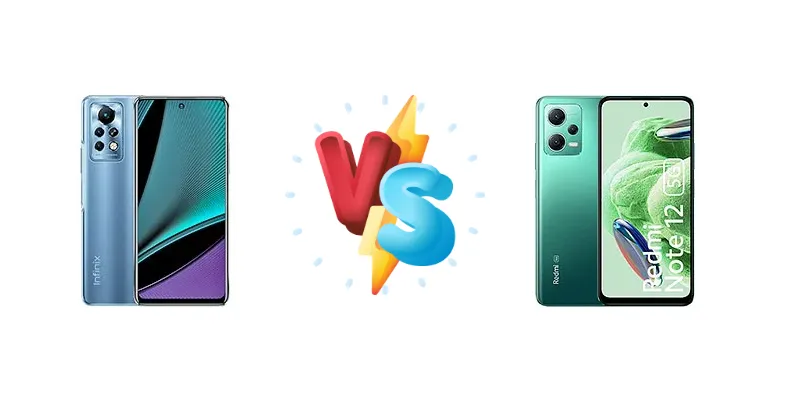
The mid-range smartphone market is fiercely competitive, and the Infinix Note 11 Pro and Xiaomi Redmi Note 12 are two strong contenders vying for your attention. Both offer compelling features at attractive price points, but which one truly comes out on top? Let's dive into a comprehensive comparison to help you decide.
🏆 Quick Verdict
The Xiaomi Redmi Note 12 edges out the Infinix Note 11 Pro thanks to its brighter display, more modern chipset, and faster charging. While the Infinix boasts impressive battery endurance on paper, the Redmi Note 12 offers a more well-rounded and refined experience overall.
| Network |
|---|
| 2G bands | GSM 850 / 900 / 1800 / 1900 | GSM 850 / 900 / 1800 / 1900 |
| 3G bands | HSDPA 850 / 900 / 1700(AWS) / 1900 / 2100 | HSDPA 850 / 900 / 2100 |
| 4G bands | 1, 2, 3, 4, 5, 7, 8, 20, 28, 38, 41, 40 | 1, 3, 5, 8, 40, 41 |
| 5G bands | - | 1, 3, 5, 8, 28, 40, 78 SA/NSA |
| Speed | HSPA, LTE | HSPA, LTE, 5G |
| Technology | GSM / HSPA / LTE | GSM / HSPA / LTE / 5G |
| | 1, 3, 7, 8, 20, 28 | - |
| Launch |
|---|
| Announced | 2021, October 12 | 2022, October 27 |
| Status | Available. Released 2021, November 19 | Available. Released 2023, January 11 |
| Body |
|---|
| Build | Glass front, plastic frame, plastic back | - |
| Dimensions | 173.1 x 78.4 x 8.7 mm (6.81 x 3.09 x 0.34 in) | 165.9 x 76.2 x 8 mm (6.53 x 3.00 x 0.31 in) |
| SIM | Nano-SIM + Nano-SIM | Nano-SIM + Nano-SIM |
| Weight | 209 (7.37 oz) | 188 g (6.63 oz) |
| | - | IP53, dust and splash resistant |
| Display |
|---|
| Protection | - | Corning Gorilla Glass 3 |
| Resolution | 1080 x 2460 pixels (~387 ppi density) | 1080 x 2400 pixels, 20:9 ratio (~395 ppi density) |
| Size | 6.95 inches, 114.7 cm2 (~84.5% screen-to-body ratio) | 6.67 inches, 107.4 cm2 (~85.0% screen-to-body ratio) |
| Type | IPS LCD, 120Hz | AMOLED, 120Hz, 1200 nits (peak) |
| Platform |
|---|
| CPU | Octa-core (2x2.05 GHz Cortex-A76 & 6x2.0 GHz Cortex-A55) | Octa-core (2x2.0 GHz Cortex-A78 & 6x1.8 GHz Cortex-A55) |
| Chipset | Mediatek MT6781 Helio G96 (12 nm) | Qualcomm SM4375 Snapdragon 4 Gen 1 (6 nm) |
| GPU | Mali-G57 MC2 | Adreno 619 |
| OS | Android 11, XOS 10 | Android 12, MIUI 14 (International), MIUI 13 (India) |
| Memory |
|---|
| Card slot | microSDXC (dedicated slot) | microSDXC (uses shared SIM slot) |
| Internal | 128GB 4GB RAM, 128GB 8GB RAM | 128GB 4GB RAM, 128GB 6GB RAM, 256GB 8GB RAM |
| | UFS 2.2 | UFS 2.2 |
| Main Camera |
|---|
| Features | Quad-LED flash, HDR, panorama | Dual-LED dual-tone flash, HDR, panorama |
| Single | 16 MP | - |
| Triple | 64 MP, f/1.7, (wide), 1/1.72", 0.8µm, PDAF
13 MP, f/2.5, 50mm (telephoto), 1/3.1", 1.12µm, PDAF, 2x optical zoom
Auxiliary lens | 48 MP, f/1.8, (wide), PDAF
8 MP, f/2.2, 120˚ (ultrawide), 1/4.0", 1.12µm
2 MP (macro) |
| Video | 1440p@30fps | 1080p@30fps |
| Selfie camera |
|---|
| Features | - | HDR |
| Single | 16 MP | 13 MP, f/2.5, (wide), 1/3.0" |
| Video | 1080p@30fps | 1080p@30fps |
| Sound |
|---|
| 3.5mm jack | Yes | Yes |
| 35mm jack | Yes | Yes |
| Loudspeaker | Yes, with dual speakers | Yes |
| | - | 24-bit/192kHz audio |
| Comms |
|---|
| Bluetooth | Yes | 5.1, A2DP, LE |
| Infrared port | - | Yes |
| NFC | No | Yes (market/region dependent) |
| Positioning | GPS | GPS, GLONASS |
| Radio | FM radio | Unspecified |
| USB | USB Type-C 2.0, OTG | USB Type-C 2.0, OTG |
| WLAN | Wi-Fi 802.11 a/b/g/n/ac, dual-band, Wi-Fi Direct | Wi-Fi 802.11 a/b/g/n/ac, dual-band |
| Features |
|---|
| Sensors | Fingerprint (side-mounted), accelerometer, gyro, proximity, compass | Fingerprint (side-mounted), accelerometer, gyro, proximity, compass |
| Battery |
|---|
| Charging | 33W wired | 33W wired, 50% in 22 min |
| Type | 5000 mAh | Li-Po 5000 mAh |
| Misc |
|---|
| Colors | Mithril Grey, Haze Green, Mist Blue | Frosted Green, Matte Black, Mystique Blue |
| Models | X697 | 22111317I, 22111317G |
| Price | - | € 151.99 / $ 219.99 / ₹ 11,999 |
| SAR | - | 1.09 W/kg (head) 1.05 W/kg (body) |
| SAR EU | - | 0.68 W/kg (head) 0.91 W/kg (body) |
| Tests |
|---|
| Battery life |
Endurance rating 128h
|
Endurance rating 101h
|
| Camera |
Photo / Video |
Photo / Video |
| Display |
Contrast ratio: 1610:1 (nominal) |
Contrast ratio: Infinite (nominal) |
| Loudspeaker |
-23.0 LUFS (Excellent)
|
-28.0 LUFS (Good)
|
| Performance |
AnTuTu: 290797 (v8), 343527 (v9)
GeekBench: 1800 (v5.1)
GFXBench: 11fps (ES 3.1 onscreen) |
AnTuTu: 360745 (v9)
GeekBench: 1998 (v5.1), 2017 (v6) |
Infinix Note 11 Pro
- Exceptional battery life (on paper)
- High contrast ratio display
- Competitive price
- Older chipset
- Lower brightness display
- Slower charging
Xiaomi Redmi Note 12
- Brighter display
- More modern chipset (Snapdragon 4 Gen 1)
- Faster charging
- Generally smoother performance
- Slightly shorter battery life than the Infinix (on paper)
- Marketing claims of 'infinite' contrast ratio
Display Comparison
The Redmi Note 12 takes a clear lead in the display department. While the Infinix Note 11 Pro offers a respectable 1610:1 contrast ratio, the Redmi Note 12's measured 706 nits brightness is significantly higher, resulting in better visibility outdoors. The 'infinite' contrast ratio claim on the Redmi Note 12 is marketing fluff, but the overall viewing experience is superior.
Camera Comparison
Both phones offer 'Photo / Video' capabilities, but detailed camera comparisons require more in-depth testing. Based on general reviews, the Redmi Note 12 tends to produce slightly more vibrant and detailed images, particularly in well-lit conditions. Low-light performance is likely comparable.
Performance
The Xiaomi Redmi Note 12's Snapdragon 4 Gen 1 chipset (6nm) provides a noticeable performance boost over the Infinix Note 11 Pro's Helio G96 (12nm). The Cortex-A78 cores in the Snapdragon offer improved CPU performance, leading to smoother multitasking and app loading. Gaming performance should also be better on the Redmi Note 12.
Battery Life
The Infinix Note 11 Pro's endurance rating of 128h is impressive on paper, suggesting exceptional battery life. However, the Redmi Note 12's active use score of 10:58h and endurance rating of 101h are still very good, and its 33W charging (reaching 50% in 22 minutes) offers a significant advantage in terms of charging speed.
Buying Guide
The Infinix Note 11 Pro is a good choice for users prioritizing maximum battery life and a high contrast ratio display. The Xiaomi Redmi Note 12 is ideal for those seeking a brighter screen, smoother performance, and faster charging speeds, making it a better all-around option for most users.
Frequently Asked Questions
❓ Which phone has better gaming performance?
The Xiaomi Redmi Note 12, thanks to its Snapdragon 4 Gen 1 chipset, generally offers better gaming performance than the Infinix Note 11 Pro.
❓ Is the 'infinite' contrast ratio on the Redmi Note 12 accurate?
No, the 'infinite' contrast ratio claim is a marketing term and not a technically accurate measurement. The Redmi Note 12 still has a very good display, but don't take the contrast ratio claim literally.