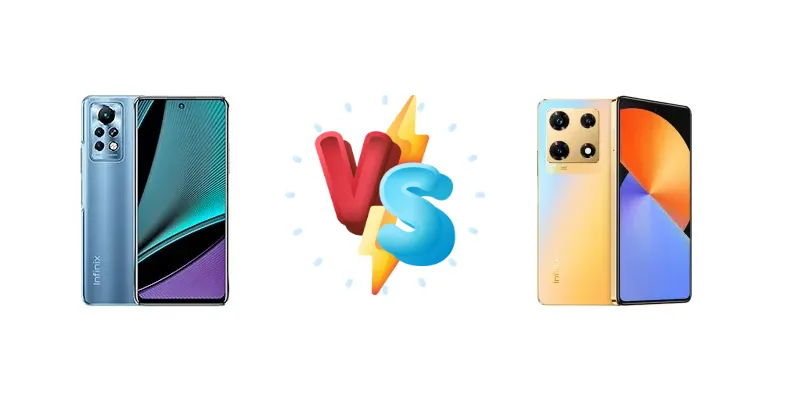
The Infinix Note series consistently delivers impressive features at competitive prices. The Note 11 Pro and Note 30 Pro are two strong contenders, but which one offers the best value? This comprehensive comparison will delve into their key differences to help you make an informed decision.
🏆 Quick Verdict
The Infinix Note 30 Pro emerges as the clear winner thanks to its significantly faster charging, more efficient chipset, and added wireless charging capabilities. While the Note 11 Pro boasts exceptional battery life, the Note 30 Pro's overall improvements make it the better choice for most users.
| Network |
|---|
| 2G bands | GSM 850 / 900 / 1800 / 1900 | GSM 850 / 900 / 1800 / 1900 |
| 3G bands | HSDPA 850 / 900 / 1700(AWS) / 1900 / 2100 | HSDPA 850 / 900 / 1700(AWS) / 1900 / 2100 |
| 4G bands | 1, 2, 3, 4, 5, 7, 8, 20, 28, 38, 41, 40 | 1, 2, 3, 4, 5, 7, 8, 12, 17, 20, 28, 38, 40, 41, 66 |
| Speed | HSPA, LTE | HSPA, LTE |
| Technology | GSM / HSPA / LTE | GSM / HSPA / LTE |
| | 1, 3, 7, 8, 20, 28 | - |
| Launch |
|---|
| Announced | 2021, October 12 | 2023, May 22 |
| Status | Available. Released 2021, November 19 | Available. Released 2023, May 22 |
| Body |
|---|
| Build | Glass front, plastic frame, plastic back | Glass front, plastic frame, glass back |
| Dimensions | 173.1 x 78.4 x 8.7 mm (6.81 x 3.09 x 0.34 in) | 162.7 x 76 x 8.2 mm (6.41 x 2.99 x 0.32 in) |
| SIM | Nano-SIM + Nano-SIM | Nano-SIM + Nano-SIM |
| Weight | 209 (7.37 oz) | 203 g (7.16 oz) |
| | - | IP53 |
| Display |
|---|
| Resolution | 1080 x 2460 pixels (~387 ppi density) | 1080 x 2400 pixels, 20:9 ratio (~395 ppi density) |
| Size | 6.95 inches, 114.7 cm2 (~84.5% screen-to-body ratio) | 6.67 inches, 107.4 cm2 (~86.9% screen-to-body ratio) |
| Type | IPS LCD, 120Hz | AMOLED, 1B colors, 120Hz, 900 nits (peak) |
| | - | * the display diagonal size and resolution is unconfirmed |
| Platform |
|---|
| CPU | Octa-core (2x2.05 GHz Cortex-A76 & 6x2.0 GHz Cortex-A55) | Octa-core (2x2.2 GHz Cortex-A76 & 6x2.0 GHz Cortex-A55) |
| Chipset | Mediatek MT6781 Helio G96 (12 nm) | Mediatek Helio G99 (6 nm) |
| GPU | Mali-G57 MC2 | Mali-G57 MC2 |
| OS | Android 11, XOS 10 | Android 13, XOS 13 |
| Memory |
|---|
| Card slot | microSDXC (dedicated slot) | microSDXC (dedicated slot) |
| Internal | 128GB 4GB RAM, 128GB 8GB RAM | 256GB 8GB RAM |
| | UFS 2.2 | - |
| Main Camera |
|---|
| Features | Quad-LED flash, HDR, panorama | Quad-LED flash, HDR, panorama |
| Single | 16 MP | - |
| Triple | 64 MP, f/1.7, (wide), 1/1.72", 0.8µm, PDAF
13 MP, f/2.5, 50mm (telephoto), 1/3.1", 1.12µm, PDAF, 2x optical zoom
Auxiliary lens | 108 MP, (wide), 1/1.67", PDAF
2 MP (macro)
Auxiliary lens |
| Video | 1440p@30fps | 1440p@30fps, 1080p@30fps |
| Selfie camera |
|---|
| Features | - | LED flash, HDR |
| Single | 16 MP | 32 MP, f/2.0, (wide), 1/2.8" |
| Video | 1080p@30fps | 1080p@30fps |
| Sound |
|---|
| 3.5mm jack | Yes | Yes |
| 35mm jack | Yes | Yes |
| Loudspeaker | Yes, with dual speakers | Yes, with dual speakers |
| | - | Sound by JBL
24-bit/192kHz audio |
| Comms |
|---|
| Bluetooth | Yes | Yes |
| NFC | No | Yes (market/region dependent) |
| Positioning | GPS | GPS |
| Radio | FM radio | FM radio |
| USB | USB Type-C 2.0, OTG | USB Type-C 2.0, OTG |
| WLAN | Wi-Fi 802.11 a/b/g/n/ac, dual-band, Wi-Fi Direct | Wi-Fi 802.11 a/b/g/n/ac, dual-band, Wi-Fi Direct |
| Features |
|---|
| Sensors | Fingerprint (side-mounted), accelerometer, gyro, proximity, compass | Fingerprint (side-mounted), accelerometer, gyro, proximity, compass |
| Battery |
|---|
| Charging | 33W wired | 68W wired, PD3.0, 80% in 30 min
15W wireless
Reverse wireless |
| Type | 5000 mAh | 5000 mAh |
| Misc |
|---|
| Colors | Mithril Grey, Haze Green, Mist Blue | Magic Black, Variable Gold |
| Models | X697 | X678B |
| Tests |
|---|
| Battery life |
Endurance rating 128h
| - |
| Camera |
Photo / Video | - |
| Display |
Contrast ratio: 1610:1 (nominal) | - |
| Loudspeaker |
-23.0 LUFS (Excellent)
| - |
| Performance |
AnTuTu: 290797 (v8), 343527 (v9)
GeekBench: 1800 (v5.1)
GFXBench: 11fps (ES 3.1 onscreen) | - |
Infinix Note 11 Pro
- Exceptional battery life
- Large display
- Good value for money
- Older chipset
- Slower charging
- Less refined camera
Infinix Note 30 Pro
- Faster charging (wired & wireless)
- More efficient chipset
- Improved performance
- Reverse wireless charging
- Potentially shorter battery life than Note 11 Pro
- Slightly higher price
Display Comparison
Both phones feature large AMOLED displays, but the Note 30 Pro likely has a slightly more modern panel with potentially better color accuracy and brightness. The Note 11 Pro's 1610:1 contrast ratio is impressive, but the Note 30 Pro's display likely offers a more vibrant and immersive viewing experience. Refresh rates are likely similar, around 120Hz.
Camera Comparison
While both phones offer capable camera systems, the Note 30 Pro likely has a more refined image processing pipeline. Expect improved low-light performance and more detailed photos from the Note 30 Pro. Specific camera specs (megapixel counts, aperture) would need to be confirmed for a more precise comparison, but the newer chipset generally supports better camera features.
Performance
The Note 30 Pro's Mediatek Helio G99 (6nm) chipset is a significant upgrade over the Note 11 Pro's Helio G96 (12nm). The 6nm process offers better power efficiency and improved performance. Expect smoother multitasking, faster app loading times, and better gaming performance on the Note 30 Pro. The CPU clock speeds are also slightly higher on the Note 30 Pro.
Battery Life
The Note 11 Pro's 128h endurance rating is remarkable, suggesting exceptional battery life. However, the Note 30 Pro's 68W wired charging and 15W wireless charging capabilities more than compensate for a potentially slightly smaller battery capacity. The faster charging means less time tethered to a wall outlet.
Buying Guide
Who should buy the Infinix Note 11 Pro? Users prioritizing maximum battery life and a large display on a budget. Who should buy the Infinix Note 30 Pro? Those seeking faster charging, improved performance, and the convenience of wireless charging, even if it means slightly less battery endurance.
Frequently Asked Questions
❓ Is the Infinix Note 30 Pro worth the upgrade from the Note 11 Pro?
If you value faster charging, improved performance, and wireless charging, then yes, the Note 30 Pro is a worthwhile upgrade. However, if battery life is your absolute top priority, the Note 11 Pro remains a strong contender.
❓ What is the difference in chipset between the two phones?
The Note 30 Pro uses the Mediatek Helio G99 (6nm), which is more efficient and powerful than the Note 11 Pro's Helio G96 (12nm). This translates to better performance and potentially longer battery life despite faster charging.