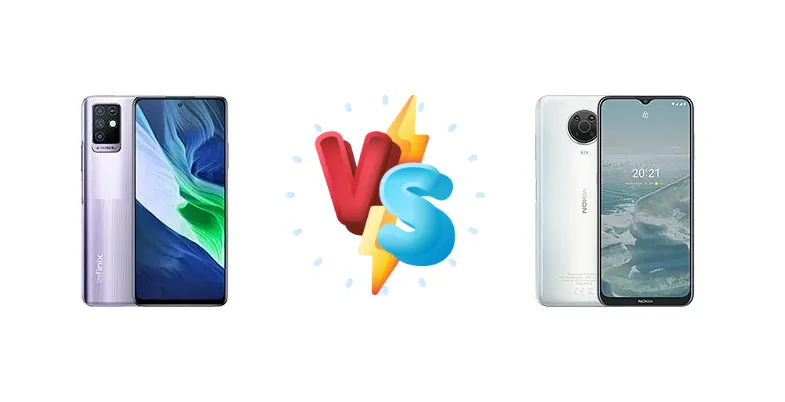
The Infinix Note 10 and Nokia G20 represent two approaches to the ultra-budget smartphone market. The Note 10 prioritizes performance with a more powerful chipset, while the G20 aims for longevity and a clean software experience. This comparison dissects their key differences to help you choose the right device.
🏆 Quick Verdict
For most users, the Infinix Note 10 emerges as the stronger choice. Its Mediatek Helio G85 chipset delivers noticeably better performance than the Nokia G20’s Helio G35, making it more suitable for gaming and demanding applications. While the Nokia G20 offers a cleaner software experience, the performance gap is too significant to ignore.
| Network |
|---|
| 2G bands | GSM 850 / 900 / 1800 / 1900 | GSM 850 / 900 / 1800 / 1900 |
| 3G bands | HSDPA 850 / 900 / 1700(AWS) / 1900 / 2100 | HSDPA 850 / 900 / 1900 / 2100 - International |
| 4G bands | 1, 2, 3, 4, 5, 7, 8, 20, 28, 38, 41, 40, 66 | 1, 3, 5, 7, 8, 20, 28, 38, 40, 41 - International |
| Speed | HSPA, LTE | HSPA 42.2/5.76 Mbps, LTE Cat4 150/50 Mbps |
| Technology | GSM / HSPA / LTE | GSM / HSPA / LTE |
| | 1, 3, 7, 8, 20, 28 | 1, 2, 3, 4, 5, 7, 8, 12, 17, 28, 66 - LATAM |
| Launch |
|---|
| Announced | 2021, May 12 | 2021, April 08 |
| Status | Available. Released 2021, June 07 | Available. Released 2021, May 17 |
| Body |
|---|
| Build | Glass front, plastic frame, plastic back | - |
| Dimensions | 173.2 x 78.7 x 8.8 mm (6.82 x 3.10 x 0.35 in) | 164.9 x 76 x 9.2 mm (6.49 x 2.99 x 0.36 in) |
| SIM | Nano-SIM + Nano-SIM | · Nano-SIM· Nano-SIM + Nano-SIM |
| Weight | - | 197 g (6.95 oz) |
| | - | Splash protection |
| Display |
|---|
| Resolution | 1080 x 2460 pixels (~387 ppi density) | 720 x 1600 pixels, 20:9 ratio (~269 ppi density) |
| Size | 6.95 inches, 114.7 cm2 (~84.2% screen-to-body ratio) | 6.52 inches, 102.6 cm2 (~81.9% screen-to-body ratio) |
| Type | IPS LCD | IPS LCD |
| Platform |
|---|
| CPU | Octa-core (2x2.0 GHz Cortex-A75 & 6x1.8 GHz Cortex-A55) | Octa-core (4x2.3 GHz Cortex-A53 & 4x1.8 GHz Cortex-A53) |
| Chipset | Mediatek MT6769Z Helio G85 (12 nm) | Mediatek MT6765G Helio G35 (12 nm) |
| GPU | Mali-G52 MC2 | PowerVR GE8320 |
| OS | Android 11, XOS 7.6 | Android 11, upgradable to Android 13 |
| Memory |
|---|
| Card slot | microSDXC (dedicated slot) | microSDXC (dedicated slot) |
| Internal | 64GB 4GB RAM, 128GB 4GB RAM, 128GB 6GB RAM | 64GB 4GB RAM, 128GB 4GB RAM |
| Main Camera |
|---|
| Features | Quad-LED flash, HDR, panorama | LED flash, HDR, panorama |
| Quad | - | 48 MP, f/1.8, (wide), PDAF
5 MP, (ultrawide)
2 MP (macro)
Auxiliary lens |
| Single | 16 MP | 8 MP, (wide) |
| Triple | 48 MP, PDAF
2 MP, f/2.4, (monochrome)
Auxiliary lens | - |
| Video | 1440p@30fps, 1080p@30fps | 1080p@30fps |
| Selfie camera |
|---|
| Single | 16 MP | 8 MP, (wide) |
| Video | 1080p@30fps | 1080p@30fps |
| Sound |
|---|
| 3.5mm jack | Yes | Yes |
| 35mm jack | Yes | Yes |
| Loudspeaker | Yes, with dual speakers | Yes |
| Comms |
|---|
| Bluetooth | 5.0, A2DP, LE | 5.0, A2DP, LE |
| NFC | No | Yes (market/region dependent) |
| Positioning | GPS | GPS, GLONASS, BDS |
| Radio | FM radio | FM radio |
| USB | USB Type-C 2.0, OTG | USB Type-C 2.0, OTG |
| WLAN | Wi-Fi 802.11 a/b/g/n/ac, dual-band, Wi-Fi Direct | Wi-Fi 802.11 b/g/n |
| Features |
|---|
| Sensors | Fingerprint (side-mounted), accelerometer, proximity, compass | Fingerprint (side-mounted), accelerometer, gyro, proximity |
| Battery |
|---|
| Charging | 18W wired | 10W wired |
| Type | 5000 mAh | Li-Po 5050 mAh |
| Misc |
|---|
| Colors | Black, Purple, Emerald Green | Glacier, Night |
| Models | X693 | TA-1336, TA-1343, TA-1347, TA-1372, TA-1365 |
| Price | About 170 EUR | About 90 EUR |
| SAR | - | 1.01 W/kg (head) 1.02 W/kg (body) |
| SAR EU | - | 0.49 W/kg (head) 1.13 W/kg (body) |
Infinix Note 10
- Faster processor for smoother performance
- 18W fast charging for quicker top-ups
- Potentially better gaming experience
- Software may be more heavily customized
- Potentially less frequent software updates
Nokia G20
- Clean, near-stock Android experience
- Guaranteed software updates from Nokia
- Potentially longer battery life due to less demanding processor
- Significantly slower processor
- Slow 10W charging
- Less responsive user experience
Display Comparison
Neither device boasts a standout display. Both utilize 12nm chipsets, suggesting similar power constraints impacting display capabilities. While specific display specs (resolution, brightness) are missing, the focus here is on performance. The absence of high refresh rates on either device indicates a cost-saving measure, prioritizing battery life over visual fluidity.
Camera Comparison
Without detailed camera specifications, a direct comparison is limited. However, given the price point, both phones likely feature similar sensor quality. The focus will be on image processing. Nokia is known for its natural image processing, while Infinix often leans towards more vibrant, saturated colors. The absence of Optical Image Stabilization (OIS) on either device suggests a reliance on software stabilization, which may struggle in low-light conditions. The usefulness of any 2MP macro lens on either phone is questionable, offering minimal practical benefit.
Performance
The core difference lies in the chipsets. The Infinix Note 10’s Mediatek Helio G85, with its 2x2.0 GHz Cortex-A75 and 6x1.8 GHz Cortex-A55 cores, offers a significant advantage over the Nokia G20’s Helio G35. The G35’s 4x2.3 GHz Cortex-A53 and 4x1.8 GHz Cortex-A53 configuration, while octa-core, relies on less efficient core architecture. The A75 cores in the G85 provide a substantial boost in single-core performance, crucial for app launch speeds and general responsiveness. This translates to a smoother user experience on the Infinix Note 10, particularly when multitasking or running demanding applications. The G85 is designed for gaming, while the G35 is more suited for basic tasks.
Battery Life
The Nokia G20’s 10W charging is a significant disadvantage compared to the Infinix Note 10’s 18W charging. While battery capacity isn’t specified, the faster charging speed of the Note 10 means less time tethered to a wall outlet. A 10W charger will take considerably longer to reach a full charge, impacting usability for users who need quick top-ups. The more efficient chipset in the Note 10 may also contribute to better overall battery life, despite potentially similar battery capacities.
Buying Guide
Buy the Infinix Note 10 if you need a phone capable of handling moderate gaming, multitasking, and generally snappier performance. It’s ideal for users who prioritize responsiveness and don’t mind a potentially more customized software experience. Buy the Nokia G20 if you value a clean, near-stock Android experience, prioritize software update guarantees, and primarily use your phone for basic tasks like calls, messaging, and light social media browsing.
Frequently Asked Questions
❓ Will the Infinix Note 10 struggle with popular games like PUBG Mobile?
While the Helio G85 isn't a flagship gaming chip, it's capable of running PUBG Mobile at medium settings with reasonable frame rates. Expect some occasional frame drops during intense action, but it's a playable experience. The Nokia G20’s Helio G35 will likely struggle to maintain stable frame rates even at lower settings.
❓ How important are Nokia's software update guarantees on the G20?
Nokia is committed to providing regular security updates and software upgrades for the G20, which is a significant advantage for users concerned about security and longevity. This means the phone will remain protected against vulnerabilities and receive new features for a longer period than many other phones in this price range. However, this benefit is offset by the lower performance.
❓ Is the difference in processor speed noticeable in everyday use?
Yes, the difference between the Helio G85 and Helio G35 is quite noticeable. The Infinix Note 10 will feel snappier when opening apps, switching between tasks, and browsing the web. The Nokia G20 may exhibit lag or slowdowns during these activities, especially with multiple apps open.