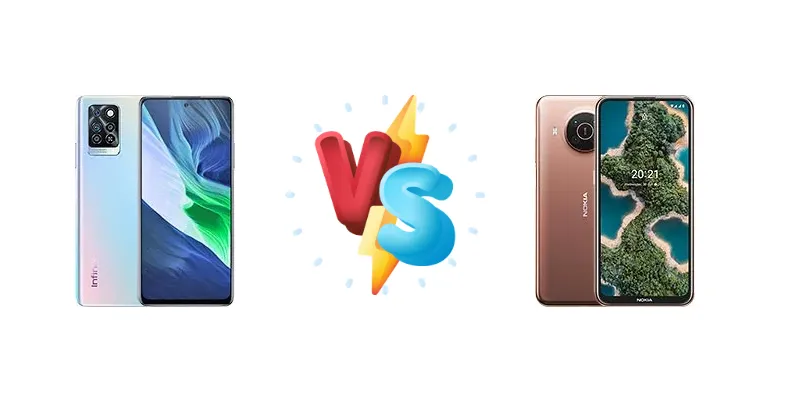
The Infinix Note 10 Pro and Nokia X20 represent distinct approaches to the budget smartphone market. The Infinix prioritizes raw processing power for gaming and multimedia, while the Nokia X20 focuses on bringing 5G connectivity and a clean software experience to a wider audience. This comparison dissects their key differences to determine which device best suits your needs.
🏆 Quick Verdict
For users prioritizing gaming and demanding performance, the Infinix Note 10 Pro is the clear winner. Its Helio G95 chipset delivers significantly more processing power. However, the Nokia X20 offers a compelling package for those seeking 5G connectivity and a streamlined Android experience, despite its less powerful processor.
| Network |
|---|
| 2G bands | GSM 850 / 900 / 1800 / 1900 | GSM 850 / 900 / 1800 / 1900 |
| 3G bands | HSDPA 850 / 900 / 1700(AWS) / 1900 / 2100 | HSDPA 850 / 900 / 1700(AWS) / 1900 / 2100 |
| 4G bands | 1, 2, 3, 4, 5, 7, 8, 20, 28, 38, 41, 40, 66 | 1, 2, 3, 4, 5, 7, 8, 12, 20, 28, 66, 38, 39, 40, 41 |
| 5G bands | - | 1, 2, 3, 5, 7, 28, 38, 41, 66, 78 SA/NSA/Sub6 |
| Speed | HSPA, LTE | HSPA, LTE, 5G |
| Technology | GSM / HSPA / LTE | GSM / HSPA / LTE / 5G |
| | 1, 3, 7, 8, 20, 28 | - |
| Launch |
|---|
| Announced | 2021, May 12 | 2021, April 08 |
| Status | Available. Released 2021, June 07 | Available. Released 2021, May 12 |
| Body |
|---|
| Dimensions | 172.8 x 78.3 x 7.8 mm (6.80 x 3.08 x 0.31 in) | 168.9 x 79.7 x 9.1 mm (6.65 x 3.14 x 0.36 in) |
| SIM | Nano-SIM + Nano-SIM | · Nano-SIM· Nano-SIM + Nano-SIM |
| Weight | 209 g (7.37 oz) | 220 g (7.76 oz) |
| Display |
|---|
| Protection | - | Corning Gorilla Glass 5 |
| Resolution | 1080 x 2460 pixels (~387 ppi density) | 1080 x 2400 pixels, 20:9 ratio (~395 ppi density) |
| Size | 6.95 inches, 114.7 cm2 (~84.8% screen-to-body ratio) | 6.67 inches, 107.4 cm2 (~79.8% screen-to-body ratio) |
| Type | IPS LCD, 90Hz | IPS LCD, 450 nits (typ) |
| Platform |
|---|
| CPU | Octa-core (2x2.05 GHz Cortex-A76 & 6x2.0 GHz Cortex-A55) | Octa-core (2x2.0 GHz Kryo 460 & 6x1.8 GHz Kryo 460) |
| Chipset | Mediatek MT6785V/CD Helio G95 (12 nm) | Qualcomm SM4350 Snapdragon 480 5G (8 nm) |
| GPU | Mali-G76 MC4 | Adreno 619 |
| OS | Android 11, XOS 7.6 | Android 11, upgradable to Android 14 |
| Memory |
|---|
| Card slot | microSDXC (dedicated slot) | microSDXC (uses shared SIM slot) |
| Internal | 64GB 6GB RAM, 128GB 8GB RAM, 256GB 8GB RAM | 128GB 6GB RAM, 128GB 8GB RAM |
| | UFS 2.2 | - |
| Main Camera |
|---|
| Features | Quad-LED flash, HDR, panorama | Zeiss optics, LED flash, HDR, panorama |
| Quad | 64 MP, f/1.9, (wide), 1/1.72", 0.8µm, PDAF
8 MP, f/2.3, 120˚ (ultrawide)
2 MP, f/2.4, (monochrome)
Auxiliary lens | 64 MP, (wide), PDAF
5 MP, (ultrawide)
2 MP (macro)
Auxiliary lens |
| Single | 16 MP | 32 MP, (wide) |
| Video | 4K@30fps, 1080p@30fps | 1080p@30/60fps |
| Selfie camera |
|---|
| Single | 16 MP, f/2.0, (wide), 1/3.09" | 32 MP, (wide) |
| Video | 1080p@30fps | 1080p@30fps |
| Sound |
|---|
| 3.5mm jack | Yes | Yes |
| 35mm jack | Yes | Yes |
| Loudspeaker | Yes, with dual speakers | Yes |
| Comms |
|---|
| Bluetooth | 5.0, A2DP, LE | 5.0, A2DP, LE, aptX HD |
| NFC | No | Yes |
| Positioning | GPS | GPS, GLONASS, GALILEO |
| Radio | FM radio | FM radio |
| USB | USB Type-C 2.0, OTG | USB Type-C 2.0, OTG |
| WLAN | Wi-Fi 802.11 a/b/g/n/ac, dual-band, Wi-Fi Direct | Wi-Fi 802.11 a/b/g/n/ac, dual-band, Wi-Fi Direct |
| Features |
|---|
| Sensors | Fingerprint (side-mounted), accelerometer, gyro, proximity, compass | Fingerprint (side-mounted), accelerometer, gyro, proximity |
| Battery |
|---|
| Charging | 33W wired | 18W wired |
| Type | 5000 mAh | Li-Po 4470 mAh |
| Misc |
|---|
| Colors | Black, Purple, Nordic Secret | Midnight Sun, Nordic Blue |
| Models | X695, X695D | TA-1341, TA-1344 |
| Price | About 180 EUR | About 130 EUR |
| SAR | 0.61 W/kg (head) 0.22 W/kg (body) | 1.04 W/kg (head) 0.62 W/kg (body) |
| SAR EU | - | 0.51 W/kg (head) 1.29 W/kg (body) |
| Tests |
|---|
| Battery life |
Endurance rating 128h
| - |
| Camera |
Photo / Video | - |
| Loudspeaker |
-25.3 LUFS (Very good)
| - |
Infinix Note 10 Pro
- Superior gaming performance due to the Helio G95 chipset.
- Faster 33W wired charging.
- Higher display brightness for better outdoor visibility.
- Lacks 5G connectivity.
- Software experience may be less refined than Nokia's Android One.
Nokia X20
- 5G connectivity for faster data speeds.
- Clean Android One software with guaranteed updates.
- Potentially better thermal management due to the 8nm Snapdragon 480.
- Significantly less powerful processor for gaming and demanding tasks.
- Slower 18W wired charging.
Display Comparison
The Infinix Note 10 Pro boasts a display capable of 447 nits of peak brightness, offering adequate visibility outdoors. While the Nokia X20’s display specs are not provided, the Note 10 Pro’s 1326:1 contrast ratio suggests a more vibrant viewing experience. The absence of high refresh rate information for both devices places them in the standard 60Hz category, which is typical for this price point. The Note 10 Pro’s brightness is a key advantage for users who frequently consume content in bright environments.
Camera Comparison
Both phones list 'Photo / Video' capabilities, but lack specific details. Without sensor size or aperture information, a direct comparison is difficult. However, the market positioning suggests the Infinix Note 10 Pro may prioritize camera features to appeal to a younger, social media-focused audience. The Nokia X20, with its emphasis on practicality, likely offers a more balanced camera experience. The absence of details makes it difficult to assess the quality of either system, and reliance on software processing is likely significant in both cases. We can assume both will include standard features like HDR and portrait modes.
Performance
The core difference lies in the chipsets. The Infinix Note 10 Pro utilizes the Mediatek Helio G95 (12nm), featuring an octa-core CPU with two Cortex-A76 cores clocked at 2.05 GHz, geared towards gaming. The Nokia X20, on the other hand, employs the Qualcomm Snapdragon 480 5G (8nm). While the Snapdragon 480 benefits from a more efficient 8nm process, its CPU configuration – two Kryo 460 cores at 2.0 GHz – is less focused on peak performance than the Helio G95. This translates to a noticeable advantage for the Infinix in graphically intensive tasks. The 8nm process of the Snapdragon 480 should, however, offer better thermal management under sustained load, potentially preventing throttling.
Battery Life
The Infinix Note 10 Pro has an endurance rating of 128 hours, indicating solid battery life. Coupled with 33W wired charging, it offers a relatively quick recharge time. The Nokia X20’s battery capacity and charging speed are not provided, but its 18W charging is significantly slower than the Infinix. While a larger battery on the Nokia X20 could offset the slower charging, the Infinix’s 33W charging provides a tangible benefit for users who need to quickly top up their device.
Buying Guide
Buy the Infinix Note 10 Pro if you need a phone primarily for gaming, video streaming, and demanding applications, and are willing to trade 5G connectivity for superior performance. Buy the Nokia X20 if you prioritize 5G access, a clean Android One software experience with guaranteed updates, and a more balanced overall package, even if it means sacrificing some processing power.
Frequently Asked Questions
❓ Will the Snapdragon 480 in the Nokia X20 struggle with graphically intensive games like PUBG Mobile?
Yes, the Snapdragon 480 is a budget-oriented chipset and will likely require significantly reduced graphics settings and frame rates to achieve playable performance in demanding games like PUBG Mobile. The Infinix Note 10 Pro’s Helio G95 is much better suited for gaming.
❓ How does the software experience differ between the Infinix Note 10 Pro and the Nokia X20?
The Nokia X20 runs Android One, offering a clean, bloatware-free experience with guaranteed software updates directly from Google. The Infinix Note 10 Pro typically uses a customized version of Android, which may include pre-installed apps and a different user interface. This can impact performance and update frequency.
❓ Is the lack of 5G on the Infinix Note 10 Pro a significant drawback in 2024?
The significance of lacking 5G depends on your location and carrier. If 5G coverage is limited or unavailable in your area, the absence of 5G on the Infinix Note 10 Pro is unlikely to be a major issue. However, if you live in an area with widespread 5G coverage and plan to utilize it, the Nokia X20 is the better choice.