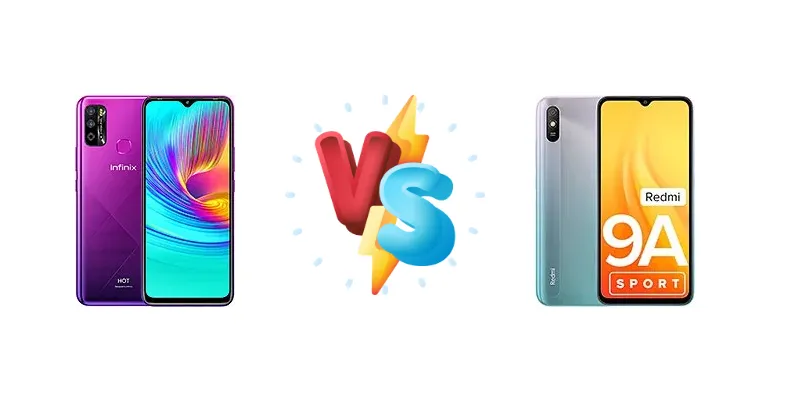
The sub-$150 smartphone market is fiercely competitive, and the Infinix Hot 9 Play and Xiaomi Redmi 9A Sport are two contenders vying for dominance. Both aim to deliver essential smartphone functionality at an incredibly accessible price point, but they achieve this with different approaches to chipset selection and configuration. This comparison will dissect their key specifications to determine which device offers the best value for your money.
🏆 Quick Verdict
For most users, the Xiaomi Redmi 9A Sport emerges as the slightly better choice. Its Helio G25 chipset, while still entry-level, provides a noticeable performance uplift over the base Infinix Hot 9 Play’s Helio A22, offering a smoother experience for everyday tasks and light gaming. However, the Hot 9 Play’s potential for a more powerful Helio A25 configuration and reverse wired charging offer compelling alternatives.
| Network |
|---|
| 2G bands | GSM 850 / 900 / 1800 / 1900 | GSM 850 / 900 / 1800 / 1900 |
| 3G bands | HSDPA 850 / 900 / 1700(AWS) / 1900 / 2100 | HSDPA 850 / 900 / 2100 |
| 4G bands | 1, 2, 3, 4, 5, 7, 8, 20, 38, 40, 41 | 1, 3, 5, 8, 40, 41 |
| Speed | HSPA 42.2/5.76 Mbps, LTE Cat4 150/50 Mbps | HSPA, LTE |
| Technology | GSM / HSPA / LTE | GSM / HSPA / LTE |
| Launch |
|---|
| Announced | 2020, April 09. Released 2020, April 09 | 2021, September 28 |
| Status | Discontinued | Available. Released 2021, September 28 |
| Body |
|---|
| Build | Glass front, plastic back, plastic frame | - |
| Dimensions | 171.8 x 78 x 8.9 mm (6.76 x 3.07 x 0.35 in) | 164.9 x 77.1 x 9 mm (6.49 x 3.04 x 0.35 in) |
| SIM | Nano-SIM + Nano-SIM | Nano-SIM + Nano-SIM |
| Weight | 209 g (7.37 oz) | 194 g (6.84 oz) |
| | - | Water-repellent coating |
| Display |
|---|
| Protection | Corning Gorilla Glass 3 | - |
| Resolution | 720 x 1640 pixels (~263 ppi density) | 720 x 1600 pixels, 20:9 ratio (~269 ppi density) |
| Size | 6.82 inches, 110.5 cm2 (~82.4% screen-to-body ratio) | 6.53 inches, 102.9 cm2 (~81.0% screen-to-body ratio) |
| Type | IPS LCD | IPS LCD, 400 nits (typ) |
| Platform |
|---|
| CPU | Quad-core 2.0 GHz Cortex-A53 - 32/2GBOcta-core (4x1.8 GHz Cortex-A53 & 4x1.5 GHz Cortex-A53) - 32/3GB, 64/3-4GB | Octa-core (4x2.0 GHz Cortex-A53 & 4x1.5 GHz Cortex-A53) |
| Chipset | Mediatek MT6761 Helio A22 (12 nm) - 32/2GBMediatek MT6762D Helio A25 (12 nm) - 32/3GB, 64/3-4GB | Mediatek MT6762G Helio G25 (12 nm) |
| GPU | PowerVR GE8300PowerVR GE8320 | PowerVR GE8320 |
| OS | Android 9.0 Pie (Go edition) - 32/2GBAndroid 9.0 (Pie) - 32/3GB, 64/3-4GB | Android 10, MIUI 12 |
| Memory |
|---|
| Card slot | microSDXC (dedicated slot) | microSDXC (dedicated slot) |
| Internal | 32GB 2GB RAM, 32GB 3GB RAM, 64GB 3GB RAM, 64GB 4GB RAM | 32GB 2GB RAM, 32GB 3GB RAM |
| | eMMC 5.1 | eMMC 5.1 |
| Main Camera |
|---|
| Dual | 13 MP, (wide), 1/3.1", 1.12µm, AF
Auxiliary lens | - |
| Features | Triple-LED flash, panorama, HDR | LED flash, HDR |
| Single | 13 MP, AF | 13 MP, f/2.2, 28mm (wide), 1.0µm, PDAF |
| Video | 1080p@30fps | 1080p@30/60fps |
| Selfie camera |
|---|
| Features | - | HDR |
| Single | 8 MP, (wide) | 5 MP, f/2.2, (wide), 1.12µm |
| Video | 1080p@30fps | 1080p@30fps |
| Sound |
|---|
| 3.5mm jack | Yes | Yes |
| 35mm jack | Yes | Yes |
| Loudspeaker | Yes | Yes |
| Comms |
|---|
| Bluetooth | 5.0, A2DP, LE | 5.0, A2DP, LE |
| NFC | No | No |
| Positioning | GPS | GPS, GLONASS, BDS |
| Radio | FM radio | FM radio |
| USB | microUSB 2.0, OTG | microUSB 2.0, OTG |
| WLAN | Wi-Fi 802.11 a/b/g/n/ac, dual-band, Wi-Fi Direct | Wi-Fi 802.11 a/b/g/n, Wi-Fi Direct |
| Features |
|---|
| Sensors | Fingerprint (rear-mounted), accelerometer, gyro, proximity, compass | Accelerometer, proximity |
| Battery |
|---|
| Charging | 10W wired
Reverse wired | 10W wired |
| Stand-by | Up to 750 h | - |
| Talk time | Up to 25 h | - |
| Type | 6000 mAh | Li-Po 5000 mAh |
| Misc |
|---|
| Colors | Midnight Black, Quetzal Cyan, Violet, Ocean Wave | Carbon Black, Coral Green, Metallic Blue |
| Models | X680, X680B, X680C | - |
| Price | About 100 EUR | About 100 EUR |
| SAR EU | 0.35 W/kg (head) | - |
Infinix Hot 9 Play
- Potential for Helio A25 configuration offers improved performance.
- Reverse wired charging provides added utility.
- Generally more affordable base price.
- Base Helio A22 configuration is significantly slower than the Redmi 9A Sport.
- May require careful specification checking to ensure the desired chipset.
Xiaomi Redmi 9A Sport
- Helio G25 chipset delivers consistently smoother performance.
- Octa-core CPU provides better multitasking capabilities.
- Slightly better gaming performance compared to the base Hot 9 Play.
- Lacks reverse wired charging functionality.
- May be slightly more expensive than the base Hot 9 Play configuration.
Display Comparison
Neither device boasts a standout display. Both likely utilize standard IPS LCD panels, and detailed specifications like brightness and color accuracy are unavailable. The focus here is on functionality, not fidelity. Bezels are expected to be substantial on both, reflecting their budget positioning. The user experience will be similar – adequate for basic consumption but not ideal for media enthusiasts.
Camera Comparison
Camera performance is expected to be similar and unremarkable on both devices. Details regarding sensor size and image processing are lacking. Both likely feature a primary camera accompanied by auxiliary sensors (often 2MP depth or macro lenses, which offer limited practical benefit). Image quality will be acceptable in good lighting conditions, but expect significant noise and a lack of detail in low light. The focus should be on capturing memories, not professional-grade photography.
Performance
The core difference lies in the chipset. The Redmi 9A Sport’s MediaTek Helio G25 (12nm) features an octa-core CPU configuration (4x2.0 GHz Cortex-A53 & 4x1.5 GHz Cortex-A53). This is a clear advantage over the base Infinix Hot 9 Play’s Helio A22 (12nm) with its quad-core 2.0 GHz Cortex-A53 setup. The G25’s octa-core design allows for better multitasking and responsiveness. However, the Hot 9 Play *can* be configured with the Helio A25 (12nm) – an octa-core chip with a similar configuration to the G25, potentially closing the performance gap. The Redmi 9A Sport’s GPU is also likely to be more capable, offering a slightly better gaming experience. Both devices will struggle with demanding titles, but the G25 will provide a more playable experience at lower settings.
Battery Life
Both phones feature a 10W wired charging capability. Battery capacity is not specified in the provided data, but typical capacities for this segment are around 5000mAh. The 10W charging rate is slow by modern standards, requiring several hours for a full charge. The Infinix Hot 9 Play gains a slight edge with its inclusion of reverse wired charging, allowing it to function as a power bank for other devices – a useful feature for users with multiple gadgets.
Buying Guide
Buy the Infinix Hot 9 Play if you prioritize potential upgrade options (choosing the Helio A25 variant) and the convenience of reverse wired charging to top up accessories. Buy the Xiaomi Redmi 9A Sport if you want a consistently smoother experience for daily use and slightly better gaming performance thanks to the Helio G25’s optimized architecture, even if it lacks the reverse charging feature.
Frequently Asked Questions
❓ Will the Redmi 9A Sport handle PUBG Mobile smoothly?
The Helio G25 in the Redmi 9A Sport can run PUBG Mobile, but expect to play at the lowest graphics settings and potentially experience occasional frame drops. It's not designed for high-end gaming, but it's playable for casual users. The Infinix Hot 9 Play with the Helio A22 will struggle significantly more.
❓ What does 'reverse wired charging' on the Infinix Hot 9 Play actually let me do?
Reverse wired charging allows you to use the Infinix Hot 9 Play as a power bank to charge other devices, like wireless earbuds, smartwatches, or even another phone, using a USB cable. It's a slow charging method, but useful in emergencies or when you don't have access to a wall outlet.
❓ Is the difference between the Helio A22 and Helio A25 significant enough to justify paying extra for the Hot 9 Play with the A25?
Yes, the difference is noticeable. The Helio A25's octa-core CPU provides a substantial performance boost over the Helio A22's quad-core setup, resulting in smoother multitasking and a more responsive user experience. If the price difference is minimal, opting for the A25 variant is highly recommended.