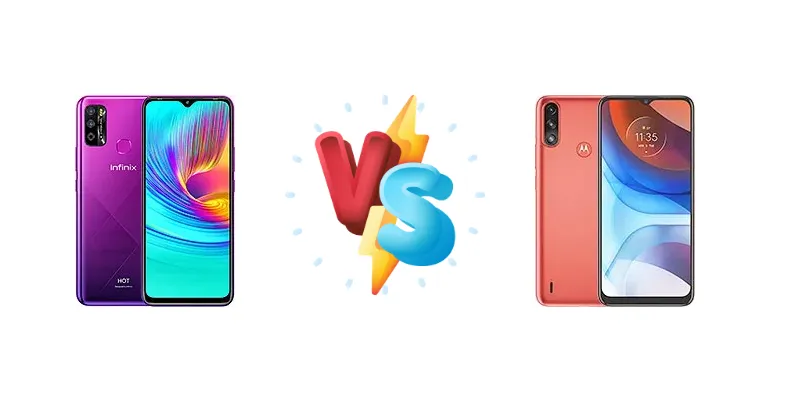
The Infinix Hot 9 Play and Motorola Moto E7 Power represent the extreme end of the budget smartphone market. Both aim to deliver essential smartphone functionality at the lowest possible price point, but they take slightly different approaches to achieving this. This comparison dives deep into their specifications to determine which device offers the best value for users prioritizing affordability and reliability.
🏆 Quick Verdict
For most users, the Motorola Moto E7 Power emerges as the slightly better choice. Its Helio G25 chipset provides a noticeable performance uplift over the base Helio A22 configuration of the Hot 9 Play, translating to smoother multitasking and app loading. While both offer similar battery life, the E7 Power’s more efficient processor contributes to longer sustained usage.
| Network |
|---|
| 2G bands | GSM 850 / 900 / 1800 / 1900 | GSM 850 / 900 / 1800 / 1900 |
| 3G bands | HSDPA 850 / 900 / 1700(AWS) / 1900 / 2100 | HSDPA 850 / 900 / 1700(AWS) / 1900 / 2100 |
| 4G bands | 1, 2, 3, 4, 5, 7, 8, 20, 38, 40, 41 | 1, 3, 5, 7, 8, 20, 38, 40, 41 |
| Speed | HSPA 42.2/5.76 Mbps, LTE Cat4 150/50 Mbps | HSPA, LTE |
| Technology | GSM / HSPA / LTE | GSM / HSPA / LTE |
| Launch |
|---|
| Announced | 2020, April 09. Released 2020, April 09 | 2021, February 19 |
| Status | Discontinued | Available. Released 2021, February 26 |
| Body |
|---|
| Build | Glass front, plastic back, plastic frame | Glass front, plastic back, plastic frame |
| Dimensions | 171.8 x 78 x 8.9 mm (6.76 x 3.07 x 0.35 in) | 165.1 x 75.9 x 9.2 mm (6.5 x 2.99 x 0.36 in) |
| SIM | Nano-SIM + Nano-SIM | Nano-SIM + Nano-SIM |
| Weight | 209 g (7.37 oz) | 200 g (7.05 oz) |
| | - | Water-repellent design |
| Display |
|---|
| Protection | Corning Gorilla Glass 3 | - |
| Resolution | 720 x 1640 pixels (~263 ppi density) | 720 x 1600 pixels, 20:9 ratio (~269 ppi density) |
| Size | 6.82 inches, 110.5 cm2 (~82.4% screen-to-body ratio) | 6.51 inches, 103.1 cm2 (~82.3% screen-to-body ratio) |
| Type | IPS LCD | IPS LCD, 380 nits (typ) |
| Platform |
|---|
| CPU | Quad-core 2.0 GHz Cortex-A53 - 32/2GBOcta-core (4x1.8 GHz Cortex-A53 & 4x1.5 GHz Cortex-A53) - 32/3GB, 64/3-4GB | Octa-core (4x2.0 GHz Cortex-A53 & 4x1.5 GHz Cortex-A53) |
| Chipset | Mediatek MT6761 Helio A22 (12 nm) - 32/2GBMediatek MT6762D Helio A25 (12 nm) - 32/3GB, 64/3-4GB | Mediatek MT6762G Helio G25 (12 nm) |
| GPU | PowerVR GE8300PowerVR GE8320 | PowerVR GE8320 |
| OS | Android 9.0 Pie (Go edition) - 32/2GBAndroid 9.0 (Pie) - 32/3GB, 64/3-4GB | Android 10 |
| Memory |
|---|
| Card slot | microSDXC (dedicated slot) | microSDXC (uses shared SIM slot) |
| Internal | 32GB 2GB RAM, 32GB 3GB RAM, 64GB 3GB RAM, 64GB 4GB RAM | 32GB 2GB RAM, 64GB 4GB RAM |
| | eMMC 5.1 | eMCP |
| Main Camera |
|---|
| Dual | 13 MP, (wide), 1/3.1", 1.12µm, AF
Auxiliary lens | 13 MP, f/2.0, 26mm (wide), 1/3.1", 1.12µm, PDAF
2 MP (macro) |
| Features | Triple-LED flash, panorama, HDR | LED flash, HDR, panorama |
| Single | 13 MP, AF | - |
| Video | 1080p@30fps | 1080p@30fps |
| Selfie camera |
|---|
| Features | - | HDR |
| Single | 8 MP, (wide) | 5 MP, f/2.2, 27mm (wide), 1.12µm |
| Video | 1080p@30fps | 1080p@30fps |
| Sound |
|---|
| 3.5mm jack | Yes | Yes |
| 35mm jack | Yes | Yes |
| Loudspeaker | Yes | Yes |
| Comms |
|---|
| Bluetooth | 5.0, A2DP, LE | 5.0, A2DP, LE |
| NFC | No | No |
| Positioning | GPS | GPS, GLONASS, GALILEO |
| Radio | FM radio | FM radio |
| USB | microUSB 2.0, OTG | USB Type-C 2.0, OTG |
| WLAN | Wi-Fi 802.11 a/b/g/n/ac, dual-band, Wi-Fi Direct | Wi-Fi 802.11 b/g/n |
| Features |
|---|
| Sensors | Fingerprint (rear-mounted), accelerometer, gyro, proximity, compass | Fingerprint (rear-mounted), accelerometer, proximity |
| Battery |
|---|
| Charging | 10W wired
Reverse wired | 10W wired |
| Stand-by | Up to 750 h | - |
| Talk time | Up to 25 h | - |
| Type | 6000 mAh | Li-Ion 5000 mAh |
| Misc |
|---|
| Colors | Midnight Black, Quetzal Cyan, Violet, Ocean Wave | Tahiti Blue, Coral Red |
| Models | X680, X680B, X680C | PAMH0001IN, PAMH0010IN, PAMH0019IN |
| Price | About 100 EUR | About 140 EUR |
| SAR EU | 0.35 W/kg (head) | - |
Infinix Hot 9 Play
- Potentially lower price point (depending on configuration)
- Reverse wired charging capability
- Larger storage options available (64GB)
- Helio A22 chipset is significantly less powerful
- May feel sluggish with multiple apps open
- Limited gaming capabilities
Motorola Moto E7 Power
- More powerful Helio G25 chipset
- Smoother multitasking and app loading
- Better overall performance for everyday tasks
- May be slightly more expensive than the base Hot 9 Play
- Limited storage options (typically 32GB)
- 10W charging is slow
Display Comparison
Neither device boasts a particularly impressive display. Both likely utilize LCD panels, a standard for this price bracket. Specifics like resolution and peak brightness are not provided, but we can assume they are similar – likely 720p+ and adequate for indoor use. The focus here isn’t on visual fidelity, but on basic readability. Bezels are expected to be substantial on both, maximizing screen real estate within a compact form factor.
Camera Comparison
Camera performance on both devices will be basic. Details are scarce, but both likely feature a primary camera alongside depth and macro sensors. The usefulness of the 2MP macro sensors on either phone is questionable. The image processing capabilities of both Mediatek chipsets are limited, so image quality will be heavily reliant on good lighting conditions. Without specific sensor size information, it’s difficult to declare a clear winner, but the G25’s image signal processor (ISP) may offer slightly better noise reduction and dynamic range.
Performance
The core difference lies in the chipset. The Infinix Hot 9 Play is available with either the Mediatek Helio A22 or A25, while the Moto E7 Power features the Helio G25. The G25, while still an entry-level chip, represents a step up. Its octa-core configuration (4x2.0 GHz Cortex-A53 & 4x1.5 GHz Cortex-A53) compared to the A22’s quad-core (2.0 GHz Cortex-A53) provides a significant advantage in multitasking and app responsiveness. The A25 variant of the Hot 9 Play narrows the gap, but the G25 still holds an edge. Both phones are likely paired with limited RAM (2-4GB), further emphasizing the importance of the chipset’s efficiency. The G25’s slightly more modern architecture will result in a smoother experience, particularly when switching between apps.
Battery Life
Both phones feature a 10W charging rate, indicating a similar charging experience – expect several hours to fully charge. The Moto E7 Power’s Helio G25 chipset, being more power-efficient, will likely translate to slightly longer battery life during typical usage. While the exact battery capacity isn’t specified, the E7 Power’s more efficient processor will allow it to extract more usage from a similar-sized battery. Both phones are designed for all-day battery life with moderate use.
Buying Guide
Buy the Infinix Hot 9 Play if you absolutely need the lowest possible price and are willing to compromise on performance. It’s suitable for very basic tasks like calls, texts, and light social media. Buy the Motorola Moto E7 Power if you prioritize a more responsive user experience, even for everyday tasks, and want a phone that will handle slightly more demanding apps without significant lag. The E7 Power is the better option for users who want a phone that feels less sluggish.
Frequently Asked Questions
❓ Will the Moto E7 Power struggle with popular apps like WhatsApp and Facebook?
While the Moto E7 Power is an entry-level phone, the Helio G25 chipset is capable of running apps like WhatsApp and Facebook smoothly. You might experience some slowdown with multiple apps open simultaneously, but for typical social media usage, it should be adequate.
❓ Is the Infinix Hot 9 Play a good option for mobile gaming?
The Infinix Hot 9 Play, especially the Helio A22 variant, is not well-suited for mobile gaming. While it can run some less demanding games, you'll likely experience significant lag and low frame rates. The Helio G25 in the Moto E7 Power offers a slightly better gaming experience, but still isn't ideal for graphically intensive titles.
❓ Can I expand the storage on either phone?
Both the Infinix Hot 9 Play and Motorola Moto E7 Power feature a dedicated microSD card slot, allowing you to expand the storage capacity. This is particularly useful given the limited internal storage options available on these devices.
❓ How long will it take to fully charge either phone?
With both phones supporting only 10W charging, expect a full charge to take approximately 3-4 hours from 0%. This is a common limitation for phones in this price range.