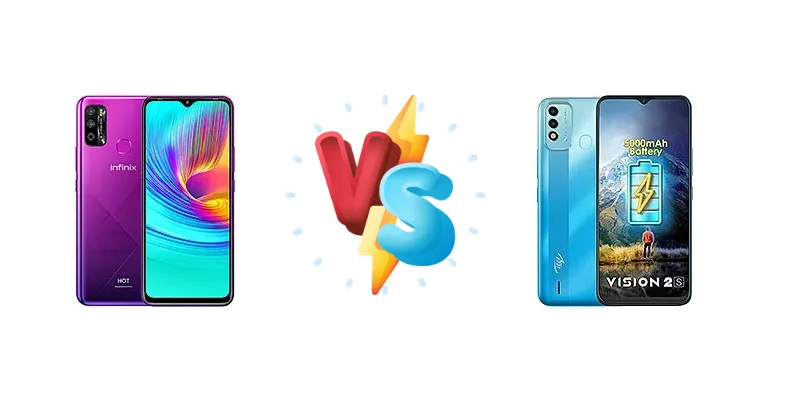
The sub-$100 smartphone market is fiercely competitive. Both the Infinix Hot 9 Play and the itel Vision 2S aim to deliver essential smartphone functionality at an incredibly accessible price point. However, they take different approaches to achieving this, particularly in their core processing power and charging capabilities. This comparison dissects these differences to determine which device offers the best value.
🏆 Quick Verdict
For most users, the itel Vision 2S emerges as the slightly better choice. While the Infinix Hot 9 Play offers configuration options with more RAM, the itel Vision 2S’s newer Unisoc SC9863A chipset, built on an octa-core architecture, provides a more responsive experience, and its 18W charging significantly reduces downtime compared to the Infinix’s 10W.
| Network |
|---|
| 2G bands | GSM 850 / 900 / 1800 / 1900 | GSM 850 / 900 / 1800 / 1900 |
| 3G bands | HSDPA 850 / 900 / 1700(AWS) / 1900 / 2100 | HSDPA 850 / 900 / 2100 |
| 4G bands | 1, 2, 3, 4, 5, 7, 8, 20, 38, 40, 41 | LTE |
| Speed | HSPA 42.2/5.76 Mbps, LTE Cat4 150/50 Mbps | HSPA, LTE |
| Technology | GSM / HSPA / LTE | GSM / HSPA / LTE |
| Launch |
|---|
| Announced | 2020, April 09. Released 2020, April 09 | 2021 |
| Status | Discontinued | Available. Released 2021 |
| Body |
|---|
| Build | Glass front, plastic back, plastic frame | - |
| Dimensions | 171.8 x 78 x 8.9 mm (6.76 x 3.07 x 0.35 in) | 166 x 76.3 x 8.9 mm (6.54 x 3.00 x 0.35 in) |
| SIM | Nano-SIM + Nano-SIM | Dual SIM |
| Weight | 209 g (7.37 oz) | - |
| Display |
|---|
| Protection | Corning Gorilla Glass 3 | - |
| Resolution | 720 x 1640 pixels (~263 ppi density) | 720 x 1600 pixels, 20:9 ratio (~269 ppi density) |
| Size | 6.82 inches, 110.5 cm2 (~82.4% screen-to-body ratio) | 6.52 inches, 102.6 cm2 (~81.0% screen-to-body ratio) |
| Type | IPS LCD | IPS LCD |
| Platform |
|---|
| CPU | Quad-core 2.0 GHz Cortex-A53 - 32/2GBOcta-core (4x1.8 GHz Cortex-A53 & 4x1.5 GHz Cortex-A53) - 32/3GB, 64/3-4GB | Octa-core (4x1.6 GHz Cortex-A55 & 4x1.2 GHz Cortex-A55) |
| Chipset | Mediatek MT6761 Helio A22 (12 nm) - 32/2GBMediatek MT6762D Helio A25 (12 nm) - 32/3GB, 64/3-4GB | Unisoc SC9863A (28 nm) |
| GPU | PowerVR GE8300PowerVR GE8320 | IMG8322 |
| OS | Android 9.0 Pie (Go edition) - 32/2GBAndroid 9.0 (Pie) - 32/3GB, 64/3-4GB | Android 11 (Go edition) |
| Memory |
|---|
| Card slot | microSDXC (dedicated slot) | microSDXC |
| Internal | 32GB 2GB RAM, 32GB 3GB RAM, 64GB 3GB RAM, 64GB 4GB RAM | 32GB 2GB RAM |
| | eMMC 5.1 | - |
| Main Camera |
|---|
| Dual | 13 MP, (wide), 1/3.1", 1.12µm, AF
Auxiliary lens | 8 MP
0.3 MP |
| Features | Triple-LED flash, panorama, HDR | LED flash |
| Single | 13 MP, AF | - |
| Video | 1080p@30fps | 1080p@30fps |
| Selfie camera |
|---|
| Single | 8 MP, (wide) | 5 MP |
| Video | 1080p@30fps | Yes |
| Sound |
|---|
| 3.5mm jack | Yes | - |
| 35mm jack | Yes | Yes |
| Loudspeaker | Yes | Yes |
| Comms |
|---|
| Bluetooth | 5.0, A2DP, LE | Yes |
| NFC | No | No |
| Positioning | GPS | GPS |
| Radio | FM radio | Unspecified |
| USB | microUSB 2.0, OTG | microUSB |
| WLAN | Wi-Fi 802.11 a/b/g/n/ac, dual-band, Wi-Fi Direct | Yes |
| Features |
|---|
| Sensors | Fingerprint (rear-mounted), accelerometer, gyro, proximity, compass | Fingerprint (rear-mounted), accelerometer |
| Battery |
|---|
| Charging | 10W wired
Reverse wired | 18W wired |
| Stand-by | Up to 750 h | - |
| Talk time | Up to 25 h | - |
| Type | 6000 mAh | 5000 mAh |
| Misc |
|---|
| Colors | Midnight Black, Quetzal Cyan, Violet, Ocean Wave | Gradation Purple, Gradation Blue, Deep Blue |
| Models | X680, X680B, X680C | - |
| Price | About 100 EUR | - |
| SAR EU | 0.35 W/kg (head) | - |
Infinix Hot 9 Play
- Potential for higher RAM configurations (up to 4GB)
- Reverse wired charging for accessory top-ups
- More established brand recognition (Infinix)
- Older, less efficient processor architecture (Helio A22)
- Slower 10W charging
- Potentially less responsive user experience
itel Vision 2S
- More modern and efficient processor (Unisoc SC9863A)
- Faster 18W charging
- Newer Cortex-A55 cores for improved performance
- Limited RAM options
- Less brand recognition (itel)
- Less efficient 28nm process
Display Comparison
Neither device boasts a standout display. Both likely utilize LCD panels, typical for this price bracket. Specifics like resolution and brightness are not provided, but we can assume they are similar – likely 720p+ and adequate for basic viewing. The focus here isn’t on visual fidelity, but on functionality.
Camera Comparison
Camera performance is likely to be similar on both devices, focusing on basic image capture. Details are scarce, but both will likely feature a primary sensor paired with auxiliary lenses of limited utility. Without specific sensor sizes or aperture information, it’s difficult to declare a clear winner. Image processing will likely be basic on both, prioritizing speed over quality.
Performance
The core difference lies in the chipsets. The Infinix Hot 9 Play utilizes either the Mediatek MT6761 Helio A22 (quad-core) or the MT6762D Helio A25 (octa-core). The Helio A25, found in higher-end configurations, represents a step up with its octa-core configuration (4x1.8 GHz Cortex-A53 & 4x1.5 GHz Cortex-A53) compared to the A22’s quad-core 2.0 GHz Cortex-A53. However, the itel Vision 2S counters with the Unisoc SC9863A, also octa-core (4x1.6 GHz Cortex-A55 & 4x1.2 GHz Cortex-A55). Crucially, the SC9863A uses newer Cortex-A55 cores, which offer improved efficiency and performance per clock speed compared to the older A53 cores in the Helio chips. This translates to a snappier user experience in everyday tasks for the itel, despite the slightly lower clock speeds. The 28nm process of the Unisoc chip is less efficient than the 12nm process of the Mediatek chips, but the architectural improvements offset this.
Battery Life
The itel Vision 2S takes a clear lead in charging. Its 18W wired charging capability is a significant advantage over the Infinix Hot 9 Play’s 10W charging. While battery capacity isn’t specified for either, the faster charging speed will result in considerably less downtime for the itel. This is particularly important for users who frequently use their phones throughout the day and need quick top-ups. The Infinix does offer reverse wired charging, a niche feature allowing it to charge other devices, but this is unlikely to be a deciding factor for most buyers.
Buying Guide
Buy the Infinix Hot 9 Play if you prioritize potential RAM configurations (up to 4GB) and the flexibility of reverse wired charging, potentially useful for topping up accessories. Buy the itel Vision 2S if you value a more modern, efficient processor for smoother daily tasks and significantly faster charging, making it ideal for users who rely heavily on their phone throughout the day and need quick power boosts.
Frequently Asked Questions
❓ Will the Unisoc SC9863A in the itel Vision 2S struggle with multitasking?
While not a powerhouse, the Unisoc SC9863A’s octa-core architecture and newer Cortex-A55 cores are well-suited for moderate multitasking. Expect smooth performance with typical apps like messaging, social media, and web browsing. However, running numerous demanding apps simultaneously may lead to slowdowns.
❓ How long does it realistically take to charge the Infinix Hot 9 Play from 0% to 100%?
With only 10W charging, expect a full charge to take approximately 3-4 hours. This is significantly slower than the itel Vision 2S, making it less convenient for users who need a quick power boost.
❓ Is the reverse wired charging on the Infinix Hot 9 Play useful for more than just emergencies?
The reverse wired charging is primarily useful for emergencies or topping up small accessories like Bluetooth headphones or a smartwatch. It's not designed for quickly charging larger devices like another smartphone.
❓ Does the itel Vision 2S support fast charging protocols beyond standard 18W?
Information on specific fast charging protocol support (like Quick Charge or Power Delivery) for the itel Vision 2S is limited. It likely supports standard 18W charging, but compatibility with proprietary fast charging standards is uncertain.