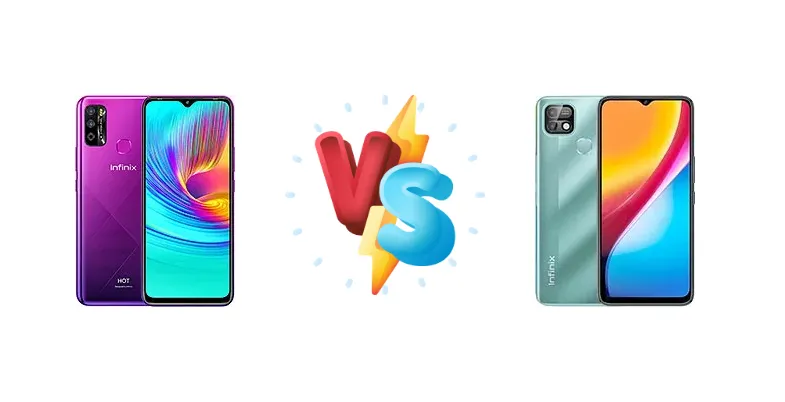
The Infinix Hot 9 Play and Smart 5 Pro represent Infinix’s commitment to the ultra-budget smartphone market. While both aim to deliver essential smartphone functionality at a low price point, they diverge significantly in their internal hardware, particularly in their chipsets. This comparison dissects these differences to determine which device offers the best value for users prioritizing performance and everyday usability.
🏆 Quick Verdict
For most users, the Infinix Hot 9 Play (specifically the Helio A25 variant) is the better choice. Its more powerful octa-core processor and potential for more RAM provide a smoother experience for multitasking and moderately demanding apps, despite both phones sharing the same slow 10W charging.
| Network |
|---|
| 2G bands | GSM 850 / 900 / 1800 / 1900 | GSM 850 / 900 / 1800 / 1900 |
| 3G bands | HSDPA 850 / 900 / 1700(AWS) / 1900 / 2100 | HSDPA 850 / 900 / 2100 |
| 4G bands | 1, 2, 3, 4, 5, 7, 8, 20, 38, 40, 41 | 1, 3, 5, 8, 38, 40, 41 |
| Speed | HSPA 42.2/5.76 Mbps, LTE Cat4 150/50 Mbps | HSPA 21.1/5.76 Mbps, LTE Cat4 150/50 Mbps |
| Technology | GSM / HSPA / LTE | GSM / HSPA / LTE |
| | - | 1, 2, 3, 4, 5, 7, 8, 20, 28, 38, 41, 40, 66 |
| Launch |
|---|
| Announced | 2020, April 09. Released 2020, April 09 | 2021, November 17 |
| Status | Discontinued | Available. Released 2021, November 17 |
| Body |
|---|
| Build | Glass front, plastic back, plastic frame | Glass front, plastic back, plastic frame |
| Dimensions | 171.8 x 78 x 8.9 mm (6.76 x 3.07 x 0.35 in) | 164.4 x 75.6 x 9.5 mm (6.47 x 2.98 x 0.37 in) |
| SIM | Nano-SIM + Nano-SIM | Nano-SIM + Nano-SIM |
| Weight | 209 g (7.37 oz) | - |
| Display |
|---|
| Protection | Corning Gorilla Glass 3 | - |
| Resolution | 720 x 1640 pixels (~263 ppi density) | 720 x 1600 pixels, 20:9 ratio (~269 ppi density) |
| Size | 6.82 inches, 110.5 cm2 (~82.4% screen-to-body ratio) | 6.52 inches, 102.6 cm2 (~82.6% screen-to-body ratio) |
| Type | IPS LCD | IPS LCD, 500 nits (peak) |
| Platform |
|---|
| CPU | Quad-core 2.0 GHz Cortex-A53 - 32/2GBOcta-core (4x1.8 GHz Cortex-A53 & 4x1.5 GHz Cortex-A53) - 32/3GB, 64/3-4GB | Octa-core (4x1.6 GHz Cortex-A55 & 4x1.2 GHz Cortex-A55) |
| Chipset | Mediatek MT6761 Helio A22 (12 nm) - 32/2GBMediatek MT6762D Helio A25 (12 nm) - 32/3GB, 64/3-4GB | Unisoc SC9863A (28 nm) |
| GPU | PowerVR GE8300PowerVR GE8320 | IMG8322 |
| OS | Android 9.0 Pie (Go edition) - 32/2GBAndroid 9.0 (Pie) - 32/3GB, 64/3-4GB | Android 11 (Go edition), XOS 7.6 |
| Memory |
|---|
| Card slot | microSDXC (dedicated slot) | microSDXC (dedicated slot) |
| Internal | 32GB 2GB RAM, 32GB 3GB RAM, 64GB 3GB RAM, 64GB 4GB RAM | 32GB 2GB RAM |
| | eMMC 5.1 | eMMC 5.1 |
| Main Camera |
|---|
| Dual | 13 MP, (wide), 1/3.1", 1.12µm, AF
Auxiliary lens | 13 MP, f/1.8, AF
Auxiliary lens |
| Features | Triple-LED flash, panorama, HDR | Quad-LED flash |
| Single | 13 MP, AF | 8 MP |
| Video | 1080p@30fps | 1440p@30fps |
| Selfie camera |
|---|
| Features | - | Dual-LED flash |
| Single | 8 MP, (wide) | 8 MP |
| Video | 1080p@30fps | 1080p@30fps |
| Sound |
|---|
| 3.5mm jack | Yes | Yes |
| 35mm jack | Yes | Yes |
| Loudspeaker | Yes | Yes |
| Comms |
|---|
| Bluetooth | 5.0, A2DP, LE | 4.2, A2DP |
| NFC | No | No |
| Positioning | GPS | GPS |
| Radio | FM radio | FM radio |
| USB | microUSB 2.0, OTG | microUSB 2.0 |
| WLAN | Wi-Fi 802.11 a/b/g/n/ac, dual-band, Wi-Fi Direct | Wi-Fi 802.11 b/g/n |
| Features |
|---|
| Sensors | Fingerprint (rear-mounted), accelerometer, gyro, proximity, compass | Fingerprint (rear-mounted), accelerometer, proximity |
| Battery |
|---|
| Charging | 10W wired
Reverse wired | 10W wired |
| Stand-by | Up to 750 h | - |
| Talk time | Up to 25 h | - |
| Type | 6000 mAh | 6000 mAh |
| Misc |
|---|
| Colors | Midnight Black, Quetzal Cyan, Violet, Ocean Wave | Morandi Green, Heart of Ocean |
| Models | X680, X680B, X680C | - |
| Price | About 100 EUR | About 70 EUR |
| SAR EU | 0.35 W/kg (head) | - |
Infinix Hot 9 Play
- Potentially faster processor (Helio A25 variant)
- More RAM options (up to 4GB)
- Better multitasking capabilities
- Reverse wired charging
- 10W charging is slow
- Build quality may be basic
Infinix Smart 5 Pro
- Slightly newer design (potentially)
- Affordable price point
- Acceptable for basic tasks
- Less powerful processor (Unisoc SC9863A)
- Limited RAM (likely 2GB)
- Slower overall performance
Display Comparison
Neither Infinix provides detailed display specifications beyond size and resolution. However, given their price points, both likely utilize LCD panels. The focus here isn’t display quality, but rather the internal hardware driving the experience. Display performance will be largely dictated by the chipset’s ability to render graphics smoothly, favoring the Hot 9 Play’s more capable processors.
Camera Comparison
Both phones likely feature basic camera setups focused on affordability. Detailed camera specs are scarce, but the emphasis should not be placed on image quality. The real-world difference in camera performance will be minimal, as both rely on budget sensors and image processing. Any marketing around camera features should be viewed with skepticism.
Performance
The core difference lies in the chipsets. The Hot 9 Play features either the Mediatek Helio A22 (quad-core) or the Helio A25 (octa-core), while the Smart 5 Pro uses the Unisoc SC9863A. The Helio A25, found in some Hot 9 Play configurations, is a significant upgrade over the A22, boasting eight Cortex-A53 cores clocked at 1.8GHz and 1.5GHz, compared to the A22’s four cores at 2.0GHz. While the A22’s individual core clock speed is higher, the A25’s octa-core architecture provides superior multitasking capabilities. The Unisoc SC9863A, also octa-core, uses Cortex-A55 cores clocked lower at 1.6GHz and 1.2GHz. While Cortex-A55 is more efficient than A53, the lower clock speeds and generally lower performance ceiling of the SC9863A put it behind the Helio A25. The Hot 9 Play’s potential for 3-4GB of RAM (versus the Smart 5 Pro’s likely 2GB) further enhances its multitasking prowess.
Battery Life
Both devices are equipped with 10W wired charging, indicating a similar charging experience – slow by modern standards. Battery capacity isn’t specified, but both will likely offer all-day battery life with moderate usage due to the low-power chipsets and basic displays. The Hot 9 Play’s more efficient processor (especially the A25 variant) *may* translate to slightly longer battery life under load, but the difference will be marginal.
Buying Guide
Buy the Infinix Hot 9 Play if you need a phone capable of handling more than just basic tasks like calls and messaging. It’s suitable for users who occasionally browse social media, play light games, or need to run multiple apps simultaneously. Buy the Infinix Smart 5 Pro if your primary needs are extremely basic – primarily calls, WhatsApp, and light web browsing – and you prioritize a slightly newer design over raw performance.
Frequently Asked Questions
❓ Will the Infinix Smart 5 Pro struggle with popular apps like Facebook and WhatsApp?
While the Smart 5 Pro can run Facebook and WhatsApp, expect slower loading times and occasional lag, especially with multiple chats or tabs open. The Unisoc SC9863A is designed for very basic tasks, and these apps can push its limits.
❓ Is the Infinix Hot 9 Play a good option for playing mobile games?
The Hot 9 Play (with the Helio A25) can handle light mobile games like Candy Crush or Subway Surfers. However, demanding titles like PUBG Mobile or Call of Duty will likely require very low graphics settings and may still experience frame drops. The Helio A22 variant will struggle even more with gaming.
❓ Does either phone support fast charging?
No, both the Infinix Hot 9 Play and the Smart 5 Pro are limited to 10W wired charging, which is considerably slower than the fast charging technologies found in more expensive smartphones. Expect a full charge to take several hours.
❓ What is the difference between the Helio A22 and Helio A25 versions of the Hot 9 Play?
The Helio A25 version of the Hot 9 Play has an octa-core processor compared to the quad-core Helio A22. This results in significantly improved multitasking and smoother performance in apps and games. If you can find the A25 variant, it's worth the extra cost.