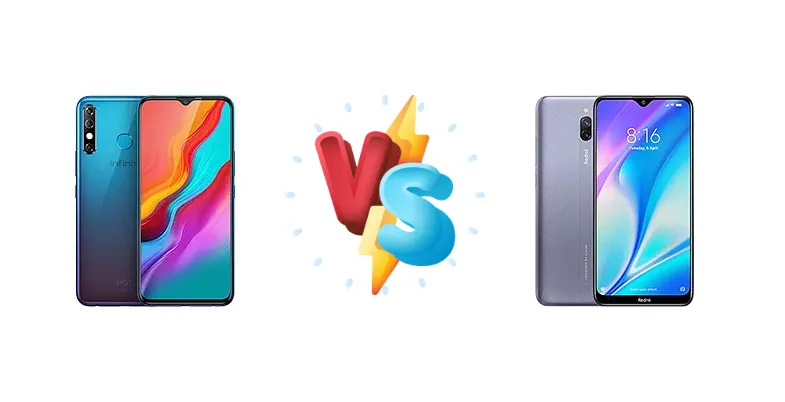
The sub-$150 smartphone market is fiercely competitive. The Infinix Hot 8 and Xiaomi Redmi 8A Pro represent compelling options for users prioritizing affordability. However, they take different approaches to achieving that price point, particularly in chipset selection and feature sets. This comparison dissects those differences to determine which device delivers the best value.
🏆 Quick Verdict
For the average user, the Xiaomi Redmi 8A Pro is the better choice. While the Infinix Hot 8 offers configuration options with a more powerful Helio P22 chipset, the Redmi 8A Pro’s Snapdragon 439 provides a more consistently efficient experience, coupled with the significant advantage of 18W fast charging – a feature absent in the Hot 8.
| Network |
|---|
| 2G bands | GSM 850 / 900 / 1800 / 1900 | GSM 850 / 900 / 1800 / 1900 |
| 3G bands | HSDPA 850 / 900 / 2100 | HSDPA 850 / 900 / 1900 / 2100 |
| 4G bands | 1, 3, 5, 8, 38, 40, 41 | 1, 3, 5, 8, 40, 41 |
| Speed | HSPA 42.2/5.76 Mbps, LTE Cat4 150/50 Mbps | HSPA, LTE |
| Technology | GSM / HSPA / LTE | GSM / HSPA / LTE |
| Launch |
|---|
| Announced | 2019, September 04. Released 2019, September | 2020, April 02. Released 2020, April 02 |
| Status | Discontinued | Discontinued |
| Body |
|---|
| Build | Glass front, glass back | Glass front (Gorilla Glass 5), plastic back, plastic frame |
| Dimensions | 165 x 76.3 x 8.7 mm (6.50 x 3.00 x 0.34 in) | 156.5 x 75.4 x 9.4 mm (6.16 x 2.97 x 0.37 in) |
| SIM | Nano-SIM + Nano-SIM | Nano-SIM + Nano-SIM |
| Weight | 179 g (6.31 oz) | 188 g (6.63 oz) |
| | - | Water-repellent coating |
| Display |
|---|
| Protection | - | Corning Gorilla Glass 5 |
| Resolution | 720 x 1600 pixels, 20:9 ratio (~269 ppi density) | 720 x 1520 pixels, 19:9 ratio (~270 ppi density) |
| Size | 6.52 inches, 102.6 cm2 (~81.5% screen-to-body ratio) | 6.22 inches, 96.6 cm2 (~81.8% screen-to-body ratio) |
| Type | IPS LCD | IPS LCD, 400 nits (typ) |
| Platform |
|---|
| CPU | Quad-core 2.0 GHz Cortex-A53Octa-core 1.8 GHz Cortex-A53 | Octa-core (4x1.95 GHz Cortex-A53 & 4x1.45 GHz Cortex A53) |
| Chipset | Mediatek MT6761 Helio A22 (12 nm) - 32/2 GBMediatek MT6762 Helio P22 (12 nm) - 64/4 GB | Qualcomm SDM439 Snapdragon 439 (12 nm) |
| GPU | PowerVR GE8320 | Adreno 505 |
| OS | Android 10 | Android 9.0 (Pie), planned upgrade to Android 10, MIUI 12 |
| Memory |
|---|
| Card slot | microSDXC (dedicated slot) | microSDXC (dedicated slot) |
| Internal | 32GB 2GB RAM, 64GB 4GB RAM | 32GB 2GB RAM, 32GB 3GB RAM |
| | eMMC 5.1 | eMMC 5.1 |
| Main Camera |
|---|
| Dual | - | 13 MP, f/2.2, (wide), 1/3.1", 1.12µm, PDAF
Auxiliary lens |
| Features | Quad-LED flash, panorama, HDR | LED flash, HDR, panorama |
| Triple | 13 MP, f/1.8, 26mm (wide), 1/3.1", 1.12µm, PDAF
Auxiliary lenses | - |
| Video | 1080p@30fps | 1080p@30fps |
| Selfie camera |
|---|
| Features | LED flash | HDR |
| Single | 8 MP, f/2.0, 25mm (wide) | 8 MP, f/2.0, 1/4.0", 1.12µm |
| Video | 1080p@30fps | 1080p@30fps |
| Sound |
|---|
| 3.5mm jack | Yes | Yes |
| 35mm jack | Yes | Yes |
| Loudspeaker | Yes | Yes |
| | Dirac Surround Sound | - |
| Comms |
|---|
| Bluetooth | 5.0, A2DP, LE | 4.2, A2DP, LE |
| NFC | No | No |
| Positioning | GPS | GPS, GLONASS, BDS |
| Radio | FM radio | FM Radio, built-in antenna |
| USB | microUSB 2.0, OTG | USB Type-C 2.0, OTG |
| WLAN | Wi-Fi 802.11 a/b/g/n/ac, dual-band, Wi-Fi Direct | Wi-Fi 802.11 b/g/n, Wi-Fi Direct |
| Features |
|---|
| Sensors | Fingerprint (rear-mounted), accelerometer, proximity, compass | Accelerometer, proximity, compass |
| Battery |
|---|
| Charging | - | 18W wired
2.5W reverse wired |
| Type | 5000 mAh, non-removable | Li-Po 5000 mAh |
| Misc |
|---|
| Colors | Quetzal Cyan, Cosmic Purple, Shark Grey, Midnight Black | Sky White, Sea Blue, Midnight Grey |
| Models | X650C, X650B, X650D | - |
| Price | About 7000 INR | About 90 EUR |
Infinix Hot 8
- Potential for higher CPU performance with Helio P22 variant
- Larger RAM options available (up to 4GB)
- Potentially lower price point (depending on retailer)
- No fast charging support
- Helio A22 variant offers limited performance
- Less efficient chipset compared to Snapdragon 439
Xiaomi Redmi 8A Pro
- 18W fast charging support
- More efficient Snapdragon 439 chipset
- Generally better software optimization
- Limited RAM options (typically 2GB or 3GB)
- Potentially slightly higher price
- May lack some features found in higher-end Xiaomi models
Display Comparison
Neither device boasts a standout display. Both likely utilize LCD panels, typical for this price bracket. Specifics like resolution and brightness are not provided, but we can assume they are similar – around 720p+ and adequate for indoor use. The focus here isn't on visual fidelity, but rather on basic functionality. Bezels are likely comparable, reflecting the budget nature of both phones.
Camera Comparison
Camera performance is likely to be similar, with both phones relying on budget sensors. Details on sensor size and aperture are missing, but it’s safe to assume both feature a primary sensor around 13MP. Image processing will be a key differentiator, and Xiaomi generally offers more refined software algorithms. The presence of a dedicated night mode on the Redmi 8A Pro (a common feature in Xiaomi phones) would give it an edge in low-light conditions. The inclusion of a 2MP depth sensor on either device is largely marketing fluff and won't significantly impact image quality.
Performance
The core difference lies in the chipsets. The Infinix Hot 8 comes in two configurations: the Helio A22 (quad-core, 2.0 GHz) and the Helio P22 (octa-core, 1.8 GHz). The Xiaomi Redmi 8A Pro features the Snapdragon 439 (octa-core, 1.95 GHz & 1.45 GHz). While the P22 variant of the Hot 8 has more cores than the Snapdragon 439, the Snapdragon’s architecture is more efficient. The 439’s Kryo cores, even with varying clock speeds, generally outperform the Cortex-A53 cores found in both Helio chips in sustained workloads. This translates to smoother multitasking and a more responsive user interface on the Redmi 8A Pro. The A22 variant of the Hot 8 will struggle with demanding tasks. The Redmi 8A Pro’s chipset is better suited for light gaming and everyday applications.
Battery Life
Both phones likely feature around a 5000mAh battery, a common capacity for this segment. However, the Redmi 8A Pro’s 18W fast charging is a game-changer. The Infinix Hot 8 lacks fast charging, relying on standard 5W or 10W charging, resulting in significantly longer charge times. This means the Redmi 8A Pro can go from 0-100% much faster, offering greater convenience. While battery life will be comparable in typical usage, the Redmi 8A Pro’s charging advantage is a substantial benefit.
Buying Guide
Buy the Infinix Hot 8 if you absolutely need the potential for more raw CPU power (with the Helio P22 variant) and are willing to sacrifice charging speed and potentially battery efficiency. Buy the Xiaomi Redmi 8A Pro if you prioritize a smoother, more consistent user experience, faster charging, and a more refined software experience, even if it means slightly less peak CPU performance.
Frequently Asked Questions
❓ Will the Infinix Hot 8's Helio A22 struggle with popular apps like WhatsApp and Facebook?
Yes, the Helio A22 variant of the Infinix Hot 8 will likely exhibit noticeable lag and slowdowns when running multiple apps or demanding tasks like scrolling through Facebook feeds. It's best suited for very basic usage.
❓ How long does it take to fully charge the Xiaomi Redmi 8A Pro with the included charger?
With the 18W charger, the Xiaomi Redmi 8A Pro can typically charge from 0% to 100% in approximately 2.5 to 3 hours. This is significantly faster than the Infinix Hot 8, which could take 5+ hours with a standard charger.
❓ Is the Redmi 8A Pro a good option for playing PUBG Mobile?
The Redmi 8A Pro can run PUBG Mobile, but you'll need to lower the graphics settings to the lowest possible levels to achieve playable frame rates. Expect some stuttering and lag, especially in intense firefights. It's not ideal for serious PUBG gaming.
❓ Does the Infinix Hot 8 support USB-C charging?
No, the Infinix Hot 8 uses a Micro-USB port for charging and data transfer, which is slower and less convenient than the USB-C port found on many modern smartphones.