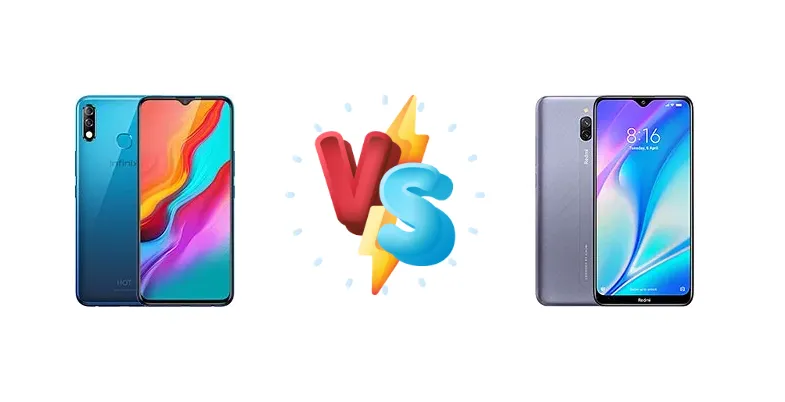
The budget smartphone market is fiercely competitive, offering incredible value for money. Two contenders vying for your attention are the Infinix Hot 8 Lite and the Xiaomi Redmi 8A Pro. Both promise affordability, but which one delivers the best overall experience? Let's dive into a comprehensive comparison.
🏆 Quick Verdict
The Xiaomi Redmi 8A Pro emerges as the clear winner. Its superior Snapdragon 439 chipset, faster charging (including reverse charging), and generally improved performance outweigh the Infinix Hot 8 Lite's strengths. While both are budget options, the Redmi 8A Pro offers a more polished and future-proof experience.
| Network |
|---|
| 2G bands | GSM 850 / 900 / 1800 / 1900 | GSM 850 / 900 / 1800 / 1900 |
| 3G bands | HSDPA 850 / 900 / 1900 / 2100 | HSDPA 850 / 900 / 1900 / 2100 |
| 4G bands | - | 1, 3, 5, 8, 40, 41 |
| Speed | HSPA 42.2/5.76 Mbps, LTE Cat4 150/50 Mbps | HSPA, LTE |
| Technology | GSM / HSPA | GSM / HSPA / LTE |
| Launch |
|---|
| Announced | 2019, October. Released 2019, October | 2020, April 02. Released 2020, April 02 |
| Status | Discontinued | Discontinued |
| Body |
|---|
| Build | Glass front, plastic back, plastic frame | Glass front (Gorilla Glass 5), plastic back, plastic frame |
| Dimensions | 165 x 76.3 x 8.7 mm (6.50 x 3.00 x 0.34 in) | 156.5 x 75.4 x 9.4 mm (6.16 x 2.97 x 0.37 in) |
| SIM | Nano-SIM + Nano-SIM | Nano-SIM + Nano-SIM |
| Weight | 175 g (6.17 oz) | 188 g (6.63 oz) |
| | - | Water-repellent coating |
| Display |
|---|
| Protection | - | Corning Gorilla Glass 5 |
| Resolution | 720 x 1600 pixels, 20:9 ratio (~266 ppi density) | 720 x 1520 pixels, 19:9 ratio (~270 ppi density) |
| Size | 6.6 inches, 105.2 cm2 (~83.5% screen-to-body ratio) | 6.22 inches, 96.6 cm2 (~81.8% screen-to-body ratio) |
| Type | IPS LCD, 450 nits (typ) | IPS LCD, 400 nits (typ) |
| Platform |
|---|
| CPU | Quad-core 1.3 GHz | Octa-core (4x1.95 GHz Cortex-A53 & 4x1.45 GHz Cortex A53) |
| Chipset | Mediatek MT6580 | Qualcomm SDM439 Snapdragon 439 (12 nm) |
| GPU | - | Adreno 505 |
| OS | Android 8.1 Oreo (Go edition) | Android 9.0 (Pie), planned upgrade to Android 10, MIUI 12 |
| Memory |
|---|
| Card slot | microSDXC (dedicated slot) | microSDXC (dedicated slot) |
| Internal | 32GB 2GB RAM | 32GB 2GB RAM, 32GB 3GB RAM |
| | eMMC 5.1 | eMMC 5.1 |
| Main Camera |
|---|
| Dual | 8 MP, f/1.8, PDAF
Auxiliary lens | 13 MP, f/2.2, (wide), 1/3.1", 1.12µm, PDAF
Auxiliary lens |
| Features | Quad-LED flash, panorama, HDR | LED flash, HDR, panorama |
| Video | 1080p@30fps | 1080p@30fps |
| Selfie camera |
|---|
| Features | LED flash | HDR |
| Single | 8 MP | 8 MP, f/2.0, 1/4.0", 1.12µm |
| Video | 1080p@30fps | 1080p@30fps |
| Sound |
|---|
| 3.5mm jack | Yes | Yes |
| 35mm jack | Yes | Yes |
| Loudspeaker | Yes | Yes |
| | Dirac sound
| - |
| Comms |
|---|
| Bluetooth | 5.0, A2DP, LE | 4.2, A2DP, LE |
| NFC | No | No |
| Positioning | GPS | GPS, GLONASS, BDS |
| Radio | FM radio | FM Radio, built-in antenna |
| USB | microUSB 2.0, OTG | USB Type-C 2.0, OTG |
| WLAN | Wi-Fi 802.11 a/b/g/n, Wi-Fi Direct | Wi-Fi 802.11 b/g/n, Wi-Fi Direct |
| Features |
|---|
| Sensors | Fingerprint (rear-mounted), accelerometer, proximity, compass | Accelerometer, proximity, compass |
| Battery |
|---|
| Charging | - | 18W wired
2.5W reverse wired |
| Type | 5000 mAh, non-removable | Li-Po 5000 mAh |
| Misc |
|---|
| Colors | Quetzal Cyan, Cosmic Purple, Shark Grey, Midnight Black | Sky White, Sea Blue, Midnight Grey |
| Models | X650 | - |
| Price | - | About 90 EUR |
Infinix Hot 8 Lite
- Large Display
- Long Battery Life
- Affordable Price
- Weak Processor
- Slow Charging
- Outdated Chipset
Xiaomi Redmi 8A Pro
- Faster Processor
- Faster Charging (18W & Reverse)
- Improved Performance
- Modern Chipset
- Slightly Smaller Display
- Potentially Higher Price
Display Comparison
The Infinix Hot 8 Lite typically features a larger display (around 6.5 inches) with an HD+ resolution. The Redmi 8A Pro usually has a slightly smaller display (around 6.26 inches) also with HD+ resolution. While both are adequate for everyday use, the larger screen on the Infinix might be preferable for media consumption, but the Redmi 8A Pro's smaller size can make it more comfortable to hold.
Camera Comparison
Camera quality is often a compromise in this price range. The Infinix Hot 8 Lite typically has a dual-camera setup, while the Redmi 8A Pro often features a single, improved main camera. While megapixels aren't everything, the Redmi 8A Pro's better image processing and sensor often result in slightly better photos, especially in low light. Both phones likely offer decent front-facing cameras for selfies.
Performance
This is where the Redmi 8A Pro shines. The Qualcomm Snapdragon 439 octa-core processor is significantly more powerful than the Infinix Hot 8 Lite's Mediatek MT6580 quad-core. Expect smoother multitasking, faster app loading times, and a generally more responsive user experience on the Redmi 8A Pro. Gaming performance will also be noticeably better.
Battery Life
Both phones offer large batteries, typically around 5000mAh. However, the Redmi 8A Pro's more efficient chipset and faster charging (18W wired and 2.5W reverse wired) give it an edge. The reverse charging feature is a bonus, allowing you to charge other devices like earbuds or smartwatches.
Buying Guide
The Infinix Hot 8 Lite is a good choice for users prioritizing a large display and extended battery life on an extremely tight budget. The Xiaomi Redmi 8A Pro is ideal for those seeking better performance, faster charging, and a more modern chipset, even if it means a slightly higher price point.
Frequently Asked Questions
❓ Which phone is better for gaming?
The Xiaomi Redmi 8A Pro is significantly better for gaming due to its more powerful processor and better graphics capabilities.
❓ Does the Redmi 8A Pro support reverse charging?
Yes, the Redmi 8A Pro supports 2.5W reverse wired charging, allowing you to charge other devices.
❓ Which phone has a better camera for low-light photography?
The Xiaomi Redmi 8A Pro generally performs better in low-light conditions due to its improved image processing.