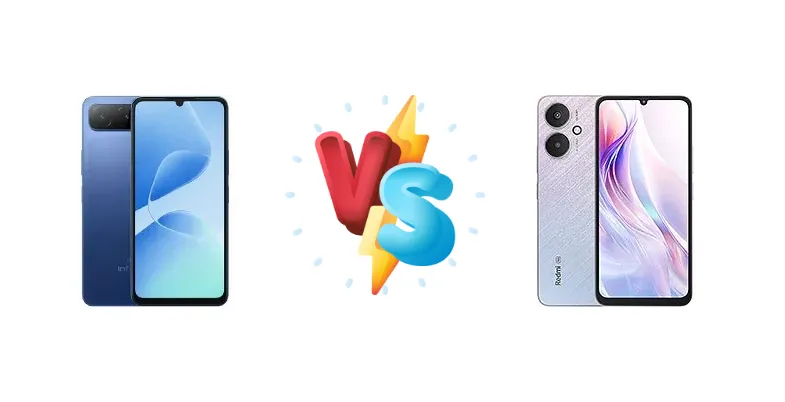
The sub-$200 5G smartphone market is heating up, and the Infinix Hot 60i and Xiaomi Redmi 13C 5G are two key contenders. Both aim to deliver 5G connectivity and a modern smartphone experience without breaking the bank. This comparison dives deep into their specifications to determine which device offers the best balance of performance, features, and value.
🏆 Quick Verdict
For most users, the Infinix Hot 60i emerges as the slightly stronger choice. Its Mediatek Dimensity 6400 chipset, with its higher clocked Cortex-A76 cores, provides a noticeable performance edge in demanding tasks, making it better suited for gaming and multitasking. While both offer similar charging speeds, the Hot 60i's bypass charging is a useful addition.
| Network |
|---|
| 2G bands | GSM 850 / 900 / 1800 / 1900 | GSM 850 / 900 / 1800 / 1900 |
| 3G bands | HSDPA 850 / 900 / 1700(AWS) / 1900 / 2100 | HSDPA 800 / 850 / 900 / 1700(AWS) / 1900 / 2100 - International |
| 4G bands | LTE | 1, 2, 3, 4, 5, 7, 8, 12, 13, 17, 18, 19, 20, 26, 28, 32, 38, 40, 41, 66 - International |
| 5G bands | SA/NSA | 1, 3, 5, 7, 8, 20, 28, 38, 40, 41, 66, 77, 78 SA/NSA - International |
| Speed | HSPA, LTE, 5G | HSPA, LTE, 5G |
| Technology | GSM / HSPA / LTE / 5G | GSM / HSPA / LTE / 5G |
| Launch |
|---|
| Announced | 2025, August 16 | 2023, December 06 |
| Status | Available. Released 2025, August 21 | Available. Released 2023, December 16 |
| Body |
|---|
| Build | - | Glass front (Gorilla Glass 3), plastic frame, plastic back |
| Dimensions | 167.4 x 77.7 x 8.1 mm (6.59 x 3.06 x 0.32 in) | 168.1 x 77.9 x 8.2 mm (6.62 x 3.07 x 0.32 in) |
| SIM | Nano-SIM + Nano-SIM | Nano-SIM + Nano-SIM |
| Weight | 199 g (7.02 oz) | 192 g or 195 g (6.77 oz) |
| Display |
|---|
| Protection | - | Corning Gorilla Glass 3 |
| Resolution | 720 x 1600 pixels, 20:9 ratio (~260 ppi density) | 720 x 1600 pixels, 20:9 ratio (~260 ppi density) |
| Size | 6.75 inches, 110.0 cm2 (~84.6% screen-to-body ratio) | 6.74 inches, 109.7 cm2 (~83.8% screen-to-body ratio) |
| Type | IPS LCD, 120Hz, 560 nits (typ), 670 nits (HBM) | IPS LCD, 90Hz, 450 nits (typ), 600 nits (HBM) |
| Platform |
|---|
| CPU | Octa-core (2x2.5 GHz Cortex-A76 & 6x2.0 GHz Cortex-A55) | Octa-core (2x2.2 GHz Cortex-A76 & 6x2.0 GHz Cortex-A55) |
| Chipset | Mediatek Dimensity 6400 (6 nm) | Mediatek Dimensity 6100+ (6 nm) |
| GPU | Mali-G57 MC2 | Mali-G57 MC2 |
| OS | Android 15, XOS 15.1 | Android 13, MIUI 14 |
| Memory |
|---|
| Card slot | microSDXC (dedicated slot) | microSDXC (dedicated slot) |
| Internal | 128GB 4GB RAM | 64GB 4GB RAM, 128GB 4GB RAM, 128GB 6GB RAM, 256GB 8GB RAM |
| Main Camera |
|---|
| Features | Dual-LED flash, HDR, panorama | LED flash, HDR |
| Single | 50 MP, f/1.6, (wide), AF
Auxiliary lens | 50 MP, f/1.8, 28mm (wide), 1/2.76", 1.12µm, PDAF
Auxiliary lens |
| Video | 1080p@30fps | 1080p@30fps |
| Selfie camera |
|---|
| Features | - | HDR |
| Single | 5 MP, f/2.0, (wide) | 5 MP, f/2.2, (wide) |
| Video | 1080p@30fps | 1080p@30fps |
| Sound |
|---|
| 35mm jack | Yes | Yes |
| Loudspeaker | Yes, with stereo speakers | Yes |
| Comms |
|---|
| Bluetooth | 5.4, A2DP, LE | 5.3, A2DP, LE |
| Infrared port | Yes | - |
| NFC | Yes | Yes (market/region dependent) |
| Positioning | GPS | GPS, GLONASS, GALILEO, BDS |
| Radio | Yes | FM radio |
| USB | USB Type-C 2.0, OTG | USB Type-C 2.0, OTG |
| WLAN | Wi-Fi 802.11 a/b/g/n/ac, dual-band | Wi-Fi 802.11 a/b/g/n/ac, dual-band |
| Features |
|---|
| Sensors | Fingerprint (side-mounted), accelerometer, proximity, compass | Fingerprint (side-mounted), accelerometer, compass |
| Battery |
|---|
| Charging | 18W wired
10W reverse wired
Bypass charging | 18W wired, PD |
| Type | 6000 mAh | 5000 mAh |
| Misc |
|---|
| Colors | Shadow Blue, Sleek Black, Monsoon Green, Plum Red | Starry Black, Twilight Blue, Starry Silver, Starlight Black, Startrail Green, Startrail Silver |
| Models | X6730 | 23124RN87G, 23124RN87I, 23124RN87C |
| Price | About 90 EUR | $ 198.99 / £ 119.00 / € 116.99 / ₹ 10,895 |
| SAR | - | 1.09 W/kg (head) 1.09 W/kg (body) |
| SAR EU | - | 0.98 W/kg (head) 0.98 W/kg (body) |
Infinix Hot 60i
- Faster CPU performance with Dimensity 6400
- 10W Reverse Wired Charging
- Bypass Charging for cooler charging
- Likely less refined software experience
- Camera performance unknown without samples
Xiaomi Redmi 13C 5G
- Power Delivery (PD) charging support
- Potentially more polished software (Xiaomi UI)
- Wider charger compatibility
- Slightly slower CPU performance
- No reverse charging
Display Comparison
Neither device boasts a standout display. Both likely utilize 6.6-inch LCD panels, typical for this price point. The absence of detailed display specs (resolution, brightness, color gamut) suggests a focus on cost-cutting. However, the Redmi 13C 5G’s inclusion of PD charging *could* indicate a slightly more advanced display controller, potentially leading to better power efficiency. Without further data, it’s a tie.
Camera Comparison
Camera performance is difficult to assess without sample images. Both phones likely feature a primary camera and depth/macro sensors. Given the price point, expect modest image quality. The absence of OIS on either device means low-light performance will be limited. The Redmi 13C 5G’s camera system is likely tuned for Xiaomi’s signature vibrant color profile, while Infinix often leans towards a more natural look. Without detailed sensor information, it’s difficult to declare a clear winner; the primary sensor resolution will be the deciding factor.
Performance
The core difference lies in the chipsets. The Infinix Hot 60i’s Mediatek Dimensity 6400 features two Cortex-A76 cores clocked at 2.5 GHz, compared to the Redmi 13C 5G’s Dimensity 6100+ with 2.2 GHz Cortex-A76 cores. This 300 MHz clock speed difference, while seemingly small, translates to a measurable performance boost in CPU-intensive tasks. Both utilize the same Cortex-A55 efficiency cores, but the 6400’s superior CPU clock speed will result in faster app loading and smoother multitasking. The 6nm fabrication process is shared, suggesting similar thermal efficiency, but the Hot 60i will likely sustain higher performance for longer periods.
Battery Life
Both devices feature 18W wired charging, a standard offering in this segment. The Redmi 13C 5G’s inclusion of Power Delivery (PD) offers broader charger compatibility and potentially faster charging with a compatible PD adapter. The Infinix Hot 60i adds 10W reverse wired charging, allowing it to top up other devices, a feature absent on the Redmi. Battery capacity is not specified, but given the similar form factors, they likely hover around the 5000 mAh mark. The Hot 60i’s bypass charging feature allows charging the phone while it’s on, reducing heat generation and potentially extending battery lifespan.
Buying Guide
Buy the Infinix Hot 60i if you prioritize raw processing power for gaming or running multiple apps simultaneously. Its Dimensity 6400 offers a tangible performance advantage. Buy the Xiaomi Redmi 13C 5G if you value a potentially more refined software experience (based on Xiaomi’s established UI) and are less concerned with pushing the absolute limits of performance in this price bracket.
Frequently Asked Questions
❓ Will the Dimensity 6400 in the Infinix Hot 60i handle demanding games like PUBG Mobile smoothly?
The Dimensity 6400’s higher clocked CPU cores should provide a noticeably smoother gaming experience compared to the Dimensity 6100+ in the Redmi 13C 5G. Expect playable frame rates at medium settings, though sustained performance will depend on thermal management. Don't expect flagship-level graphics, but it's capable for casual gaming.
❓ Does the Redmi 13C 5G’s Power Delivery charging mean it charges significantly faster than the Infinix Hot 60i?
While the Redmi 13C 5G supports PD, both phones are rated for 18W charging. PD allows compatibility with a wider range of chargers, and *if* you have a compatible PD charger, you *might* see slightly faster charging speeds. However, without a PD charger, the charging speeds will be comparable.
❓ Is the 10W reverse charging on the Infinix Hot 60i useful for everyday use?
The 10W reverse charging is primarily useful for topping up accessories like wireless earbuds or a smartwatch in a pinch. It won’t rapidly charge another phone, but it’s a convenient feature to have if you frequently find yourself needing to share a little power with a friend or charge a small device on the go.