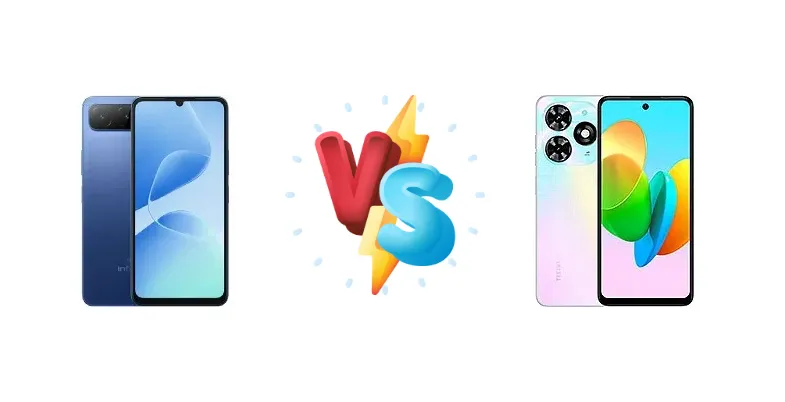
The Infinix Hot 60i and Tecno Spark 20C represent the fiercely competitive sub-$150 smartphone market. Both aim to deliver essential features at an accessible price, but they take different approaches to achieving this. The Hot 60i boasts a significantly newer and more powerful chipset, while the Spark 20C focuses on a streamlined experience. This comparison will dissect their key differences to help you choose the right device.
🏆 Quick Verdict
For the average user prioritizing performance and future-proofing, the Infinix Hot 60i is the clear winner. Its Mediatek Dimensity 6400 chipset offers a substantial leap in processing power compared to the Tecno Spark 20C’s older Cortex-A53, making it better suited for gaming and demanding applications. However, the Spark 20C remains a viable option for basic users.
| Network |
|---|
| 2G bands | GSM 850 / 900 / 1800 / 1900 | GSM 850 / 900 / 1800 / 1900 |
| 3G bands | HSDPA 850 / 900 / 1700(AWS) / 1900 / 2100 | HSDPA 900 / 2100 |
| 4G bands | LTE | LTE |
| 5G bands | SA/NSA | - |
| Speed | HSPA, LTE, 5G | HSPA, LTE |
| Technology | GSM / HSPA / LTE / 5G | GSM / HSPA / LTE |
| Launch |
|---|
| Announced | 2025, August 16 | 2023, November 27 |
| Status | Available. Released 2025, August 21 | Available. Released 2023, December |
| Body |
|---|
| Build | - | Glass front, plastic back, plastic frame |
| Dimensions | 167.4 x 77.7 x 8.1 mm (6.59 x 3.06 x 0.32 in) | 163.7 x 75.6 x 8.6 mm (6.44 x 2.98 x 0.34 in) |
| SIM | Nano-SIM + Nano-SIM | Nano-SIM + Nano-SIM |
| Weight | 199 g (7.02 oz) | - |
| Display |
|---|
| Resolution | 720 x 1600 pixels, 20:9 ratio (~260 ppi density) | 720 x 1612 pixels, 20:9 ratio (~267 ppi density) |
| Size | 6.75 inches, 110.0 cm2 (~84.6% screen-to-body ratio) | 6.6 inches, 104.6 cm2 (~84.6% screen-to-body ratio) |
| Type | IPS LCD, 120Hz, 560 nits (typ), 670 nits (HBM) | IPS LCD, 90Hz |
| Platform |
|---|
| CPU | Octa-core (2x2.5 GHz Cortex-A76 & 6x2.0 GHz Cortex-A55) | Octa-core 2.2 GHz Cortex-A53 |
| Chipset | Mediatek Dimensity 6400 (6 nm) | Mediatek |
| GPU | Mali-G57 MC2 | - |
| OS | Android 15, XOS 15.1 | Android 13 |
| Memory |
|---|
| Card slot | microSDXC (dedicated slot) | microSDXC |
| Internal | 128GB 4GB RAM | 128GB 4GB RAM, 128GB 8GB RAM, 256GB 4GB RAM |
| Main Camera |
|---|
| Features | Dual-LED flash, HDR, panorama | Dual-LED flash, HDR |
| Single | 50 MP, f/1.6, (wide), AF
Auxiliary lens | 50 MP, (wide), 1/2.8", PDAF
Auxiliary lens |
| Video | 1080p@30fps | 1080p@30fps |
| Selfie camera |
|---|
| Features | - | Dual-LED flash |
| Single | 5 MP, f/2.0, (wide) | 8 MP |
| Video | 1080p@30fps | Yes |
| Sound |
|---|
| 35mm jack | Yes | Yes |
| Loudspeaker | Yes, with stereo speakers | Yes, with stereo speakers |
| Comms |
|---|
| Bluetooth | 5.4, A2DP, LE | Yes |
| Infrared port | Yes | - |
| NFC | Yes | No |
| Positioning | GPS | GPS |
| Radio | Yes | FM radio |
| USB | USB Type-C 2.0, OTG | USB Type-C, OTG |
| WLAN | Wi-Fi 802.11 a/b/g/n/ac, dual-band | Yes |
| Features |
|---|
| Sensors | Fingerprint (side-mounted), accelerometer, proximity, compass | Fingerprint (side-mounted), accelerometer, compass |
| Battery |
|---|
| Charging | 18W wired
10W reverse wired
Bypass charging | 18W wired |
| Type | 6000 mAh | 5000 mAh |
| Misc |
|---|
| Colors | Shadow Blue, Sleek Black, Monsoon Green, Plum Red | Mystery White, Alpenglow Gold, Magic Skin, Gravity Black |
| Models | X6730 | BG7n, BG7 |
| Price | About 90 EUR | About 140 EUR |
Infinix Hot 60i
- Significantly more powerful processor (Dimensity 6400)
- Reverse wired charging capability
- Bypass charging for gaming
- May receive fewer software updates due to faster hardware turnover
- Potentially higher price point
Tecno Spark 20C
- Potentially longer software support due to simpler hardware
- Likely more affordable
- Streamlined user experience
- Outdated processor (Cortex-A53)
- Limited performance for gaming and multitasking
- Lacks reverse charging
Display Comparison
Neither device provides display specifications, so a direct comparison is limited. However, given their price points, both likely utilize LCD panels with 720p+ resolution. The absence of details like refresh rate or peak brightness suggests neither prioritizes a premium visual experience. Bezels are likely to be substantial on both, typical for this segment. Color accuracy will likely be standard, leaning towards warmer tones to appear more vibrant.
Camera Comparison
Without detailed camera specifications, a precise comparison is difficult. Both phones likely feature a primary camera alongside auxiliary lenses (potentially a depth or macro sensor). However, the chipset difference suggests the Hot 60i will have a more capable image signal processor (ISP), leading to better image processing, noise reduction, and dynamic range. The Spark 20C’s older chipset will likely result in slower image capture and less refined image quality. We can assume both will perform adequately in well-lit conditions, but the Hot 60i will likely excel in low-light scenarios.
Performance
The core difference lies in the chipsets. The Infinix Hot 60i’s Mediatek Dimensity 6400 (6nm) is a modern processor featuring a combination of 2x 2.5 GHz Cortex-A76 and 6x 2.0 GHz Cortex-A55 cores. This architecture provides a significant performance advantage over the Tecno Spark 20C’s Octa-core 2.2 GHz Cortex-A53. The Dimensity 6400’s newer core design and smaller 6nm process translate to faster application loading, smoother multitasking, and improved gaming performance. The Cortex-A53 in the Spark 20C, while still functional, is an older generation design that will struggle with more demanding tasks. The Hot 60i will benefit users who play graphically intensive games or frequently switch between apps.
Battery Life
Both devices offer 18W wired charging, suggesting similar charging speeds – approximately 2-3 hours for a full charge. The Infinix Hot 60i adds 10W reverse wired charging and bypass charging, features absent on the Spark 20C. Reverse charging allows the Hot 60i to act as a power bank for other devices, a useful feature for users with multiple gadgets. Bypass charging allows charging the phone while it's in use without significantly impacting battery health, beneficial for gamers.
Buying Guide
Buy the Infinix Hot 60i if you need a phone capable of handling modern mobile games, multitasking efficiently, and benefiting from faster software updates thanks to its more powerful processor. Buy the Tecno Spark 20C if you prioritize simplicity, a potentially longer software support lifecycle due to its less demanding hardware, and are primarily focused on basic communication and light social media use.
Frequently Asked Questions
❓ Will the Infinix Hot 60i’s Dimensity 6400 handle demanding games like PUBG Mobile or Call of Duty Mobile?
Yes, the Dimensity 6400 is capable of running PUBG Mobile and Call of Duty Mobile at medium to high settings with playable frame rates. While it won't deliver a flagship gaming experience, it provides a significant improvement over the Tecno Spark 20C and allows for enjoyable gaming sessions.
❓ Does the Tecno Spark 20C have enough processing power for everyday tasks like browsing, social media, and messaging?
The Tecno Spark 20C is sufficient for basic tasks like browsing, social media, and messaging. However, expect some lag when opening multiple apps or switching between them. It's best suited for users who prioritize simplicity and don't require high performance.
❓ What is bypass charging and how does it benefit gamers on the Infinix Hot 60i?
Bypass charging allows you to continue playing games while the phone is charging. Traditionally, charging generates heat which can throttle performance. Bypass charging minimizes this heat buildup, allowing the phone to maintain higher performance levels during extended gaming sessions.
❓ How does the older Cortex-A53 processor in the Tecno Spark 20C impact long-term software support?
While not a guarantee, the Cortex-A53 processor's lower power demands and simpler architecture *could* lead to a longer software support lifecycle for the Tecno Spark 20C. Manufacturers may continue providing security updates for older hardware for a longer period due to reduced strain on resources.