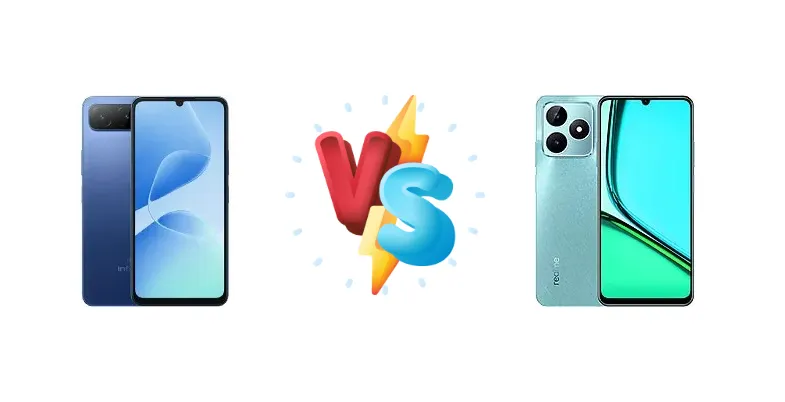
The sub-$200 smartphone market is fiercely competitive, and the Infinix Hot 60i and Realme C51s are two contenders vying for your attention. The Hot 60i boasts a more modern and powerful Mediatek Dimensity 6400 chipset, while the C51s prioritizes rapid 33W charging. This comparison dives deep into the specifics to determine which phone delivers the best overall experience.
🏆 Quick Verdict
For users prioritizing sustained performance and future-proofing, the Infinix Hot 60i is the clear winner. Its Dimensity 6400 chipset offers a significant performance advantage over the Realme C51s' Unisoc Tiger T612. However, the Realme C51s appeals to those who value quick top-ups with its 33W charging.
| Network |
|---|
| 2G bands | GSM 850 / 900 / 1800 / 1900 | GSM 850 / 900 / 1800 / 1900 |
| 3G bands | HSDPA 850 / 900 / 1700(AWS) / 1900 / 2100 | HSDPA 900 / 2100 |
| 4G bands | LTE | 1, 3, 5, 8, 38, 40 |
| 5G bands | SA/NSA | - |
| Speed | HSPA, LTE, 5G | HSPA, LTE |
| Technology | GSM / HSPA / LTE / 5G | GSM / HSPA / LTE |
| Launch |
|---|
| Announced | 2025, August 16 | 2024, March 15 |
| Status | Available. Released 2025, August 21 | Available. Released 2024, March 15 |
| Body |
|---|
| Build | - | Glass front, plastic frame, plastic back |
| Dimensions | 167.4 x 77.7 x 8.1 mm (6.59 x 3.06 x 0.32 in) | 167.2 x 76.7 x 7.5 mm (6.58 x 3.02 x 0.30 in) |
| SIM | Nano-SIM + Nano-SIM | Nano-SIM + Nano-SIM |
| Weight | 199 g (7.02 oz) | 182 g (6.42 oz) |
| Display |
|---|
| Resolution | 720 x 1600 pixels, 20:9 ratio (~260 ppi density) | 720 x 1600 pixels, 20:9 ratio (~260 ppi density) |
| Size | 6.75 inches, 110.0 cm2 (~84.6% screen-to-body ratio) | 6.74 inches, 109.7 cm2 (~85.5% screen-to-body ratio) |
| Type | IPS LCD, 120Hz, 560 nits (typ), 670 nits (HBM) | IPS LCD, 90Hz, 560 nits (peak) |
| Platform |
|---|
| CPU | Octa-core (2x2.5 GHz Cortex-A76 & 6x2.0 GHz Cortex-A55) | Octa-core (2x1.8 GHz Cortex-A75 & 6x1.8 GHz Cortex-A55) |
| Chipset | Mediatek Dimensity 6400 (6 nm) | Unisoc Tiger T612 (12 nm) |
| GPU | Mali-G57 MC2 | Mali-G57 |
| OS | Android 15, XOS 15.1 | Android 13, Realme UI |
| Memory |
|---|
| Card slot | microSDXC (dedicated slot) | microSDXC (dedicated slot) |
| Internal | 128GB 4GB RAM | 128GB 6GB RAM |
| Main Camera |
|---|
| Features | Dual-LED flash, HDR, panorama | LED flash, HDR, panorama |
| Single | 50 MP, f/1.6, (wide), AF
Auxiliary lens | 50 MP, f/1.8, 27mm (wide), 1/2.76", 0.64µm, PDAF
Auxiliary lens |
| Video | 1080p@30fps | 1080p@30fps |
| Selfie camera |
|---|
| Features | - | HDR |
| Single | 5 MP, f/2.0, (wide) | 5 MP, f/2.2, 28mm (wide), 1/5.0", 1.12µm |
| Video | 1080p@30fps | 720p@30fps |
| Sound |
|---|
| 35mm jack | Yes | Yes |
| Loudspeaker | Yes, with stereo speakers | Yes |
| Comms |
|---|
| Bluetooth | 5.4, A2DP, LE | 5.0, A2DP, LE |
| Infrared port | Yes | - |
| NFC | Yes | Yes, 360˚ (market/region dependent) |
| Positioning | GPS | GPS, GLONASS, GALILEO |
| Radio | Yes | Unspecified |
| USB | USB Type-C 2.0, OTG | USB Type-C |
| WLAN | Wi-Fi 802.11 a/b/g/n/ac, dual-band | Wi-Fi 802.11 a/b/g/n/ac, dual-band |
| Features |
|---|
| Sensors | Fingerprint (side-mounted), accelerometer, proximity, compass | Fingerprint (side-mounted), accelerometer, gyro, proximity, compass |
| Battery |
|---|
| Charging | 18W wired
10W reverse wired
Bypass charging | 33W wired, 0-50% in 28 min |
| Type | 6000 mAh | 5000 mAh |
| Misc |
|---|
| Colors | Shadow Blue, Sleek Black, Monsoon Green, Plum Red | Shiny Green, Mighty Black |
| Models | X6730 | RMX3765 |
| Price | About 90 EUR | About 100 EUR |
Infinix Hot 60i
- Significantly more powerful processor (Dimensity 6400)
- More efficient 6nm manufacturing process
- Reverse wireless charging capability
- Slower 18W charging
- Display specifications unknown, potentially average
Realme C51s
- Faster 33W wired charging (0-50% in 28 minutes)
- Potentially better battery life due to charging focus
- Competitive price point
- Less powerful Unisoc Tiger T612 chipset
- 12nm process node less efficient
Display Comparison
Neither device's display specifications are provided, so a direct comparison is limited. However, given the price bracket, both likely utilize LCD panels. The Realme C51s' focus on fast charging suggests a potential emphasis on power efficiency, which *could* translate to slightly better battery life during display use. Without knowing resolution, brightness, or refresh rate, it's difficult to definitively declare a winner. We anticipate both will offer adequate, but not exceptional, viewing experiences.
Camera Comparison
Without detailed camera specifications, a comprehensive comparison is impossible. However, the focus should be on the main sensor. Given the price point, both phones likely feature a primary sensor paired with auxiliary lenses of limited utility. Image processing will play a crucial role, and brand-specific tuning will likely differentiate the results. The absence of OIS on either device suggests reliance on software stabilization, which may not be as effective in low-light conditions. We expect the Infinix Hot 60i's more powerful ISP (integrated signal processor) within the Dimensity 6400 to offer slightly better image processing capabilities.
Performance
The core difference lies in the chipsets. The Infinix Hot 60i’s Mediatek Dimensity 6400 (6nm) is a significant step up from the Realme C51s’ Unisoc Tiger T612 (12nm). The Dimensity 6400’s Cortex-A76 cores, clocked at 2.5 GHz, offer substantially more processing power than the C51s’ Cortex-A75 cores at 1.8 GHz. The 6nm process node further enhances efficiency, leading to less heat generation and potentially sustained performance during extended gaming sessions. The Unisoc T612 is adequate for basic tasks, but will struggle with demanding applications and multitasking. This translates to a noticeably smoother and more responsive experience on the Infinix Hot 60i.
Battery Life
The Realme C51s’ 33W wired charging is a clear advantage, promising a 0-50% charge in just 28 minutes. The Infinix Hot 60i’s 18W charging is considerably slower. While the Hot 60i also offers 10W reverse wired charging – a useful feature for topping up accessories – the C51s’ faster charging speed is more impactful for daily use. Battery capacity isn't specified for either device, but the Dimensity 6400’s 6nm efficiency could partially offset a potentially smaller battery size in the Hot 60i.
Buying Guide
Buy the Infinix Hot 60i if you frequently multitask, play demanding mobile games, or want a phone that will remain responsive for years to come. Its superior processor and efficient 6nm manufacturing process provide a smoother, more reliable experience. Buy the Realme C51s if you prioritize minimizing downtime and need a phone that can quickly regain battery life, even if it means sacrificing some raw processing power. It's ideal for casual users and those who frequently find themselves away from a charger.
Frequently Asked Questions
❓ Will the Infinix Hot 60i handle demanding games like PUBG or Call of Duty?
The Dimensity 6400 chipset in the Infinix Hot 60i is capable of running PUBG and Call of Duty, but you'll likely need to adjust graphics settings to medium or low for a consistently smooth experience. The 6nm process should help mitigate thermal throttling during extended gaming sessions, but it won't match the performance of flagship-level chipsets.
❓ How long does it realistically take to fully charge the Realme C51s with the 33W charger?
Realme claims 0-50% in 28 minutes. A full 0-100% charge will likely take around 60-70 minutes, depending on background processes and battery temperature. This is significantly faster than the Infinix Hot 60i's 18W charging, which could take over 2 hours for a full charge.
❓ Does the Infinix Hot 60i support any form of fast charging protocols beyond standard USB Power Delivery?
While the Infinix Hot 60i supports 18W charging, specific fast charging protocol support (like MediaTek's Pump Express or Qualcomm's Quick Charge) isn't explicitly stated. It's likely to support USB Power Delivery (PD), but using a charger that doesn't adhere to this standard may result in slower charging speeds.
❓ Is the Unisoc Tiger T612 in the Realme C51s sufficient for everyday tasks like browsing, social media, and video streaming?
Yes, the Unisoc Tiger T612 is perfectly adequate for everyday tasks. It will handle browsing, social media, video streaming, and basic app usage without significant issues. However, it will struggle with more demanding applications or heavy multitasking.