
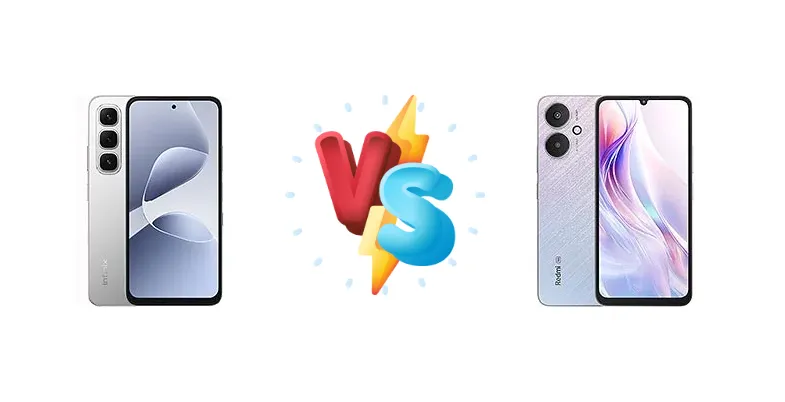
Xiaomi Redmi 13C 5G vs. Infinix Hot 60i: A Deep Dive into Budget Smartphone Choices
| Phones Images | |||||
|---|---|---|---|---|---|
|
🏆 Quick Verdict
For most users, the Xiaomi Redmi 13C 5G is the better choice. Its more modern Mediatek Dimensity 6100+ chipset, built on a 6nm process, provides a performance edge and future-proofs connectivity. While the Infinix Hot 60i’s 45W charging is faster, the Redmi 13C 5G’s 5G capability and improved efficiency offer greater long-term value.
| PHONES | ||
|---|---|---|
| Phone Names | Infinix Hot 60i 4G | Xiaomi Redmi 13C 5G |
| Network | ||
|---|---|---|
| 2G bands | GSM 850 / 900 / 1800 / 1900 | GSM 850 / 900 / 1800 / 1900 |
| 3G bands | HSDPA 850 / 900 / 1700(AWS) / 1900 / 2100 | HSDPA 800 / 850 / 900 / 1700(AWS) / 1900 / 2100 - International |
| 4G bands | 1, 2, 3, 4, 5, 7, 8, 20, 28, 38, 40, 41 | 1, 2, 3, 4, 5, 7, 8, 12, 13, 17, 18, 19, 20, 26, 28, 32, 38, 40, 41, 66 - International |
| 5G bands | - | 1, 3, 5, 7, 8, 20, 28, 38, 40, 41, 66, 77, 78 SA/NSA - International |
| Speed | HSPA, LTE | HSPA, LTE, 5G |
| Technology | GSM / HSPA / LTE | GSM / HSPA / LTE / 5G |
| Launch | ||
|---|---|---|
| Announced | 2025, July 02 | 2023, December 06 |
| Status | Available. Released 2025, July 02 | Available. Released 2023, December 16 |
| Body | ||
|---|---|---|
| Build | Glass front, plastic back, plastic frame | Glass front (Gorilla Glass 3), plastic frame, plastic back |
| Dimensions | 166 x 76.6 x 7.7 mm (6.54 x 3.02 x 0.30 in) | 168.1 x 77.9 x 8.2 mm (6.62 x 3.07 x 0.32 in) |
| SIM | Nano-SIM + Nano-SIM | Nano-SIM + Nano-SIM |
| Weight | 188 g (6.63 oz) | 192 g or 195 g (6.77 oz) |
| Display | ||
|---|---|---|
| Protection | - | Corning Gorilla Glass 3 |
| Resolution | 720 x 1600 pixels, 20:9 ratio (~262 ppi density) | 720 x 1600 pixels, 20:9 ratio (~260 ppi density) |
| Size | 6.7 inches, 108.4 cm2 (~85.2% screen-to-body ratio) | 6.74 inches, 109.7 cm2 (~83.8% screen-to-body ratio) |
| Type | IPS LCD, 120Hz, 700 nits (HBM) | IPS LCD, 90Hz, 450 nits (typ), 600 nits (HBM) |
| Platform | ||
|---|---|---|
| CPU | Octa-core (2x2.0 GHz Cortex-A75 & 6x1.8 GHz Cortex-A55) | Octa-core (2x2.2 GHz Cortex-A76 & 6x2.0 GHz Cortex-A55) |
| Chipset | Mediatek Helio G81 Ultimate (12 nm) | Mediatek Dimensity 6100+ (6 nm) |
| GPU | Mali-G52 MC2 | Mali-G57 MC2 |
| OS | Android 15, XOS 15.1 | Android 13, MIUI 14 |
| Memory | ||
|---|---|---|
| Card slot | microSDXC (dedicated slot) | microSDXC (dedicated slot) |
| Internal | 128GB 4GB RAM, 128GB 6GB RAM, 256GB 4GB RAM, 256GB 8GB RAM | 64GB 4GB RAM, 128GB 4GB RAM, 128GB 6GB RAM, 256GB 8GB RAM |
| Main Camera | ||
|---|---|---|
| Features | Dual-LED flash, HDR, panorama | LED flash, HDR |
| Single | 50 MP, (wide), AF Auxiliary lens | 50 MP, f/1.8, 28mm (wide), 1/2.76", 1.12µm, PDAF Auxiliary lens |
| Video | 1440p@30fps, 1080p@30fps | 1080p@30fps |
| Selfie camera | ||
|---|---|---|
| Features | - | HDR |
| Single | 8 MP, (wide) | 5 MP, f/2.2, (wide) |
| Video | Yes | 1080p@30fps |
| Sound | ||
|---|---|---|
| 35mm jack | Yes | Yes |
| Loudspeaker | Yes, with stereo speakers | Yes |
| Comms | ||
|---|---|---|
| Bluetooth | 5.3, A2DP, LE | 5.3, A2DP, LE |
| Infrared port | Yes | - |
| NFC | Yes (data transfer only; not for payments - market/region dependent) | Yes (market/region dependent) |
| Positioning | GPS | GPS, GLONASS, GALILEO, BDS |
| Radio | FM radio | FM radio |
| USB | USB Type-C 2.0, OTG | USB Type-C 2.0, OTG |
| WLAN | Wi-Fi 802.11 a/b/g/n/ac, dual-band | Wi-Fi 802.11 a/b/g/n/ac, dual-band |
| Features | ||
|---|---|---|
| Sensors | Fingerprint (side-mounted), accelerometer, gyro, proximity, compass | Fingerprint (side-mounted), accelerometer, compass |
| Battery | ||
|---|---|---|
| Charging | 45W wired, 50% in 24 min 10W reverse wired Bypass charging | 18W wired, PD |
| Type | 5160 mAh | 5000 mAh |
| Misc | ||
|---|---|---|
| Colors | Sleek Black, Titanium Silver, Shadow Blue, Neon Red, Meadow Green, Soul Eye Purple | Starry Black, Twilight Blue, Starry Silver, Starlight Black, Startrail Green, Startrail Silver |
| Models | X6728, X6728B | 23124RN87G, 23124RN87I, 23124RN87C |
| Price | About 100 EUR | $ 198.99 / £ 119.00 / € 116.99 / ₹ 10,895 |
| SAR | - | 1.09 W/kg (head) 1.09 W/kg (body) |
| SAR EU | - | 0.98 W/kg (head) 0.98 W/kg (body) |
Infinix Hot 60i 4G
- Significantly faster 45W charging
- 10W reverse wired charging
- Potentially lower price point
- Bypass charging feature
- Older, less efficient Helio G81 chipset
- Limited to 4G connectivity
- Potentially lower performance in demanding tasks
Xiaomi Redmi 13C 5G
- More powerful and efficient Dimensity 6100+ chipset
- 5G connectivity for future-proofing
- Likely better sustained performance
- PD charging support
- Slower 18W charging
- No reverse wired charging
- Potentially slightly higher price
Display Comparison
Neither device boasts a standout display. Both likely utilize LCD panels, common in this price bracket. The key difference lies under the hood. While specific display specs are missing, the Redmi 13C 5G’s chipset is more capable of driving higher refresh rates if the panel supports it. The Hot 60i’s older chipset may struggle to maintain smooth performance at higher refresh rates, potentially impacting scrolling and animations.
Camera Comparison
Camera performance is likely similar, relying heavily on software processing. Both phones likely feature a primary camera and depth/macro sensors. Without specific sensor details, it’s difficult to make a definitive judgment. However, the Redmi 13C 5G’s more powerful chipset can handle more complex image processing algorithms, potentially resulting in better dynamic range and low-light performance. The 2MP macro cameras on both devices are unlikely to deliver significant detail and are primarily for marketing purposes.
Performance
The performance gap is significant. The Xiaomi Redmi 13C 5G’s Mediatek Dimensity 6100+ (6nm) is a substantial upgrade over the Infinix Hot 60i’s Helio G81 Ultimate (12nm). The Dimensity 6100+ features newer Cortex-A76 cores clocked at 2.2 GHz, compared to the Hot 60i’s Cortex-A75 cores at 2.0 GHz. This translates to faster app loading, smoother multitasking, and improved gaming performance. The 6nm process also contributes to better thermal efficiency, reducing throttling during sustained workloads. The Redmi 13C 5G’s 5G modem adds another layer of future-proofing.
Battery Life
The Infinix Hot 60i 4G excels in charging speed with its 45W wired charging, capable of reaching 50% charge in just 24 minutes. The Redmi 13C 5G’s 18W charging is considerably slower. However, the Dimensity 6100+’s 6nm process is more power-efficient, meaning the Redmi 13C 5G may offer comparable or even better battery life despite potentially having a similar capacity battery. The Hot 60i also offers 10W reverse wired charging, a useful feature for topping up accessories, which the Redmi 13C 5G lacks.
Buying Guide
Buy the Infinix Hot 60i 4G if you prioritize extremely fast charging and are content with 4G connectivity. It’s ideal for users who frequently top up their phones and don’t require the latest network technology. Buy the Xiaomi Redmi 13C 5G if you want a phone that’s ready for 5G networks, offers a more efficient processor, and provides a smoother overall experience, even if it means slightly slower charging.