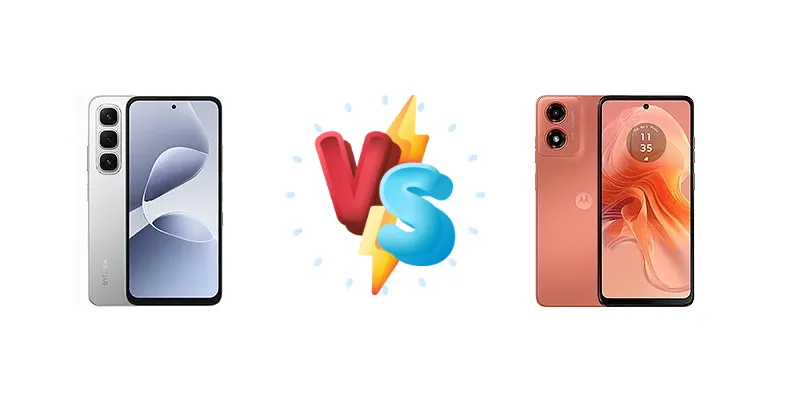
The sub-$150 smartphone market is fiercely competitive. The Infinix Hot 60i 4G and Motorola Moto G04s both aim to deliver essential features at an accessible price point, but they take different approaches to achieving this. The Hot 60i prioritizes faster charging and a more powerful chipset, while the Moto G04s focuses on a clean software experience and a more conservative power profile.
🏆 Quick Verdict
For users prioritizing performance and quick top-ups, the Infinix Hot 60i 4G is the clear winner. Its Helio G81 Ultimate chipset offers a noticeable performance advantage over the Moto G04s’ Unisoc T606, and the 45W charging is significantly faster. However, the Moto G04s remains a viable option for those seeking a simple, reliable experience.
| Network |
|---|
| 2G bands | GSM 850 / 900 / 1800 / 1900 | GSM 850 / 900 / 1800 / 1900 |
| 3G bands | HSDPA 850 / 900 / 1700(AWS) / 1900 / 2100 | HSDPA 850 / 900 / 2100 |
| 4G bands | 1, 2, 3, 4, 5, 7, 8, 20, 28, 38, 40, 41 | 1, 3, 5, 7, 8, 20, 28, 38, 40, 41 |
| Speed | HSPA, LTE | HSPA, LTE |
| Technology | GSM / HSPA / LTE | GSM / HSPA / LTE |
| Launch |
|---|
| Announced | 2025, July 02 | 2024, April 09 |
| Status | Available. Released 2025, July 02 | Available. Released 2024, April 29 |
| Body |
|---|
| Build | Glass front, plastic back, plastic frame | Glass front (Gorilla Glass 3), plastic frame, plastic back |
| Dimensions | 166 x 76.6 x 7.7 mm (6.54 x 3.02 x 0.30 in) | 163.5 x 74.5 x 8 mm (6.44 x 2.93 x 0.31 in) |
| SIM | Nano-SIM + Nano-SIM | Nano-SIM + Nano-SIM |
| Weight | 188 g (6.63 oz) | 178.8 g (6.31 oz) |
| Display |
|---|
| Protection | - | Corning Gorilla Glass 3 |
| Resolution | 720 x 1600 pixels, 20:9 ratio (~262 ppi density) | 720 x 1612 pixels, 20:9 ratio (~269 ppi density) |
| Size | 6.7 inches, 108.4 cm2 (~85.2% screen-to-body ratio) | 6.56 inches, 103.4 cm2 (~84.9% screen-to-body ratio) |
| Type | IPS LCD, 120Hz, 700 nits (HBM) | IPS LCD, 90Hz |
| Platform |
|---|
| CPU | Octa-core (2x2.0 GHz Cortex-A75 & 6x1.8 GHz Cortex-A55) | Octa-core (2x1.6 GHz Cortex-A75 & 6x1.6 GHz Cortex-A55) |
| Chipset | Mediatek Helio G81 Ultimate (12 nm) | Unisoc T606 (12 nm) |
| GPU | Mali-G52 MC2 | Mali-G57 MP1 |
| OS | Android 15, XOS 15.1 | Android 14, no major Android upgrades planned |
| Memory |
|---|
| Card slot | microSDXC (dedicated slot) | microSDXC (dedicated slot) |
| Internal | 128GB 4GB RAM, 128GB 6GB RAM, 256GB 4GB RAM, 256GB 8GB RAM | 64GB 4GB RAM, 128GB 4GB RAM, 128GB 8GB RAM, 256GB 4GB RAM |
| Main Camera |
|---|
| Features | Dual-LED flash, HDR, panorama | LED flash, HDR |
| Single | 50 MP, (wide), AF
Auxiliary lens | 50 MP, f/1.8, (wide), 0.64µm, PDAF |
| Video | 1440p@30fps, 1080p@30fps | 1080p@30fps |
| Selfie camera |
|---|
| Features | - | HDR |
| Single | 8 MP, (wide) | 5 MP, f/2.2, (wide) |
| Video | Yes | 1080p@30fps |
| Sound |
|---|
| 35mm jack | Yes | Yes |
| Loudspeaker | Yes, with stereo speakers | Yes |
| Comms |
|---|
| Bluetooth | 5.3, A2DP, LE | 5.0, A2DP, LE |
| Infrared port | Yes | - |
| NFC | Yes (data transfer only; not for payments - market/region dependent) | Yes (market/region dependent) |
| Positioning | GPS | GPS, GALILEO, GLONASS |
| Radio | FM radio | No |
| USB | USB Type-C 2.0, OTG | USB Type-C 2.0 |
| WLAN | Wi-Fi 802.11 a/b/g/n/ac, dual-band | Wi-Fi 802.11 a/b/g/n/ac, dual-band |
| Features |
|---|
| Sensors | Fingerprint (side-mounted), accelerometer, gyro, proximity, compass | Fingerprint (side-mounted), accelerometer, proximity |
| Battery |
|---|
| Charging | 45W wired, 50% in 24 min
10W reverse wired
Bypass charging | 15W wired |
| Type | 5160 mAh | 5000 mAh |
| Misc |
|---|
| Colors | Sleek Black, Titanium Silver, Shadow Blue, Neon Red, Meadow Green, Soul Eye Purple | Concord Black, Sea Green, Satin Blue, Sunrise Orange |
| Models | X6728, X6728B | XT2421-8 |
| Price | About 100 EUR | £ 90.86 / € 78.23 |
Infinix Hot 60i 4G
- Significantly faster 45W charging
- More powerful Helio G81 Ultimate chipset
- 10W reverse wired charging capability
- Potential for more aggressive software customization
- May generate more heat under sustained load
Motorola Moto G04s
- Clean and streamlined Android experience
- Potentially better battery life due to lower power chipset
- Reliable and consistent performance for basic tasks
- Slow 15W charging
- Less powerful Unisoc T606 chipset
- Limited gaming capabilities
Display Comparison
Neither device boasts a standout display. Both utilize 12nm chipsets, suggesting similar power constraints impacting display capabilities. While specific display specs (resolution, panel type) are missing, the focus here is on performance. The absence of high refresh rates on either device indicates a cost-saving measure, prioritizing battery life over visual fluidity. Bezels are likely comparable given the price bracket, and color accuracy is expected to be standard for this segment.
Camera Comparison
Without detailed camera specifications, a direct comparison is difficult. However, it’s safe to assume both phones will feature a primary camera and potentially a depth or macro sensor. Given the price point, image processing will likely be software-driven, relying on algorithms to enhance image quality. The absence of Optical Image Stabilization (OIS) on either device suggests a focus on affordability. The larger sensor (if present on the Infinix) would be the key differentiator, but without that information, the performance is expected to be similar in good lighting conditions.
Performance
The core difference lies in the chipsets. The Infinix Hot 60i 4G’s MediaTek Helio G81 Ultimate features a dual-core Cortex-A75 setup clocked at 2.0 GHz, paired with six Cortex-A55 cores at 1.8 GHz. This contrasts with the Motorola Moto G04s’ Unisoc T606, which has a similar dual-A75/hexa-A55 configuration but with a lower peak clock speed of 1.6 GHz on both core types. This means the Hot 60i will exhibit superior single-core and multi-core performance, translating to snappier app launches and smoother multitasking. While both use 12nm fabrication, the G81’s architecture provides a performance edge. The Moto G04s will likely be adequate for basic tasks, but will struggle with more demanding games or applications.
Battery Life
The Motorola Moto G04s’ 15W charging is a significant drawback compared to the Infinix Hot 60i 4G’s 45W wired charging. The Hot 60i can reach 50% charge in just 24 minutes, a substantial time saving. While battery capacity isn’t specified, the faster charging of the Hot 60i mitigates the impact of a potentially smaller battery. The Hot 60i also offers 10W reverse wired charging, a feature absent on the Moto G04s, allowing it to act as a power bank for other devices. The Hot 60i’s bypass charging feature also allows direct power from the charger to the phone, reducing heat generation during charging.
Buying Guide
Buy the Infinix Hot 60i 4G if you need a phone capable of handling moderate gaming and multitasking, and if you value the convenience of extremely fast charging. Buy the Motorola Moto G04s if you prefer a streamlined Android experience, prioritize battery longevity over peak performance, and are less concerned with demanding applications.
Frequently Asked Questions
❓ Will the Infinix Hot 60i 4G overheat during extended gaming sessions?
The Helio G81 Ultimate is known to generate some heat under sustained load. However, the Infinix Hot 60i 4G’s bypass charging feature can help mitigate this by reducing heat buildup during charging. Thermal throttling is possible, but the phone is designed for moderate gaming, not prolonged, high-intensity sessions.
❓ Is the Unisoc T606 in the Moto G04s sufficient for running popular social media apps?
Yes, the Unisoc T606 is perfectly capable of handling everyday tasks like browsing social media, messaging, and streaming videos. It’s not a powerhouse, but it provides a smooth experience for basic applications. Expect some slowdown with multiple apps open simultaneously.
❓ Does the Infinix Hot 60i 4G support fast charging with all USB-C chargers?
While the Infinix Hot 60i 4G supports 45W charging, achieving that speed requires a compatible charger that supports Power Delivery (PD) or Quick Charge protocols. Using a standard 5W or 10W charger will still charge the phone, but at a significantly slower rate.