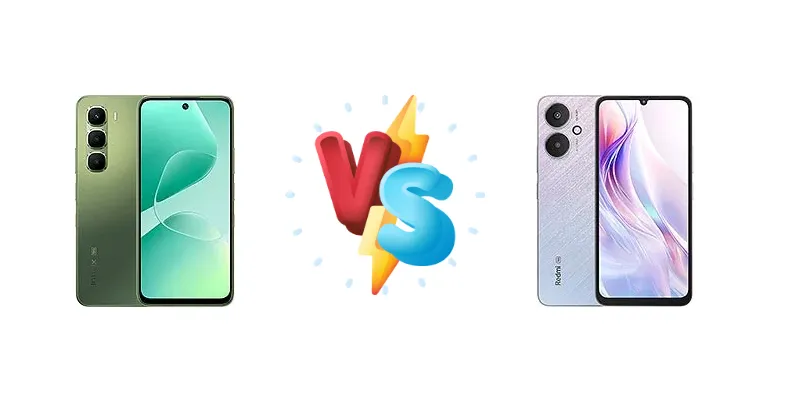
The sub-$200 5G smartphone market is heating up, and the Infinix Hot 60 and Xiaomi Redmi 13C 5G are two strong contenders. Both aim to deliver 5G connectivity and a decent smartphone experience without breaking the bank. However, they take different approaches to achieving this, primarily through their chipset choices. This comparison dives deep into the specifics to determine which phone offers the best overall package.
🏆 Quick Verdict
For most users, the Infinix Hot 60 emerges as the stronger choice. Its Mediatek Dimensity 7020 chipset, featuring Cortex-A78 cores, provides a noticeable performance edge over the Redmi 13C 5G’s Dimensity 6100+, making it better suited for demanding tasks and gaming. While both offer 18W charging, the Hot 60 adds reverse wired charging as a bonus.
| Network |
|---|
| 2G bands | GSM 850 / 900 / 1800 / 1900 | GSM 850 / 900 / 1800 / 1900 |
| 3G bands | HSDPA 850 / 900 / 2100 | HSDPA 800 / 850 / 900 / 1700(AWS) / 1900 / 2100 - International |
| 4G bands | 1, 3, 5, 8, 28, 38, 40, 41 | 1, 2, 3, 4, 5, 7, 8, 12, 13, 17, 18, 19, 20, 26, 28, 32, 38, 40, 41, 66 - International |
| 5G bands | 1, 3, 5, 8, 28, 38, 40, 41, 77, 78 SA/NSA | 1, 3, 5, 7, 8, 20, 28, 38, 40, 41, 66, 77, 78 SA/NSA - International |
| Speed | HSPA, LTE, 5G | HSPA, LTE, 5G |
| Technology | GSM / HSPA / LTE / 5G | GSM / HSPA / LTE / 5G |
| Launch |
|---|
| Announced | 2025, July 11 | 2023, December 06 |
| Status | Available. Released 2025, July 15 | Available. Released 2023, December 16 |
| Body |
|---|
| Build | Glass front, plastic back, plastic frame | Glass front (Gorilla Glass 3), plastic frame, plastic back |
| Dimensions | 166 x 76.8 x 7.8 mm (6.54 x 3.02 x 0.31 in) | 168.1 x 77.9 x 8.2 mm (6.62 x 3.07 x 0.32 in) |
| SIM | Nano-SIM + Nano-SIM | Nano-SIM + Nano-SIM |
| Weight | 193 g (6.81 oz) | 192 g or 195 g (6.77 oz) |
| Display |
|---|
| Protection | - | Corning Gorilla Glass 3 |
| Resolution | 720 x 1600 pixels, 20:9 ratio (~262 ppi density) | 720 x 1600 pixels, 20:9 ratio (~260 ppi density) |
| Size | 6.7 inches, 108.4 cm2 (~85.0% screen-to-body ratio) | 6.74 inches, 109.7 cm2 (~83.8% screen-to-body ratio) |
| Type | IPS LCD, 120Hz, 560 nits (typ), 700 nits (HBM) | IPS LCD, 90Hz, 450 nits (typ), 600 nits (HBM) |
| Platform |
|---|
| CPU | Octa-core (2x2.2 GHz Cortex-A78 & 6x2.0 GHz Cortex-A55) | Octa-core (2x2.2 GHz Cortex-A76 & 6x2.0 GHz Cortex-A55) |
| Chipset | Mediatek Dimensity 7020 (6 nm) | Mediatek Dimensity 6100+ (6 nm) |
| GPU | IMG BXM-8-256 | Mali-G57 MC2 |
| OS | Android 15, up to 3 major Android upgrades, XOS 15.1 | Android 13, MIUI 14 |
| Memory |
|---|
| Card slot | microSDXC (uses shared SIM slot) | microSDXC (dedicated slot) |
| Internal | 128GB 6GB RAM, 256GB 8GB RAM | 64GB 4GB RAM, 128GB 4GB RAM, 128GB 6GB RAM, 256GB 8GB RAM |
| Main Camera |
|---|
| Dual | 50 MP, f/1.6, (wide), AF
other unspecified cameras | - |
| Features | Dual-LED flash | LED flash, HDR |
| Single | - | 50 MP, f/1.8, 28mm (wide), 1/2.76", 1.12µm, PDAF
Auxiliary lens |
| Video | 1440p@30fps, 1080p@30/60/120fps | 1080p@30fps |
| Selfie camera |
|---|
| Features | LED flash | HDR |
| Single | 8 MP, f/2.0, (wide), 1/4.0" | 5 MP, f/2.2, (wide) |
| Video | Yes | 1080p@30fps |
| Sound |
|---|
| 35mm jack | Yes | Yes |
| Loudspeaker | Yes | Yes |
| Comms |
|---|
| Bluetooth | 5.4, A2DP, LE | 5.3, A2DP, LE |
| Infrared port | Yes | - |
| NFC | No | Yes (market/region dependent) |
| Positioning | GPS, GALILEO, GLONASS, BDS | GPS, GLONASS, GALILEO, BDS |
| Radio | No | FM radio |
| USB | USB Type-C 2.0, OTG | USB Type-C 2.0, OTG |
| WLAN | Wi-Fi 802.11 a/b/g/n/ac, dual-band | Wi-Fi 802.11 a/b/g/n/ac, dual-band |
| Features |
|---|
| Sensors | Fingerprint (side-mounted), accelerometer, proximity, compass | Fingerprint (side-mounted), accelerometer, compass |
| Battery |
|---|
| Charging | 18W wired
10W reverse wired
Bypass charging | 18W wired, PD |
| Type | 5200 mAh | 5000 mAh |
| Misc |
|---|
| Colors | Sleek Black, Tundra Green, Shadow Blue, Caramel Glow | Starry Black, Twilight Blue, Starry Silver, Starlight Black, Startrail Green, Startrail Silver |
| Models | X6726 | 23124RN87G, 23124RN87I, 23124RN87C |
| Price | About 110 EUR | $ 198.99 / £ 119.00 / € 116.99 / ₹ 10,895 |
| SAR | - | 1.09 W/kg (head) 1.09 W/kg (body) |
| SAR EU | - | 0.98 W/kg (head) 0.98 W/kg (body) |
Infinix Hot 60
- More powerful processor (Dimensity 7020)
- Reverse wired charging capability
- Potentially better gaming performance
- Brand recognition may be lower than Xiaomi
- Display specs are likely average
Xiaomi Redmi 13C 5G
- Well-established brand (Xiaomi)
- PD fast charging support
- Generally reliable software experience
- Less powerful processor (Dimensity 6100+)
- Limited features beyond basic functionality
Display Comparison
Neither device boasts a standout display. Both likely utilize LCD panels, common in this price bracket. The focus here is on functionality rather than fidelity. While specific display specs (resolution, brightness) are missing, the overall user experience will likely be similar – adequate for everyday use but not ideal for media consumption in bright sunlight. Bezels are expected to be noticeable on both devices, contributing to a less immersive viewing experience.
Camera Comparison
Camera performance is likely to be similar, focusing on basic photography needs. Both phones will likely feature a primary camera and auxiliary sensors. Without specific sensor size or aperture information, it’s difficult to make a definitive judgment. However, the image processing algorithms employed by Infinix and Xiaomi will likely be the deciding factor. Expect decent results in good lighting conditions, but image quality will suffer in low-light scenarios. The inclusion of a 2MP macro camera on the Redmi 13C 5G is unlikely to significantly enhance the photography experience.
Performance
The core difference lies in the chipsets. The Infinix Hot 60’s Mediatek Dimensity 7020 (6nm) utilizes two high-performance Cortex-A78 cores clocked at 2.2 GHz, paired with six Cortex-A55 cores. This configuration provides a significant advantage in CPU-intensive tasks compared to the Redmi 13C 5G’s Dimensity 6100+ (6nm), which features two Cortex-A76 cores at the same 2.2 GHz speed. While both have six A55 cores, the A78 architecture is demonstrably more efficient and powerful than the A76. This translates to faster app loading times, smoother multitasking, and better gaming performance on the Infinix. Both phones likely feature similar RAM configurations, but the chipset difference will be the primary bottleneck.
Battery Life
Both the Infinix Hot 60 and Xiaomi Redmi 13C 5G feature 18W wired charging. The Redmi 13C 5G adds PD (Power Delivery) support, which can offer slightly more efficient charging with compatible chargers. Battery capacity is not specified, but typical capacities for this segment range from 5000mAh to 5500mAh. The Infinix Hot 60’s inclusion of 10W reverse wired charging is a unique feature, allowing it to charge other devices, like earbuds or smartwatches, making it more versatile.
Buying Guide
Buy the Infinix Hot 60 if you prioritize performance for gaming or multitasking and appreciate the convenience of reverse charging. It’s the better option for users who want a phone that feels responsive and can handle more than just basic tasks. Buy the Xiaomi Redmi 13C 5G if you are looking for a simple, reliable 5G experience and prioritize a well-known brand ecosystem. It’s a solid choice for users who primarily use their phone for calls, texts, and light social media.
Frequently Asked Questions
❓ Will the Infinix Hot 60 handle demanding games like PUBG Mobile or Call of Duty?
The Dimensity 7020 chipset in the Infinix Hot 60 is capable of running PUBG Mobile and Call of Duty, but you'll likely need to lower graphics settings to achieve a consistently smooth frame rate. The Cortex-A78 cores provide a performance advantage over the Redmi 13C 5G, making it the better choice for mobile gaming.
❓ Does the Redmi 13C 5G support VoLTE and VoWiFi for improved call quality?
While not explicitly stated, Xiaomi typically includes VoLTE (Voice over LTE) and VoWiFi (Voice over Wi-Fi) support in their 5G devices. However, compatibility depends on your carrier. It's best to check with your mobile provider to confirm support in your region.
❓ How long will it take to fully charge the Infinix Hot 60 from 0% to 100% with the included charger?
With 18W charging, expect a full charge from 0% to 100% to take approximately 2.5 to 3 hours. Charging times can vary depending on usage during charging and ambient temperature.
❓ Is the reverse charging feature on the Infinix Hot 60 useful for everyday use?
The 10W reverse charging is primarily useful for topping up smaller devices like wireless earbuds, smartwatches, or other phones in emergencies. It's not a replacement for a dedicated power bank, but it adds a convenient layer of functionality.