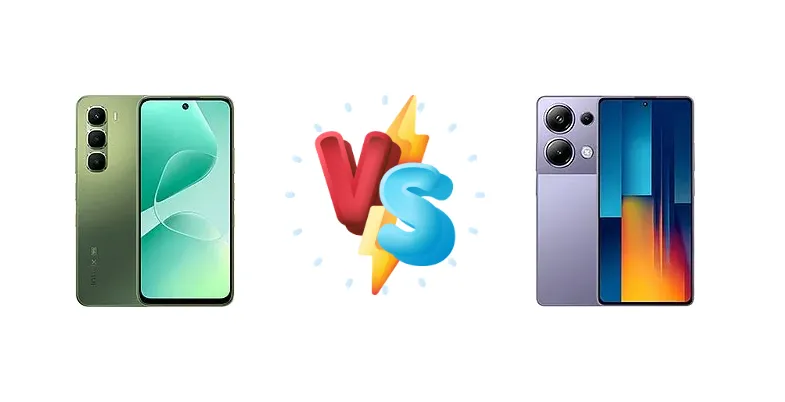
The sub-$200 smartphone market is fiercely competitive, and the Infinix Hot 60 and Xiaomi Poco M6 Pro 4G represent compelling options. The Hot 60 aims for performance with its Dimensity 7020, while the Poco M6 Pro prioritizes endurance and rapid charging with its Helio G99 Ultra and 67W charging. This comparison dissects their strengths and weaknesses to determine which device best suits your needs.
🏆 Quick Verdict
For the average user prioritizing all-day battery life and incredibly fast charging, the Xiaomi Poco M6 Pro 4G is the better choice. Its 67W charging, achieving 100% in just 44 minutes, and impressive 11:46h active use score outweigh the Hot 60’s slightly more powerful chipset for most everyday tasks.
| Network |
|---|
| 2G bands | GSM 850 / 900 / 1800 / 1900 | GSM 850 / 900 / 1800 / 1900 |
| 3G bands | HSDPA 850 / 900 / 2100 | HSDPA 800 / 850 / 900 / 1700(AWS) / 1900 / 2100 |
| 4G bands | 1, 3, 5, 8, 28, 38, 40, 41 | 1, 2, 3, 4, 5, 7, 8, 12, 13, 17, 18, 19, 20, 26, 28, 38, 40, 41, 66 |
| 5G bands | 1, 3, 5, 8, 28, 38, 40, 41, 77, 78 SA/NSA | - |
| Speed | HSPA, LTE, 5G | HSPA, LTE |
| Technology | GSM / HSPA / LTE / 5G | GSM / HSPA / LTE |
| Launch |
|---|
| Announced | 2025, July 11 | 2024, January 11 |
| Status | Available. Released 2025, July 15 | Available. Released 2024, January 12 |
| Body |
|---|
| Build | Glass front, plastic back, plastic frame | Glass front (Gorilla Glass 5), plastic frame |
| Dimensions | 166 x 76.8 x 7.8 mm (6.54 x 3.02 x 0.31 in) | 161.1 x 75 x 8 mm (6.34 x 2.95 x 0.31 in) |
| SIM | Nano-SIM + Nano-SIM | Nano-SIM + Nano-SIM |
| Weight | 193 g (6.81 oz) | 179 g (6.31 oz) |
| Display |
|---|
| Protection | - | Corning Gorilla Glass 5 |
| Resolution | 720 x 1600 pixels, 20:9 ratio (~262 ppi density) | 1080 x 2400 pixels, 20:9 ratio (~395 ppi density) |
| Size | 6.7 inches, 108.4 cm2 (~85.0% screen-to-body ratio) | 6.67 inches, 107.4 cm2 (~88.9% screen-to-body ratio) |
| Type | IPS LCD, 120Hz, 560 nits (typ), 700 nits (HBM) | AMOLED, 120Hz, 1000 nits (HBM), 1300 nits (peak) |
| Platform |
|---|
| CPU | Octa-core (2x2.2 GHz Cortex-A78 & 6x2.0 GHz Cortex-A55) | Octa-core (2x2.2 GHz Cortex-A76 & 6x2.0 GHz Cortex-A55) |
| Chipset | Mediatek Dimensity 7020 (6 nm) | Mediatek Helio G99 Ultra |
| GPU | IMG BXM-8-256 | Mali-G57 MC2 |
| OS | Android 15, up to 3 major Android upgrades, XOS 15.1 | Android 13, MIUI 14, planned upgrade to Android 14, HyperOS |
| Memory |
|---|
| Card slot | microSDXC (uses shared SIM slot) | microSDXC (uses shared SIM slot) |
| Internal | 128GB 6GB RAM, 256GB 8GB RAM | 256GB 8GB RAM, 512GB 12GB RAM |
| Main Camera |
|---|
| Dual | 50 MP, f/1.6, (wide), AF
other unspecified cameras | - |
| Features | Dual-LED flash | LED flash, HDR, panorama |
| Triple | - | 64 MP, f/1.8, 25mm (wide), 1/2.0", 0.7µm, PDAF, OIS
8 MP, f/2.2, (ultrawide)
2 MP (macro) |
| Video | 1440p@30fps, 1080p@30/60/120fps | 1080p@30/60fps, gyro-EIS |
| Selfie camera |
|---|
| Features | LED flash | - |
| Single | 8 MP, f/2.0, (wide), 1/4.0" | 16 MP, f/2.5, (wide) |
| Video | Yes | 1080p@30/60fps |
| Sound |
|---|
| 35mm jack | Yes | Yes |
| Loudspeaker | Yes | Yes, with dual speakers |
| Comms |
|---|
| Bluetooth | 5.4, A2DP, LE | 5.2, A2DP, LE |
| Infrared port | Yes | Yes |
| NFC | No | Yes (market/region dependent) |
| Positioning | GPS, GALILEO, GLONASS, BDS | GPS, GALILEO, GLONASS, BDS |
| Radio | No | FM radio |
| USB | USB Type-C 2.0, OTG | USB Type-C 2.0, OTG |
| WLAN | Wi-Fi 802.11 a/b/g/n/ac, dual-band | Wi-Fi 802.11 a/b/g/n/ac, dual-band |
| Features |
|---|
| Sensors | Fingerprint (side-mounted), accelerometer, proximity, compass | Fingerprint (under display, optical), accelerometer, gyro, compass |
| Battery |
|---|
| Charging | 18W wired
10W reverse wired
Bypass charging | 67W wired, 100% in 44 min |
| Type | 5200 mAh | 5000 mAh |
| Misc |
|---|
| Colors | Sleek Black, Tundra Green, Shadow Blue, Caramel Glow | Black, Blue, Purple |
| Models | X6726 | 2312FPCA6G |
| Price | About 110 EUR | $ 170.00 |
| SAR | - | 1.09 W/kg (head) 1.09 W/kg (body) |
| SAR EU | - | 0.99 W/kg (head) 0.99 W/kg (body) |
Infinix Hot 60
- Potentially faster CPU performance with Dimensity 7020
- 6nm process for potentially better thermal management
- Reverse wired charging for accessory top-ups
- Significantly slower 18W charging
- Likely lower peak display brightness
- Limited battery life information
Xiaomi Poco M6 Pro 4G
- Exceptional battery life (11:46h active use)
- Ultra-fast 67W charging (0-100% in 44 minutes)
- Bright 1053 nit display for outdoor visibility
- Slightly less powerful CPU cores (Cortex-A76 vs A78)
- Helio G99 Ultra may throttle under sustained load
- Camera performance relies heavily on software optimization
Display Comparison
The Poco M6 Pro 4G boasts a significantly brighter display, reaching a measured peak of 1053 nits. This is a substantial advantage for outdoor visibility compared to the Infinix Hot 60, which lacks published brightness data. While both likely utilize IPS LCD panels, the Poco’s higher brightness translates to a more usable experience in direct sunlight. We expect both to have standard 60Hz refresh rates given their price point, but the Poco’s brightness is a clear win.
Camera Comparison
Context data for both phones is limited regarding camera capabilities. However, given the market positioning, we can infer that both will feature multi-camera setups focused on versatility rather than flagship-level image quality. The Poco M6 Pro 4G likely benefits from Xiaomi’s established image processing algorithms. Without detailed sensor information, it’s difficult to definitively declare a winner, but Xiaomi’s track record suggests a more refined camera experience. We anticipate both phones will include a standard macro lens, which are often of limited practical use.
Performance
Both phones utilize octa-core MediaTek chipsets, but with key architectural differences. The Infinix Hot 60’s Dimensity 7020 (6nm) features two Cortex-A78 cores clocked at 2.2 GHz, offering a performance edge in CPU-intensive tasks compared to the Poco M6 Pro’s Helio G99 Ultra, which uses two Cortex-A76 cores at the same 2.2 GHz. However, the G99 Ultra is optimized for efficiency. While the Dimensity 7020 may win in benchmarks, the G99 Ultra’s efficiency could lead to more sustained performance during extended gaming sessions. The 6nm process of the Dimensity 7020 *should* offer better thermal efficiency, but real-world testing is needed to confirm.
Battery Life
The Poco M6 Pro 4G clearly dominates in battery and charging. Its active use score of 11:46h demonstrates excellent endurance. Crucially, the 67W wired charging, capable of a full charge in just 44 minutes, is a game-changer. The Infinix Hot 60’s 18W charging is significantly slower, making it less convenient for users who need to quickly top up their battery. The Hot 60 also offers 10W reverse wired charging, a niche feature for charging accessories, but the Poco’s charging speed is a far more impactful benefit for the majority of users.
Buying Guide
Buy the Infinix Hot 60 if you frequently engage in demanding tasks like mobile gaming or video editing and need the extra processing power offered by the Dimensity 7020. Buy the Xiaomi Poco M6 Pro 4G if you prioritize battery life, fast charging, and a brighter display for comfortable outdoor use, making it ideal for content consumption and users on the go.
Frequently Asked Questions
❓ Does the Helio G99 Ultra in the Poco M6 Pro 4G overheat during prolonged gaming sessions?
While the Helio G99 Ultra isn't a flagship chipset, it's designed for efficiency. The 6nm process helps manage thermals, but sustained gaming at maximum settings *could* lead to some throttling. However, the Poco M6 Pro 4G’s thermal design and software optimization will play a crucial role in mitigating this. It's unlikely to reach critical temperatures, but expect some performance reduction after extended play.
❓ Is the 18W charging on the Infinix Hot 60 slow enough to be a dealbreaker?
For users accustomed to fast charging, the 18W charging on the Infinix Hot 60 will feel noticeably slower. Compared to the Poco M6 Pro 4G’s 67W charging, it takes significantly longer to reach a full charge. If you frequently need to quickly top up your battery, the Hot 60’s charging speed is a significant drawback.
❓ How does the Dimensity 7020 in the Infinix Hot 60 compare to the Snapdragon 695 5G in terms of 5G connectivity?
The Dimensity 7020 offers a more modern 5G modem than the Snapdragon 695. While both support 5G, the Dimensity 7020 generally provides faster download and upload speeds, as well as better network aggregation capabilities, resulting in a more reliable 5G experience. However, real-world 5G performance also depends on carrier network conditions.