
Infinix Hot 60 vs OnePlus Nord CE 3 Lite: A Detailed Comparison
| Phones Images | |||||
|---|---|---|---|---|---|
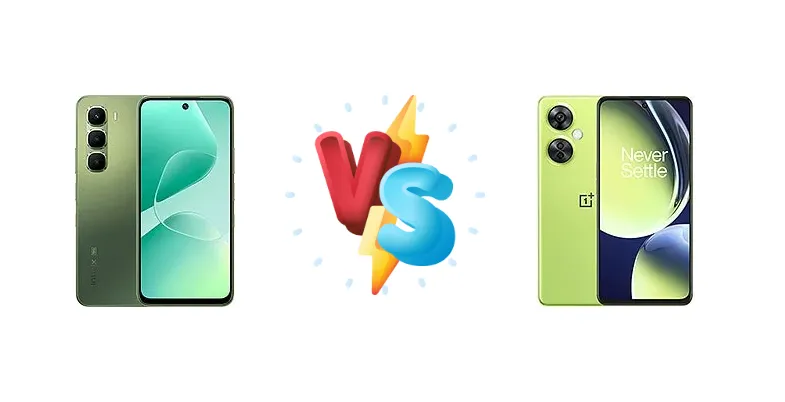
|
🏆 Quick Verdict
For the average user prioritizing fast charging and a well-established brand experience, the OnePlus Nord CE 3 Lite is the better choice. Its 67W charging significantly reduces downtime. However, the Infinix Hot 60 offers a potentially more powerful CPU for demanding tasks, making it a strong contender for power users on a tight budget.
| PHONES | ||
|---|---|---|
| Phone Names | Infinix Hot 60 | OnePlus Nord CE 3 Lite |
| Network | ||
|---|---|---|
| 2G bands | GSM 850 / 900 / 1800 / 1900 | GSM 850 / 900 / 1800 / 1900 |
| 3G bands | HSDPA 850 / 900 / 2100 | HSDPA 800 / 850 / 900 / 1700(AWS) / 1900 / 2100 - International |
| 4G bands | 1, 3, 5, 8, 28, 38, 40, 41 | 1, 2, 3, 4, 5, 7, 8, 12, 13, 17, 18, 19, 20, 26, 28, 32, 38, 39, 40, 41, 66 - International |
| 5G bands | 1, 3, 5, 8, 28, 38, 40, 41, 77, 78 SA/NSA | 1, 3, 5, 7, 8, 20, 28, 38, 40, 41, 66, 77, 78 SA/NSA - International |
| Speed | HSPA, LTE, 5G | HSPA, LTE, 5G |
| Technology | GSM / HSPA / LTE / 5G | GSM / HSPA / LTE / 5G |
| - | 1, 3, 5, 8, 28, 40, 41, 77, 78 SA/NSA - India | |
| Launch | ||
|---|---|---|
| Announced | 2025, July 11 | 2023, April 04 |
| Status | Available. Released 2025, July 15 | Available. Released 2023, April 11 |
| Body | ||
|---|---|---|
| Build | Glass front, plastic back, plastic frame | Glass front, plastic frame, plastic back |
| Dimensions | 166 x 76.8 x 7.8 mm (6.54 x 3.02 x 0.31 in) | 165.5 x 76 x 8.3 mm (6.52 x 2.99 x 0.33 in) |
| SIM | Nano-SIM + Nano-SIM | Nano-SIM + Nano-SIM |
| Weight | 193 g (6.81 oz) | 195 g (6.88 oz) |
| Display | ||
|---|---|---|
| Protection | - | Corning Gorilla Glass |
| Resolution | 720 x 1600 pixels, 20:9 ratio (~262 ppi density) | 1080 x 2400 pixels, 20:9 ratio (~391 ppi density) |
| Size | 6.7 inches, 108.4 cm2 (~85.0% screen-to-body ratio) | 6.72 inches, 109.6 cm2 (~87.1% screen-to-body ratio) |
| Type | IPS LCD, 120Hz, 560 nits (typ), 700 nits (HBM) | IPS LCD, 120Hz, 550 nits (typ), 680 nits (peak) |
| Platform | ||
|---|---|---|
| CPU | Octa-core (2x2.2 GHz Cortex-A78 & 6x2.0 GHz Cortex-A55) | Octa-core (2x2.2 GHz Kryo 660 Gold & 6x1.7 GHz Kryo 660 Silver) |
| Chipset | Mediatek Dimensity 7020 (6 nm) | Qualcomm SM6375 Snapdragon 695 5G (6 nm) |
| GPU | IMG BXM-8-256 | Adreno 619 |
| OS | Android 15, up to 3 major Android upgrades, XOS 15.1 | Android 13, OxygenOS 13.1 |
| Memory | ||
|---|---|---|
| Card slot | microSDXC (uses shared SIM slot) | microSDXC (uses shared SIM slot) |
| Internal | 128GB 6GB RAM, 256GB 8GB RAM | 128GB 8GB RAM, 256GB 8GB RAM |
| - | UFS 2.2 | |
| Main Camera | ||
|---|---|---|
| Dual | 50 MP, f/1.6, (wide), AF other unspecified cameras | - |
| Features | Dual-LED flash | LED flash, HDR, panorama |
| Triple | - | 108 MP, f/1.8, (wide), 1/1.67", 0.64µm, PDAF 2 MP (macro) Auxiliary lens |
| Video | 1440p@30fps, 1080p@30/60/120fps | 1080p@30fps |
| Selfie camera | ||
|---|---|---|
| Features | LED flash | HDR, panorama |
| Single | 8 MP, f/2.0, (wide), 1/4.0" | 16 MP, f/2.4, (wide), 1.0µm |
| Video | Yes | 1080p@30fps |
| Sound | ||
|---|---|---|
| 3.5mm jack | - | Yes |
| 35mm jack | Yes | Yes |
| Loudspeaker | Yes | Yes, with stereo speakers |
| Comms | ||
|---|---|---|
| Bluetooth | 5.4, A2DP, LE | 5.1, A2DP, LE, aptX HD |
| Infrared port | Yes | - |
| NFC | No | Yes (market/region dependent) |
| Positioning | GPS, GALILEO, GLONASS, BDS | GPS, GALILEO, GLONASS, BDS, QZSS |
| Radio | No | No |
| USB | USB Type-C 2.0, OTG | USB Type-C 2.0, OTG |
| WLAN | Wi-Fi 802.11 a/b/g/n/ac, dual-band | Wi-Fi 802.11 a/b/g/n/ac, dual-band |
| Features | ||
|---|---|---|
| Sensors | Fingerprint (side-mounted), accelerometer, proximity, compass | Fingerprint (side-mounted), accelerometer, gyro, proximity, compass |
| Battery | ||
|---|---|---|
| Charging | 18W wired 10W reverse wired Bypass charging | 67W wired, 80% in 30 min |
| Type | 5200 mAh | Li-Po 5000 mAh |
| Misc | ||
|---|---|---|
| Colors | Sleek Black, Tundra Green, Shadow Blue, Caramel Glow | Pastel Lime, Chromatic Gray |
| Models | X6726 | CPH2467, CPH2465 |
| Price | About 110 EUR | £ 169.98 / € 209.99 |
| SAR | - | 1.17 W/kg (head) 0.70 W/kg (body) |
| Tests | ||
|---|---|---|
| Performance | - | AnTuTu: 412006 (v9) GeekBench: 2052 (v5) GFXBench: 17fps (ES 3.1 onscreen) |
Infinix Hot 60
- Potentially stronger CPU performance with Dimensity 7020
- Reverse wired charging for accessory top-ups
- Competitive price point
- Significantly slower 18W charging
- Less established brand reputation
- Likely less optimized software experience
OnePlus Nord CE 3 Lite
- Ultra-fast 67W charging
- Well-known and trusted brand (OnePlus)
- Generally smoother software experience
- CPU potentially less powerful than the Dimensity 7020
- May be slightly more expensive
- No reverse wireless charging
Display Comparison
Neither device boasts a standout display. Both likely utilize LCD panels, a common trait in this price bracket. While specific details like peak brightness and color gamut coverage are unavailable, the focus here is on processing power. Bezels are expected to be similar, and color accuracy will likely be adequate for everyday use, but not professional color work. The absence of high refresh rates on either device suggests a focus on efficiency rather than visual fluidity.
Camera Comparison
Without detailed sensor information, a direct camera comparison is difficult. Both phones likely feature a multi-camera setup with a primary sensor, ultrawide, and potentially a depth or macro lens. The image processing style will likely differ – OnePlus generally aims for more natural colors, while Infinix often boosts saturation. The absence of Optical Image Stabilization (OIS) on either device suggests reliance on software stabilization, which can introduce artifacts in low-light conditions. The usefulness of any 2MP macro lens included on either phone is questionable, offering limited detail and dynamic range.
Performance
The core difference lies in the chipsets. The Infinix Hot 60’s Mediatek Dimensity 7020 (6nm) features a 2x2.2 GHz Cortex-A78 and 6x2.0 GHz Cortex-A55 configuration. This architecture suggests a stronger emphasis on peak performance, particularly in single-core tasks, compared to the OnePlus Nord CE 3 Lite’s Qualcomm Snapdragon 695 5G (6nm) with its 2x2.2 GHz Kryo 660 Gold and 6x1.7 GHz Kryo 660 Silver cores. While both are 6nm chips offering good efficiency, the Cortex-A78 cores in the Dimensity 7020 generally outperform the Kryo 660 Gold cores. However, Qualcomm’s Snapdragon typically excels in sustained performance and GPU efficiency, potentially leading to smoother gaming experiences despite the theoretical CPU advantage of the Infinix. RAM configurations are not specified, but LPDDR4X is likely on both, limiting memory bandwidth.
Battery Life
The OnePlus Nord CE 3 Lite’s 67W wired charging is a game-changer. The claim of 80% charge in 30 minutes significantly reduces downtime compared to the Infinix Hot 60’s 18W charging. While the Infinix Hot 60 also offers 10W reverse wired charging, a useful feature for topping up accessories, it doesn’t compensate for the slower primary charging speed. Battery capacity is not specified for either device, but the faster charging of the Nord CE 3 Lite effectively mitigates the impact of a potentially smaller battery.
Buying Guide
Buy the Infinix Hot 60 if you need a phone capable of handling demanding applications and multitasking, and are willing to trade off charging speed for raw processing power. Buy the OnePlus Nord CE 3 Lite if you prioritize quick top-ups, a streamlined software experience, and a brand known for consistent updates and support. The Nord CE 3 Lite is ideal for users who value convenience and reliability over absolute peak performance.