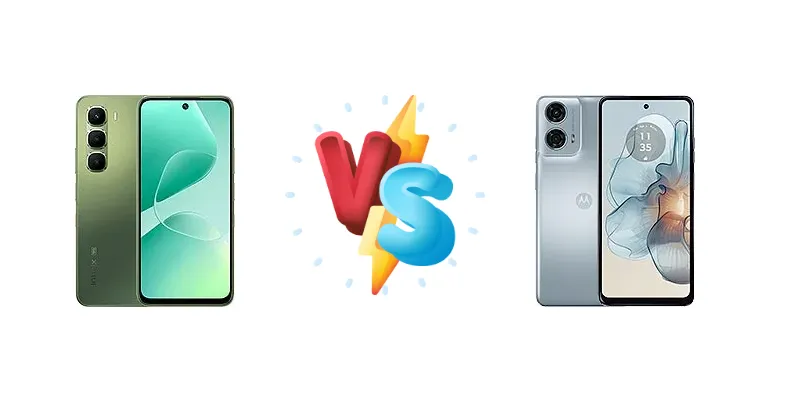
The sub-$200 smartphone market is fiercely competitive. The Infinix Hot 60 and Motorola Moto G24 Power both aim to deliver a compelling experience, but they take different approaches. The Infinix prioritizes processing power with a newer Dimensity chipset, while the Motorola focuses on maximizing battery life and charging speed. This comparison dissects these trade-offs to help you choose the right device.
🏆 Quick Verdict
For users prioritizing smooth multitasking and gaming, the Infinix Hot 60 is the better choice thanks to its significantly more powerful Dimensity 7020 chipset. However, the Motorola Moto G24 Power wins for those who value rapid charging and extended battery life, offering 30W charging versus the Infinix's 18W.
| Network |
|---|
| 2G bands | GSM 850 / 900 / 1800 / 1900 | GSM 850 / 900 / 1800 / 1900 |
| 3G bands | HSDPA 850 / 900 / 2100 | HSDPA 850 / 900 / 1900 / 2100 |
| 4G bands | 1, 3, 5, 8, 28, 38, 40, 41 | 1, 2, 3, 5, 7, 8, 20, 28, 38, 40, 41 |
| 5G bands | 1, 3, 5, 8, 28, 38, 40, 41, 77, 78 SA/NSA | - |
| Speed | HSPA, LTE, 5G | HSPA, LTE |
| Technology | GSM / HSPA / LTE / 5G | GSM / HSPA / LTE |
| Launch |
|---|
| Announced | 2025, July 11 | 2024, January 30 |
| Status | Available. Released 2025, July 15 | Available. Released 2024, February 07 |
| Body |
|---|
| Build | Glass front, plastic back, plastic frame | Glass front, plastic back, plastic frame |
| Dimensions | 166 x 76.8 x 7.8 mm (6.54 x 3.02 x 0.31 in) | 163.5 x 74.5 x 9 mm (6.44 x 2.93 x 0.35 in) |
| SIM | Nano-SIM + Nano-SIM | Nano-SIM + Nano-SIM |
| Weight | 193 g (6.81 oz) | 197 g (6.95 oz) |
| Display |
|---|
| Resolution | 720 x 1600 pixels, 20:9 ratio (~262 ppi density) | 720 x 1612 pixels, 20:9 ratio (~269 ppi density) |
| Size | 6.7 inches, 108.4 cm2 (~85.0% screen-to-body ratio) | 6.56 inches, 103.4 cm2 (~84.9% screen-to-body ratio) |
| Type | IPS LCD, 120Hz, 560 nits (typ), 700 nits (HBM) | IPS LCD, 90Hz, 537 nits (peak) |
| Platform |
|---|
| CPU | Octa-core (2x2.2 GHz Cortex-A78 & 6x2.0 GHz Cortex-A55) | Octa-core (2x2.0 GHz Cortex-A75 & 6x1.7 GHz Cortex-A55) |
| Chipset | Mediatek Dimensity 7020 (6 nm) | Mediatek MT6769Z Helio G85 (12 nm) |
| GPU | IMG BXM-8-256 | Mali-G52 MC2 |
| OS | Android 15, up to 3 major Android upgrades, XOS 15.1 | Android 14 |
| Memory |
|---|
| Card slot | microSDXC (uses shared SIM slot) | microSDXC (dedicated slot) |
| Internal | 128GB 6GB RAM, 256GB 8GB RAM | 128GB 4GB RAM, 128GB 8GB RAM, 256GB 4GB RAM, 256GB 8GB RAM |
| Main Camera |
|---|
| Dual | 50 MP, f/1.6, (wide), AF
other unspecified cameras | 50 MP, f/1.8 (wide), 0.64µm, PDAF
2 MP (macro) |
| Features | Dual-LED flash | LED flash, HDR, panorama |
| Video | 1440p@30fps, 1080p@30/60/120fps | 1080p@30fps |
| Selfie camera |
|---|
| Features | LED flash | - |
| Single | 8 MP, f/2.0, (wide), 1/4.0" | 8 MP, f/2.0, (wide), 1.12µm - International version
16 MP, f/2.5, (wide), 1.0µm - India version |
| Video | Yes | 1080p@30fps |
| Sound |
|---|
| 35mm jack | Yes | Yes |
| Loudspeaker | Yes | Yes, with stereo speakers |
| Comms |
|---|
| Bluetooth | 5.4, A2DP, LE | 5.0, A2DP, LE |
| Infrared port | Yes | - |
| NFC | No | Yes (market/region dependent) |
| Positioning | GPS, GALILEO, GLONASS, BDS | GPS, GALILEO, GLONASS |
| Radio | No | FM radio (market/region dependent) |
| USB | USB Type-C 2.0, OTG | USB Type-C 2.0 |
| WLAN | Wi-Fi 802.11 a/b/g/n/ac, dual-band | Wi-Fi 802.11 a/b/g/n/ac, dual-band |
| Features |
|---|
| Sensors | Fingerprint (side-mounted), accelerometer, proximity, compass | Fingerprint (side-mounted), accelerometer, gyro, proximity, compass |
| Battery |
|---|
| Charging | 18W wired
10W reverse wired
Bypass charging | 30W wired |
| Type | 5200 mAh | 6000 mAh |
| Misc |
|---|
| Colors | Sleek Black, Tundra Green, Shadow Blue, Caramel Glow | Glacier Blue, Ink Blue |
| Models | X6726 | - |
| Price | About 110 EUR | € 132.29 |
Infinix Hot 60
- Significantly faster processor (Dimensity 7020)
- More efficient 6nm process node
- Reverse wired charging capability
- Slower charging speed (18W)
- Potentially higher price
Motorola Moto G24 Power
- Faster charging (30W)
- Potentially better battery life due to efficient chipset
- Likely more affordable
- Less powerful processor (Helio G85)
- Less efficient 12nm process node
Display Comparison
Neither device boasts a standout display. While specific display specs (resolution, panel type) are missing, the focus here is on performance. The display quality will likely be similar, geared towards cost-effectiveness. Bezels are expected to be moderate on both, and color accuracy will likely be standard for this price bracket. The absence of high refresh rates on either device suggests a focus on power efficiency.
Camera Comparison
Without detailed camera specifications, a direct comparison is limited. However, the market segment suggests both phones will feature a primary camera supplemented by auxiliary lenses (likely a depth or macro sensor). The image processing style will likely differ – Infinix often leans towards vibrant, saturated colors, while Motorola typically aims for a more natural look. The absence of OIS on either device suggests reliance on software stabilization. The larger sensor (if present on the Infinix) would be a key advantage, capturing more light and detail.
Performance
The core difference lies in the chipsets. The Infinix Hot 60’s Mediatek Dimensity 7020 (6nm) is a clear upgrade over the Motorola Moto G24 Power’s Helio G85 (12nm). The Dimensity 7020 utilizes more efficient Cortex-A78 cores (2x2.2 GHz) compared to the G85’s Cortex-A75 cores (2x2.0 GHz), resulting in superior single-core and multi-core performance. The 6nm process node further enhances efficiency, meaning less heat generation and potentially less throttling during sustained workloads. This translates to smoother gaming, faster app loading times, and a more responsive user experience for the Infinix. The G85 is adequate for basic tasks, but will struggle with graphically intensive games or demanding applications.
Battery Life
The Motorola Moto G24 Power’s 30W wired charging is a significant advantage over the Infinix Hot 60’s 18W charging. This faster charging speed will dramatically reduce the time spent plugged into the wall. While the battery capacity isn't specified for either device, the Motorola's charging speed effectively mitigates any potential capacity disadvantage. The Infinix does offer 10W reverse wired charging, a niche feature for topping up accessories, which the Motorola lacks.
Buying Guide
Buy the Infinix Hot 60 if you frequently play mobile games, use demanding apps, or need a phone that can handle heavy multitasking. Its Dimensity 7020 provides a noticeable performance boost. Buy the Motorola Moto G24 Power if you prioritize battery longevity and quick top-ups. The 30W charging is a significant advantage for users who dislike being tethered to a charger, and the Helio G85 is sufficient for everyday tasks.
Frequently Asked Questions
❓ Will the Helio G85 in the Moto G24 Power struggle with demanding games like PUBG or Call of Duty?
The Helio G85 can run PUBG and Call of Duty, but you'll likely need to lower the graphics settings to medium or low to maintain a stable frame rate. The Dimensity 7020 in the Infinix Hot 60 will provide a much smoother experience at higher settings.
❓ How long will it take to fully charge the Motorola Moto G24 Power with the 30W charger?
While a precise time requires testing, a 30W charger should fully charge the Moto G24 Power in approximately 60-90 minutes, depending on battery capacity. This is considerably faster than the Infinix Hot 60's 18W charging.
❓ Does the Infinix Hot 60's Dimensity 7020 support 5G connectivity?
Yes, the Mediatek Dimensity 7020 is a 5G-capable chipset. This means the Infinix Hot 60 can connect to 5G networks, offering faster data speeds where available, unlike the Moto G24 Power which is likely 4G only.
❓ Is the 10W reverse charging on the Infinix Hot 60 useful for everyday use?
The 10W reverse charging is a convenient feature for topping up accessories like wireless earbuds or a smartwatch, but it's a slow charging method. Don't expect to significantly charge a larger device like another phone with it.