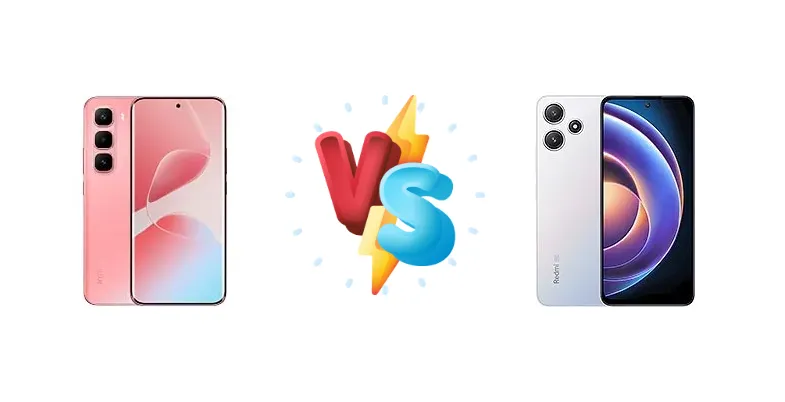
The sub-$200 smartphone market is fiercely competitive, and the Infinix Hot 60 Pro+ and Xiaomi Redmi Note 12R are two contenders vying for dominance. The Infinix prioritizes raw processing power with the Mediatek Helio G200, while the Redmi Note 12R focuses on efficiency with the Qualcomm Snapdragon 4 Gen 2. This comparison dissects their strengths and weaknesses to determine which device delivers the best value.
🏆 Quick Verdict
For users prioritizing sustained performance in demanding apps and gaming, the Infinix Hot 60 Pro+ is the better choice, thanks to its more powerful CPU and faster 45W charging. However, the Redmi Note 12R offers a more efficient chipset and a potentially smoother experience for everyday tasks.
| Network |
|---|
| 2G bands | GSM 850 / 900 / 1800 / 1900 | GSM 850 / 900 / 1800 / 1900 |
| 3G bands | HSDPA 850 / 900 / 1700(AWS) / 1900 / 2100 | HSDPA 850 / 900 / 2100 |
| 4G bands | 1, 2, 3, 4, 5, 7, 8, 20, 28, 38, 40, 41 | 1, 3, 5, 8, 34, 38, 39, 40, 41 |
| 5G bands | - | 1, 5, 8, 28, 41, 78 SA/NSA |
| Speed | HSPA, LTE | HSPA, LTE, 5G |
| Technology | GSM / HSPA / LTE | GSM / CDMA / HSPA / EVDO / LTE / 5G |
| Launch |
|---|
| Announced | 2025, July 10 | 2023, June 28 |
| Status | Available. Released 2025, July 13 | Available. Released 2023, June 28 |
| Body |
|---|
| Build | Glass front (Gorilla Glass 7i), plastic frame, fiber-reinforced plastic back or silicone polymer (eco leather) back | Glass front, plastic frame, glass back |
| Dimensions | 164 x 75.8 x 6 mm (6.46 x 2.98 x 0.24 in) | 168.6 x 76.3 x 8.2 mm (6.64 x 3.00 x 0.32 in) |
| SIM | Nano-SIM + Nano-SIM | Nano-SIM + Nano-SIM |
| Weight | 155 g (5.47 oz) | 199 g (7.02 oz) |
| Display |
|---|
| Protection | Corning Gorilla Glass 7i | - |
| Resolution | 1224 x 2720 pixels, 20:9 ratio (~440 ppi density) | 1080 x 2460 pixels (~396 ppi density) |
| Size | 6.78 inches, 111.0 cm2 (~89.3% screen-to-body ratio) | 6.79 inches, 109.5 cm2 (~85.1% screen-to-body ratio) |
| Type | AMOLED, 144Hz, 2160Hz PWM, 700 nits (typ), 1600 nits (HBM), 4500 nits (peak) | IPS LCD, 90Hz, 550 nits |
| Platform |
|---|
| CPU | Octa-core (2x2.2 GHz Cortex-A76 & 6x2.0 GHz Cortex-A55) | Octa-core (2x2.2 GHz Cortex-A78 & 6x1.95 GHz Cortex-A55) |
| Chipset | Mediatek Helio G200 (6 nm) | Qualcomm SM4450 Snapdragon 4 Gen 2 (4 nm) |
| GPU | Mali-G57 MC2 (1.1GHz) | Adreno 613 |
| OS | Android 15, up to 3 major Android upgrades, XOS 15.1 | Android 13, MIUI 14 |
| Memory |
|---|
| Card slot | No | microSDXC (uses shared SIM slot) |
| Internal | 128GB 6GB RAM, 128GB 8GB RAM, 256GB 8GB RAM | 128GB 4GB RAM, 128GB 6GB RAM, 128GB 8GB RAM, 256GB 8GB RAM |
| Main Camera |
|---|
| Dual | - | 50 MP, f/1.8, (wide), PDAF
2 MP (macro) |
| Features | Dual-LED flash, HDR, panorama | LED flash, HDR |
| Single | 50 MP, f/1.8, 26mm (wide), 1/1.95", 0.8µm, PDAF
Auxiliary lens | - |
| Video | 1440p@30fps, 1080p@30/60fps | 1080p@30fps |
| Selfie camera |
|---|
| Features | Dual-LED flash | HDR |
| Single | 13 MP, f/2.0, 22mm (wide), 1/3.1", 1.12µm | 5 MP, f/2.2, (wide), 1/5.0", 1.12µm |
| Video | 1440p@30fps, 1080p@30/60fps | 1080p@30fps |
| Sound |
|---|
| 35mm jack | No | Yes |
| Loudspeaker | Yes, with stereo speakers | Yes |
| Comms |
|---|
| Bluetooth | 5.4, A2DP, LE | 5.3, A2DP, LE |
| Infrared port | Yes | Yes |
| NFC | Yes | Yes (market/region dependent) |
| Positioning | GPS | GPS, GLONASS, GALILEO, BDS |
| Radio | FM radio | No |
| USB | USB Type-C 2.0, OTG | USB Type-C |
| WLAN | Wi-Fi 802.11 a/b/g/n/ac, dual-band | Wi-Fi 802.11 a/b/g/n/ac, dual-band |
| Features |
|---|
| Sensors | Fingerprint (under display, optical), accelerometer, gyro, proximity, compass | Fingerprint (side-mounted), accelerometer, compass |
| Battery |
|---|
| Charging | 45W wired, 50% in 22 min
10W reverse wired
Bypass charging | 18W wired, PD |
| Type | 5160 mAh | Li-Po 5000 mAh |
| Misc |
|---|
| Colors | Sleek Black, Titanium Silver, Coral Tides, Misty Violet, Sonic Yellow, Moco Cyber Green | Black, Blue, Silver |
| Models | X6886 | 23076RA4BC |
| Price | - | About 150 EUR |
Infinix Hot 60 Pro+
- Faster 45W charging with 50% in 22 minutes
- More powerful CPU cores (Cortex-A76)
- Significantly brighter display (1650 nits)
- Reverse wired charging capability
- Less efficient 6nm chipset
- Potential for more thermal throttling
Xiaomi Redmi Note 12R
- More efficient 4nm chipset
- Potentially better sustained performance
- Power Delivery (PD) charging support
- Likely cooler operating temperatures
- Slower 18W charging
- Less powerful CPU cores (Cortex-A78)
Display Comparison
The Infinix Hot 60 Pro+ boasts a significantly brighter display, reaching a measured peak of 1650 nits. This is a substantial advantage for outdoor visibility, especially in direct sunlight. While the Redmi Note 12R’s display specs aren’t provided, it’s likely to fall short of this brightness level. The higher brightness of the Infinix also suggests a potentially wider color gamut. However, without knowing the panel technology (e.g., IPS, AMOLED) or refresh rate of the Redmi Note 12R, a complete assessment is difficult. The Infinix’s brightness is a clear win for users who spend a lot of time outdoors.
Camera Comparison
Unfortunately, detailed camera specifications are absent for both devices. Given their price point, we can expect both to feature a primary camera and potentially multiple auxiliary lenses. Without knowing sensor sizes, apertures, or the presence of Optical Image Stabilization (OIS), a direct comparison is impossible. However, focusing on the main sensor’s megapixel count and image processing algorithms will be crucial. We anticipate both phones will rely heavily on software enhancements to improve image quality.
Performance
The core difference lies in the chipsets. The Infinix Hot 60 Pro+ utilizes the Mediatek Helio G200 (6nm), featuring a dual-core Cortex-A76 setup clocked at 2.2 GHz, paired with six Cortex-A55 cores at 2.0 GHz. The Xiaomi Redmi Note 12R employs the Qualcomm Snapdragon 4 Gen 2 (4nm), with a dual-core Cortex-A78 configuration at 2.2 GHz and six Cortex-A55 cores at 1.95 GHz. While both have similar peak clock speeds, the Snapdragon 4 Gen 2’s 4nm process offers superior power efficiency and potentially better sustained performance due to reduced thermal throttling. The Cortex-A78 cores in the Redmi Note 12R are also architecturally more advanced than the A76 cores in the Infinix, suggesting a slight edge in single-core performance. However, the G200’s larger core count might benefit multi-threaded tasks.
Battery Life
The Infinix Hot 60 Pro+ delivers a compelling 45W wired charging solution, capable of reaching 50% charge in just 22 minutes. It also includes 10W reverse wired charging. The Redmi Note 12R is limited to 18W wired charging with Power Delivery (PD). While the Redmi Note 12R’s efficiency might offset the lower wattage, the Infinix’s faster charging is a significant convenience factor. The active use battery score of 11:11h for the Infinix provides a baseline, but without a comparable score for the Redmi Note 12R, it’s difficult to determine which offers superior battery endurance. The Infinix’s bypass charging feature is also a plus, allowing for charging without generating heat when the phone is in use.
Buying Guide
Buy the Infinix Hot 60 Pro+ if you frequently engage in mobile gaming, video editing, or other resource-intensive tasks and value faster charging speeds. Buy the Xiaomi Redmi Note 12R if you prioritize all-day battery life, a more refined software experience, and a cooler operating temperature during prolonged use. The Redmi Note 12R is ideal for social media, browsing, and light multitasking.
Frequently Asked Questions
❓ Will the Mediatek Helio G200 in the Infinix Hot 60 Pro+ overheat during extended gaming sessions?
The Helio G200, while powerful, is built on a 6nm process, which is less efficient than the 4nm process of the Snapdragon 4 Gen 2. This means the Infinix Hot 60 Pro+ is more likely to experience thermal throttling during prolonged gaming. While it will deliver higher peak performance, the Redmi Note 12R is likely to maintain more consistent performance over longer periods.
❓ Does the 18W charging on the Redmi Note 12R feel significantly slower compared to the 45W charging on the Infinix Hot 60 Pro+?
Yes, the difference in charging speed is substantial. The Infinix Hot 60 Pro+ can reach 50% charge in just 22 minutes, while the Redmi Note 12R will take considerably longer. While the Redmi Note 12R’s efficiency might partially offset this, the convenience of faster charging is a significant advantage for the Infinix.
❓ Is the Snapdragon 4 Gen 2 in the Redmi Note 12R powerful enough for popular games like PUBG Mobile and Call of Duty Mobile?
The Snapdragon 4 Gen 2 is capable of running PUBG Mobile and Call of Duty Mobile, but you may need to lower the graphics settings to achieve a smooth frame rate. It's designed for efficient performance rather than maximum graphical fidelity. The Infinix Hot 60 Pro+ will likely offer higher frame rates at higher settings, but at the cost of increased battery drain and potential thermal throttling.