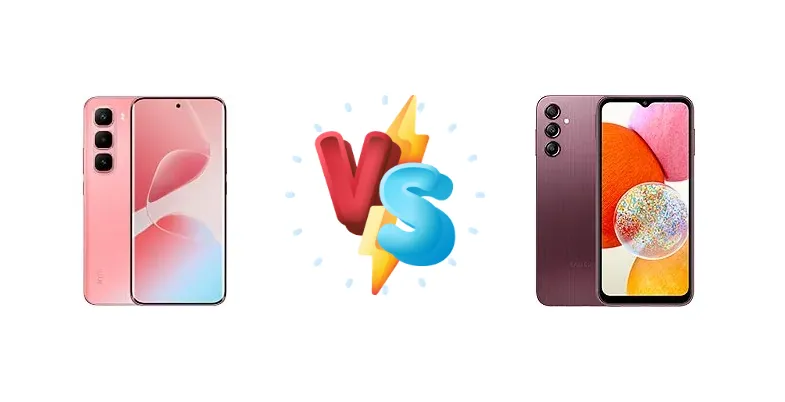
The sub-$200 smartphone market is fiercely competitive, and the Infinix Hot 60 Pro+ and Samsung Galaxy A14 are two contenders vying for dominance. The Infinix prioritizes raw performance with its newer Mediatek Helio G200 chipset and rapid charging, while the Samsung Galaxy A14 offers the brand recognition and potentially broader software support. This comparison dissects their key differences to help you choose the right device.
🏆 Quick Verdict
For users prioritizing gaming and fast charging, the Infinix Hot 60 Pro+ is the clear winner. Its Helio G200 chipset, coupled with 45W charging, provides a noticeable performance and convenience advantage. However, the Samsung Galaxy A14 remains a solid choice for those valuing brand reliability and a potentially smoother software experience.
| Network |
|---|
| 2G bands | GSM 850 / 900 / 1800 / 1900 | GSM 850 / 900 / 1800 / 1900 |
| 3G bands | HSDPA 850 / 900 / 1700(AWS) / 1900 / 2100 | HSDPA 850 / 900 / 2100 |
| 4G bands | 1, 2, 3, 4, 5, 7, 8, 20, 28, 38, 40, 41 | 1, 3, 5, 7, 8, 20, 28, 38, 40, 41 |
| Speed | HSPA, LTE | HSPA, LTE |
| Technology | GSM / HSPA / LTE | GSM / HSPA / LTE |
| Launch |
|---|
| Announced | 2025, July 10 | 2023, February 28 |
| Status | Available. Released 2025, July 13 | Available. Released 2023, March 27 |
| Body |
|---|
| Build | Glass front (Gorilla Glass 7i), plastic frame, fiber-reinforced plastic back or silicone polymer (eco leather) back | Glass front, plastic back, plastic frame |
| Dimensions | 164 x 75.8 x 6 mm (6.46 x 2.98 x 0.24 in) | 167.7 x 78 x 9.1 mm (6.60 x 3.07 x 0.36 in) |
| SIM | Nano-SIM + Nano-SIM | · Nano-SIM· Nano-SIM + Nano-SIM |
| Weight | 155 g (5.47 oz) | 201 g (7.09 oz) |
| Display |
|---|
| Protection | Corning Gorilla Glass 7i | - |
| Resolution | 1224 x 2720 pixels, 20:9 ratio (~440 ppi density) | 1080 x 2408 pixels, 20:9 ratio (~400 ppi density) |
| Size | 6.78 inches, 111.0 cm2 (~89.3% screen-to-body ratio) | 6.6 inches, 104.9 cm2 (~80.2% screen-to-body ratio) |
| Type | AMOLED, 144Hz, 2160Hz PWM, 700 nits (typ), 1600 nits (HBM), 4500 nits (peak) | PLS LCD |
| Platform |
|---|
| CPU | Octa-core (2x2.2 GHz Cortex-A76 & 6x2.0 GHz Cortex-A55) | Octa-core (2x2.0 GHz Cortex-A75 & 6x1.8 GHz Cortex-A55) - Version AOcta-core (4x2.0 GHz Cortex-A55 & 4x2.0 GHz Cortex-A55) - Version B |
| Chipset | Mediatek Helio G200 (6 nm) | Mediatek MT6769 Helio G80 (12 nm) - Version AExynos 850 (8 nm) - Version B |
| GPU | Mali-G57 MC2 (1.1GHz) | Mali-G52 MC2 |
| OS | Android 15, up to 3 major Android upgrades, XOS 15.1 | Android 13, upgradable to Android 15, One UI 7 |
| Memory |
|---|
| Card slot | No | microSDXC (dedicated slot) |
| Internal | 128GB 6GB RAM, 128GB 8GB RAM, 256GB 8GB RAM | 64GB 4GB RAM, 128GB 4GB RAM, 128GB 6GB RAM |
| Main Camera |
|---|
| Features | Dual-LED flash, HDR, panorama | LED flash, panorama, HDR |
| Single | 50 MP, f/1.8, 26mm (wide), 1/1.95", 0.8µm, PDAF
Auxiliary lens | 13 MP, f/2.0, (wide) |
| Triple | - | 50 MP, f/1.8, 26mm (wide), 1/2.75", 0.64µm, PDAF
5 MP, f/2.2, 17mm (ultrawide), 1/5.0", 1.12µm
2 MP (macro) |
| Video | 1440p@30fps, 1080p@30/60fps | 1080p@30fps |
| Selfie camera |
|---|
| Features | Dual-LED flash | - |
| Single | 13 MP, f/2.0, 22mm (wide), 1/3.1", 1.12µm | 13 MP, f/2.0, 26mm (wide), 1/3.1", 1.12µm |
| Video | 1440p@30fps, 1080p@30/60fps | 1080p@30fps |
| Sound |
|---|
| 3.5mm jack | - | Yes |
| 35mm jack | No | Yes |
| Loudspeaker | Yes, with stereo speakers | Yes |
| Comms |
|---|
| Bluetooth | 5.4, A2DP, LE | 5.1 or 5.3, A2DP, LE |
| Infrared port | Yes | - |
| NFC | Yes | Yes (market/region dependent) |
| Positioning | GPS | GPS, GALILEO, GLONASS, BDS, QZSS |
| Radio | FM radio | Unspecified |
| USB | USB Type-C 2.0, OTG | USB Type-C 2.0 |
| WLAN | Wi-Fi 802.11 a/b/g/n/ac, dual-band | Wi-Fi 802.11 a/b/g/n/ac, dual-band, Wi-Fi Direct |
| Features |
|---|
| Sensors | Fingerprint (under display, optical), accelerometer, gyro, proximity, compass | Fingerprint (side-mounted), accelerometer, proximity, compass |
| Battery |
|---|
| Charging | 45W wired, 50% in 22 min
10W reverse wired
Bypass charging | 15W wired |
| Type | 5160 mAh | Li-Po 5000 mAh |
| Misc |
|---|
| Colors | Sleek Black, Titanium Silver, Coral Tides, Misty Violet, Sonic Yellow, Moco Cyber Green | Black, Dark Red, Silver, Green |
| Models | X6886 | SM-A145F, SM-A145F/DSN, SM-A145M, SM-A145M/DS, SM-A145P, SM-A145R |
| Price | - | € 85.76 / $ 147.60 / £ 79.95 |
| SAR EU | - | 0.46 W/kg (head) 1.37 W/kg (body) |
Infinix Hot 60 Pro+
- Faster charging (45W)
- More powerful chipset (Helio G200)
- Brighter display (1650 nits)
- Less established brand
- Potentially shorter software support
Samsung Galaxy A14
- Established brand reputation
- Potentially longer software support
- More readily available
- Slower charging (15W)
- Less powerful chipset (Helio G80/Exynos 850)
- Dimmer display
Display Comparison
The Infinix Hot 60 Pro+ boasts a significantly brighter display, reaching a measured peak of 1650 nits. This is a substantial advantage over the Galaxy A14, which lacks specific brightness data but typically falls in the 400-500 nit range for this price point. The higher brightness of the Infinix translates to better outdoor visibility. While both likely utilize LCD panels, the Infinix’s brightness is the defining factor, making it superior for content consumption in bright environments. We expect the A14 to have a more color accurate display, but the brightness difference is more impactful for most users.
Camera Comparison
Without detailed camera specs, a direct comparison is difficult. However, given the price bracket, both phones likely feature a primary sensor around 50MP. The Infinix Hot 60 Pro+ may prioritize computational photography to enhance image quality, while Samsung typically focuses on natural color reproduction. The inclusion of a 2MP macro camera on the A14 is largely a marketing gimmick and offers limited practical benefit. The real differentiator will be image processing algorithms and low-light performance, which require dedicated testing.
Performance
The performance gap is where the Infinix Hot 60 Pro+ truly shines. Its Mediatek Helio G200 (6nm) chipset, featuring two 2.2 GHz Cortex-A76 cores and six 2.0 GHz Cortex-A55 cores, is architecturally more advanced and efficient than the Samsung Galaxy A14’s Mediatek Helio G80 (12nm) or Exynos 850 (8nm) options. The 6nm process node of the G200 allows for better thermal management and sustained performance under load. The A14’s CPU configuration varies; the A75 cores in the Helio G80 version offer a slight edge over the A55 cores in the Exynos 850, but neither matches the A76 performance of the G200. This translates to faster app loading times, smoother multitasking, and a more responsive gaming experience on the Infinix.
Battery Life
The Infinix Hot 60 Pro+ delivers a compelling battery and charging package. Its active use score of 11:11h indicates excellent endurance. Crucially, the 45W wired charging capability allows for a 50% charge in just 22 minutes, a significant advantage over the Galaxy A14’s slower 15W charging. While the A14 may have a slightly larger battery capacity (spec not provided), the Infinix’s faster charging effectively mitigates any capacity difference, providing more uptime in less time. The Infinix also offers 10W reverse wired charging, a feature absent on the A14.
Buying Guide
Buy the Infinix Hot 60 Pro+ if you need a phone primarily for mobile gaming, streaming video, and require exceptionally fast charging. Its Mediatek Helio G200 chipset and 45W charging are geared towards power users. Buy the Samsung Galaxy A14 if you prefer a more established brand with a focus on software stability and a potentially longer software support lifecycle, even if it means sacrificing some raw performance and charging speed.
Frequently Asked Questions
❓ Does the Mediatek Helio G200 in the Infinix Hot 60 Pro+ get hot during extended gaming sessions?
The Helio G200's 6nm process node is designed for improved thermal efficiency compared to the 12nm Helio G80. While some heat generation is inevitable during prolonged gaming, the G200 is less prone to significant throttling, allowing for more sustained performance. However, prolonged use will still result in some warming of the device.
❓ Is the 15W charging on the Samsung Galaxy A14 slow compared to the Infinix Hot 60 Pro+'s 45W charging?
Yes, 15W charging is considerably slower. The Infinix Hot 60 Pro+ can reach 50% charge in approximately 22 minutes, while the Galaxy A14 will take significantly longer – likely over 1.5 hours for a full charge. This difference is substantial for users who frequently need to quickly top up their battery.
❓ Which phone is better for playing demanding games like PUBG Mobile or Call of Duty Mobile?
The Infinix Hot 60 Pro+ is the better choice for demanding games. Its Helio G200 chipset provides a noticeable performance advantage over the Galaxy A14’s Helio G80 or Exynos 850, resulting in higher frame rates and smoother gameplay. The improved thermal management also helps maintain consistent performance during extended gaming sessions.
❓ How long will software updates be supported on the Samsung Galaxy A14 compared to the Infinix Hot 60 Pro+?
Samsung generally provides longer software support for its devices than Infinix. The Galaxy A14 is likely to receive at least two major Android updates and several years of security patches, while the Infinix Hot 60 Pro+ may receive fewer updates. This is a key consideration for users who prioritize long-term software support.