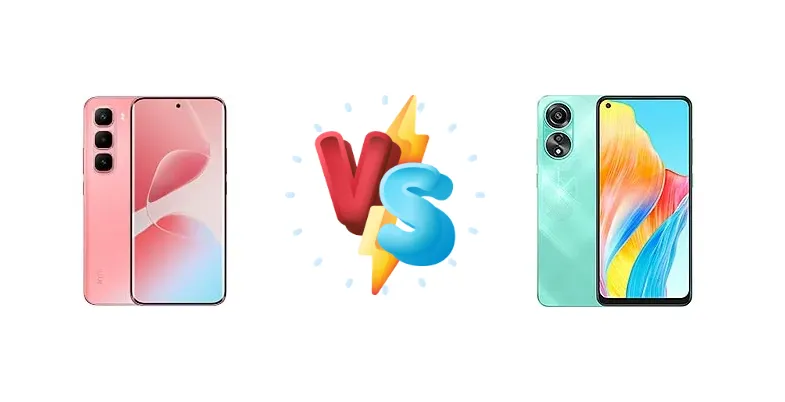
The Infinix Hot 60 Pro+ and Oppo A78 4G represent compelling options in the crowded budget smartphone market. While both aim to deliver a solid experience without breaking the bank, they take different approaches. The Infinix prioritizes raw processing power with the Mediatek Helio G200, while the Oppo A78 4G focuses on a balanced experience with the Qualcomm Snapdragon 680 and faster charging.
🏆 Quick Verdict
For users prioritizing gaming and demanding tasks, the Infinix Hot 60 Pro+ emerges as the winner. Its Helio G200 chipset offers a noticeable performance edge. However, the Oppo A78 4G is a strong contender for those valuing efficient power consumption and exceptionally fast charging.
| Network |
|---|
| 2G bands | GSM 850 / 900 / 1800 / 1900 | GSM 850 / 900 / 1800 / 1900 |
| 3G bands | HSDPA 850 / 900 / 1700(AWS) / 1900 / 2100 | HSDPA 850 / 900 / 2100 |
| 4G bands | 1, 2, 3, 4, 5, 7, 8, 20, 28, 38, 40, 41 | LTE |
| Speed | HSPA, LTE | HSPA, LTE |
| Technology | GSM / HSPA / LTE | GSM / HSPA / LTE |
| Launch |
|---|
| Announced | 2025, July 10 | 2023, July 10 |
| Status | Available. Released 2025, July 13 | Available. Released 2023, July 10 |
| Body |
|---|
| Build | Glass front (Gorilla Glass 7i), plastic frame, fiber-reinforced plastic back or silicone polymer (eco leather) back | - |
| Dimensions | 164 x 75.8 x 6 mm (6.46 x 2.98 x 0.24 in) | 160 x 73.2 x 7.9 mm (6.30 x 2.88 x 0.31 in) |
| SIM | Nano-SIM + Nano-SIM | Nano-SIM + Nano-SIM |
| Weight | 155 g (5.47 oz) | 180 g (6.35 oz) |
| Display |
|---|
| Protection | Corning Gorilla Glass 7i | Corning Gorilla Glass 5 |
| Resolution | 1224 x 2720 pixels, 20:9 ratio (~440 ppi density) | 1080 x 2400 pixels, 20:9 ratio (~409 ppi density) |
| Size | 6.78 inches, 111.0 cm2 (~89.3% screen-to-body ratio) | 6.43 inches, 99.8 cm2 (~85.2% screen-to-body ratio) |
| Type | AMOLED, 144Hz, 2160Hz PWM, 700 nits (typ), 1600 nits (HBM), 4500 nits (peak) | AMOLED, 90Hz, 430 nits |
| Platform |
|---|
| CPU | Octa-core (2x2.2 GHz Cortex-A76 & 6x2.0 GHz Cortex-A55) | Octa-core (4x2.4 GHz Kryo 265 Gold & 4x1.9 GHz Kryo 265 Silver) |
| Chipset | Mediatek Helio G200 (6 nm) | Qualcomm SM6225 Snapdragon 680 4G (6 nm) |
| GPU | Mali-G57 MC2 (1.1GHz) | Adreno 610 |
| OS | Android 15, up to 3 major Android upgrades, XOS 15.1 | Android 13, ColorOS 13.1 |
| Memory |
|---|
| Card slot | No | microSDXC |
| Internal | 128GB 6GB RAM, 128GB 8GB RAM, 256GB 8GB RAM | 128GB 8GB RAM, 256GB 8GB RAM |
| Main Camera |
|---|
| Dual | - | 50 MP, f/1.8, (wide), PDAF
Auxiliary lens |
| Features | Dual-LED flash, HDR, panorama | LED flash, HDR, panorama |
| Single | 50 MP, f/1.8, 26mm (wide), 1/1.95", 0.8µm, PDAF
Auxiliary lens | - |
| Video | 1440p@30fps, 1080p@30/60fps | 1080p@30fps |
| Selfie camera |
|---|
| Features | Dual-LED flash | - |
| Single | 13 MP, f/2.0, 22mm (wide), 1/3.1", 1.12µm | 8 MP, f/2.0, (wide) |
| Video | 1440p@30fps, 1080p@30/60fps | 1080p@30fps |
| Sound |
|---|
| 35mm jack | No | Yes |
| Loudspeaker | Yes, with stereo speakers | Yes, with stereo speakers |
| Comms |
|---|
| Bluetooth | 5.4, A2DP, LE | 5.0, A2DP, LE |
| Infrared port | Yes | - |
| NFC | Yes | Yes (market/region dependent) |
| Positioning | GPS | GPS, GALILEO, GLONASS, BDS |
| Radio | FM radio | No |
| USB | USB Type-C 2.0, OTG | USB Type-C 2.0, OTG |
| WLAN | Wi-Fi 802.11 a/b/g/n/ac, dual-band | Wi-Fi 802.11 a/b/g/n/ac, dual-band |
| Features |
|---|
| Sensors | Fingerprint (under display, optical), accelerometer, gyro, proximity, compass | Fingerprint (under display, optical), accelerometer, gyro, proximity, compass |
| Battery |
|---|
| Charging | 45W wired, 50% in 22 min
10W reverse wired
Bypass charging | 67W wired, PD, 76% in 30 min |
| Type | 5160 mAh | Li-Po 5000 mAh |
| Misc |
|---|
| Colors | Sleek Black, Titanium Silver, Coral Tides, Misty Violet, Sonic Yellow, Moco Cyber Green | Mist Black, Aqua Green |
| Models | X6886 | CPH2565 |
| Price | - | About 200 EUR |
Infinix Hot 60 Pro+
- Stronger CPU performance for gaming and multitasking
- Brighter display for outdoor visibility
- 10W Reverse Wired Charging
- Slower charging speed compared to Oppo A78 4G
- Potentially less efficient power consumption during lighter tasks
Oppo A78 4G
- Faster 67W charging with PD support
- Potentially better power efficiency for everyday use
- Qualcomm's image processing may offer refined image quality
- Less powerful CPU for demanding applications
- Likely lower peak display brightness
Display Comparison
The Infinix Hot 60 Pro+ boasts a significantly brighter display, reaching a measured peak of 1650 nits. This translates to superior visibility outdoors under direct sunlight, a clear advantage over the Oppo A78 4G (brightness data unavailable, but typically lower in this segment). While both likely utilize IPS LCD panels, the higher brightness of the Infinix suggests a more premium viewing experience. Bezels and resolution are likely comparable given the price points, but the brightness difference is a key differentiator.
Camera Comparison
Without detailed camera specs, a direct comparison is difficult. However, given the market segment, both phones likely feature a primary camera paired with depth and macro sensors. The quality will heavily depend on sensor size and image processing algorithms. We can assume the Oppo A78 4G, benefiting from Qualcomm’s image signal processor, might offer slightly more refined image processing, particularly in low-light conditions. The Infinix may lean towards more vibrant, saturated colors. The presence of OIS (Optical Image Stabilization) is unlikely on either device at this price point.
Performance
The core difference lies in the chipsets. The Infinix Hot 60 Pro+ utilizes the Mediatek Helio G200 (6nm), featuring a dual-cluster CPU configuration with 2x2.2 GHz Cortex-A76 cores and 6x2.0 GHz Cortex-A55 cores. This architecture prioritizes peak performance. The Oppo A78 4G, on the other hand, employs the Qualcomm Snapdragon 680 4G (6nm) with 4x2.4 GHz Kryo 265 Gold cores and 4x1.9 GHz Kryo 265 Silver cores. While the Snapdragon 680 has higher clocked 'performance' cores, the G200's Cortex-A76 cores are generally more efficient. This suggests the Infinix will excel in sustained workloads, while the Oppo might offer slightly snappier responsiveness in everyday tasks. The 6nm process node in both chips contributes to improved power efficiency compared to older generations.
Battery Life
The Infinix Hot 60 Pro+ achieves an impressive 11:11h active use score, indicating solid battery life. While the Oppo A78 4G’s battery capacity is unknown, its 67W wired charging with PD support is a significant advantage. Reaching 76% charge in just 30 minutes is considerably faster than the Infinix’s 45W charging (50% in 22 minutes). The Infinix also offers 10W reverse wired charging, a useful feature for topping up accessories. The faster charging of the Oppo A78 4G mitigates any potential disadvantage in battery capacity.
Buying Guide
Buy the Infinix Hot 60 Pro+ if you need a phone capable of handling demanding mobile games and multitasking without significant slowdowns. It’s ideal for users who frequently stream videos, edit photos, or run resource-intensive applications. Buy the Oppo A78 4G if you prefer a phone with longer battery life during typical use, and appreciate the convenience of incredibly fast 67W charging, making it perfect for users on the go who don't want to be tethered to a charger.
Frequently Asked Questions
❓ Does the Mediatek Helio G200 in the Infinix Hot 60 Pro+ get hot during extended gaming sessions?
The Helio G200's 6nm process helps manage thermals, but sustained gaming will inevitably generate heat. The Infinix Hot 60 Pro+ likely employs thermal management techniques to prevent excessive throttling, but performance may decrease slightly after prolonged use. The Oppo A78 4G's Snapdragon 680 may run cooler, but at the cost of overall performance.
❓ How does the 67W SuperVOOC charging on the Oppo A78 4G compare to other fast charging standards?
Oppo's 67W SuperVOOC is exceptionally fast, consistently delivering a full charge in under an hour. While not universally compatible with Power Delivery (PD) chargers, the Oppo A78 4G *does* support PD, offering some flexibility. The Infinix Hot 60 Pro+'s 45W charging is still respectable, but noticeably slower.
❓ Is the difference in CPU performance between the Helio G200 and Snapdragon 680 noticeable in everyday tasks like browsing and social media?
The difference is unlikely to be significant in basic tasks. Both chipsets are capable of handling everyday operations smoothly. The Helio G200's advantage becomes apparent when running demanding apps, playing graphics-intensive games, or multitasking with several applications open simultaneously.