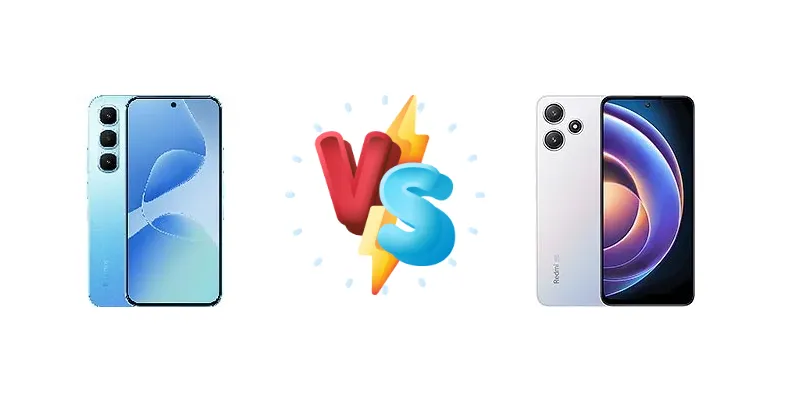
The sub-$200 smartphone market is fiercely competitive, and the Infinix Hot 60 Pro and Xiaomi Redmi Note 12R are two contenders vying for dominance. The Hot 60 Pro prioritizes charging speed, while the Redmi Note 12R leverages Qualcomm's latest 4-series silicon. This comparison dissects their strengths and weaknesses to determine which device delivers the best value.
🏆 Quick Verdict
For the average user prioritizing long-term efficiency and a smoother software experience, the Xiaomi Redmi Note 12R is the better choice. Its Snapdragon 4 Gen 2, built on a 4nm process, offers superior power efficiency and sustained performance compared to the Infinix Hot 60 Pro's Helio G200, despite the latter's faster charging.
| Network |
|---|
| 2G bands | GSM 850 / 900 / 1800 / 1900 | GSM 850 / 900 / 1800 / 1900 |
| 3G bands | HSDPA 850 / 900 / 1700(AWS) / 1900 / 2100 | HSDPA 850 / 900 / 2100 |
| 4G bands | 1, 2, 3, 4, 5, 7, 8, 20, 28, 38, 40, 41 | 1, 3, 5, 8, 34, 38, 39, 40, 41 |
| 5G bands | - | 1, 5, 8, 28, 41, 78 SA/NSA |
| Speed | HSPA, LTE | HSPA, LTE, 5G |
| Technology | GSM / HSPA / LTE | GSM / CDMA / HSPA / EVDO / LTE / 5G |
| Launch |
|---|
| Announced | 2025, July 10 | 2023, June 28 |
| Status | Available. Released 2025, July 13 | Available. Released 2023, June 28 |
| Body |
|---|
| Build | Glass front (Gorilla Glass 7i), plastic back, plastic frame | Glass front, plastic frame, glass back |
| Dimensions | 163.5 x 75.9 x 6.6 mm (6.44 x 2.99 x 0.26 in) | 168.6 x 76.3 x 8.2 mm (6.64 x 3.00 x 0.32 in) |
| SIM | Nano-SIM + Nano-SIM | Nano-SIM + Nano-SIM |
| Weight | 170 g (6.00 oz) | 199 g (7.02 oz) |
| Display |
|---|
| Protection | Corning Gorilla Glass 7i | - |
| Resolution | 1224 x 2720 pixels, 20:9 ratio (~440 ppi density) | 1080 x 2460 pixels (~396 ppi density) |
| Size | 6.78 inches, 111.0 cm2 (~89.4% screen-to-body ratio) | 6.79 inches, 109.5 cm2 (~85.1% screen-to-body ratio) |
| Type | AMOLED, 144Hz, 2160Hz PWM, 700 nits (typ), 1600 nits (HBM), 4500 nits (peak) | IPS LCD, 90Hz, 550 nits |
| Platform |
|---|
| CPU | Octa-core (2x2.2 GHz Cortex-A76 & 6x2.0 GHz Cortex-A55) | Octa-core (2x2.2 GHz Cortex-A78 & 6x1.95 GHz Cortex-A55) |
| Chipset | Mediatek Helio G200 (6 nm) | Qualcomm SM4450 Snapdragon 4 Gen 2 (4 nm) |
| GPU | Mali-G57 MC2 (1.1GHz) | Adreno 613 |
| OS | Android 15, up to 3 major Android upgrades, XOS 15.1 | Android 13, MIUI 14 |
| Memory |
|---|
| Card slot | microSDXC (dedicated slot) | microSDXC (uses shared SIM slot) |
| Internal | 128GB 8GB RAM, 256GB 8GB RAM | 128GB 4GB RAM, 128GB 6GB RAM, 128GB 8GB RAM, 256GB 8GB RAM |
| Main Camera |
|---|
| Dual | - | 50 MP, f/1.8, (wide), PDAF
2 MP (macro) |
| Features | Dual-LED flash, HDR, panorama | LED flash, HDR |
| Single | 50 MP, f/1.6, 27mm (wide), 1/2.8", 0.64µm, PDAF
Auxiliary lens | - |
| Video | 1440p@30fps, 1080p@30/60fps | 1080p@30fps |
| Selfie camera |
|---|
| Features | - | HDR |
| Single | 13 MP, f/2.2, 24mm (wide), 1/3.1", 1.12µm | 5 MP, f/2.2, (wide), 1/5.0", 1.12µm |
| Video | 1440p@30fps, 1080p@30/60fps | 1080p@30fps |
| Sound |
|---|
| 35mm jack | Yes | Yes |
| Loudspeaker | Yes, with stereo speakers | Yes |
| Comms |
|---|
| Bluetooth | 5.4, A2DP, LE | 5.3, A2DP, LE |
| Infrared port | Yes | Yes |
| NFC | Yes | Yes (market/region dependent) |
| Positioning | GPS | GPS, GLONASS, GALILEO, BDS |
| Radio | FM radio | No |
| USB | USB Type-C 2.0, OTG | USB Type-C |
| WLAN | Wi-Fi 802.11 a/b/g/n/ac, dual-band | Wi-Fi 802.11 a/b/g/n/ac, dual-band |
| Features |
|---|
| Sensors | Fingerprint (under display, optical), accelerometer, gyro, proximity, compass | Fingerprint (side-mounted), accelerometer, compass |
| Battery |
|---|
| Charging | 45W wired, 50% in 22 min
10W reverse wired | 18W wired, PD |
| Type | 5160 mAh | Li-Po 5000 mAh |
| Misc |
|---|
| Colors | Sleek Black, Titanium Silver, Coral Tides, Sapphire Blue, Jungle Breath, Orange Rose Valley | Black, Blue, Silver |
| Models | X6885 | 23076RA4BC |
| Price | About 350 EUR | About 150 EUR |
Infinix Hot 60 Pro
- Significantly faster 45W charging
- 10W reverse wired charging for accessory top-ups
- Potentially lower initial price (depending on region)
- Less efficient Helio G200 chipset
- Likely more thermal throttling under load
- Potentially inferior image processing
Xiaomi Redmi Note 12R
- More efficient Snapdragon 4 Gen 2 chipset
- Better sustained performance and multitasking
- Superior image processing capabilities
- Slower 18W charging
- May have a slightly higher price point
- No reverse wireless charging
Display Comparison
Neither device boasts a standout display. Both likely feature LCD panels, common in this price bracket. The key difference lies under the hood; display specs are not provided. However, given the Redmi Note 12R's focus on efficiency, it's plausible Xiaomi optimized the panel for lower power consumption. Bezels are expected to be similar, and color accuracy will likely be standard for the segment, requiring calibration for professional use.
Camera Comparison
Camera details are sparse, but we can infer some differences. Both phones likely feature a primary camera and depth/macro sensors. Without megapixel counts or aperture information, it’s difficult to make a definitive statement. However, Qualcomm’s image signal processor (ISP) within the Snapdragon 4 Gen 2 generally delivers superior image processing, particularly in low-light conditions, compared to MediaTek’s ISP in the Helio G200. The Redmi Note 12R is likely to produce more consistent and detailed photos. The presence of a 2MP macro camera on either device is largely a marketing gimmick and shouldn't heavily influence purchasing decisions.
Performance
The core battleground is the chipset. The Xiaomi Redmi Note 12R’s Qualcomm Snapdragon 4 Gen 2 (4nm) holds a significant advantage over the Infinix Hot 60 Pro’s MediaTek Helio G200 (6nm). The 4nm process node inherently provides better thermal efficiency, translating to less throttling during prolonged tasks like gaming. While both CPUs feature 2x2.2 GHz cores, the Snapdragon utilizes Cortex-A78 cores, which offer a performance uplift over the Helio G200’s Cortex-A76 cores. This means the Redmi Note 12R will likely handle demanding apps and multitasking more smoothly. The lack of LPDDR5X RAM specification for either device suggests both likely use LPDDR4X, limiting memory bandwidth.
Battery Life
The Infinix Hot 60 Pro’s 45W wired charging is its standout feature, promising a 50% charge in just 22 minutes. The Redmi Note 12R’s 18W charging with PD is considerably slower. However, the Snapdragon 4 Gen 2’s superior efficiency means the Redmi Note 12R will likely offer comparable, if not better, real-world battery life despite potentially having a smaller battery capacity (not specified). The 10W reverse wired charging on the Infinix Hot 60 Pro is a niche feature, useful for topping up accessories but not a primary selling point.
Buying Guide
Buy the Infinix Hot 60 Pro if you absolutely need the fastest possible charging speeds and frequently find yourself needing to top up your battery quickly. Buy the Xiaomi Redmi Note 12R if you value sustained performance, better power efficiency for all-day use, and a more refined software experience backed by Qualcomm's optimizations. The Redmi Note 12R is also the better option for those who anticipate moderate gaming sessions.
Frequently Asked Questions
❓ Will the Redmi Note 12R's Snapdragon 4 Gen 2 handle popular games like PUBG Mobile smoothly?
Yes, the Snapdragon 4 Gen 2 is capable of running PUBG Mobile at medium settings with stable frame rates. While it won't deliver a flagship gaming experience, it provides a significantly smoother experience than the Helio G200, especially during extended gaming sessions due to its superior thermal management.
❓ How much faster is the Infinix Hot 60 Pro's 45W charging in real-world use compared to the Redmi Note 12R's 18W charging?
The Infinix Hot 60 Pro can charge from 0-50% in approximately 22 minutes. The Redmi Note 12R will take considerably longer – likely over an hour to reach 50%. This makes the Hot 60 Pro ideal for users who frequently need a quick power boost, but the Redmi Note 12R's efficiency means you may not need to charge as often.
❓ Does the Redmi Note 12R support any form of fast charging protocols beyond PD?
While the specifications only mention PD (Power Delivery), Xiaomi often includes support for Quick Charge protocols as well. However, to achieve the fastest charging speeds, using a PD-compatible charger is recommended.