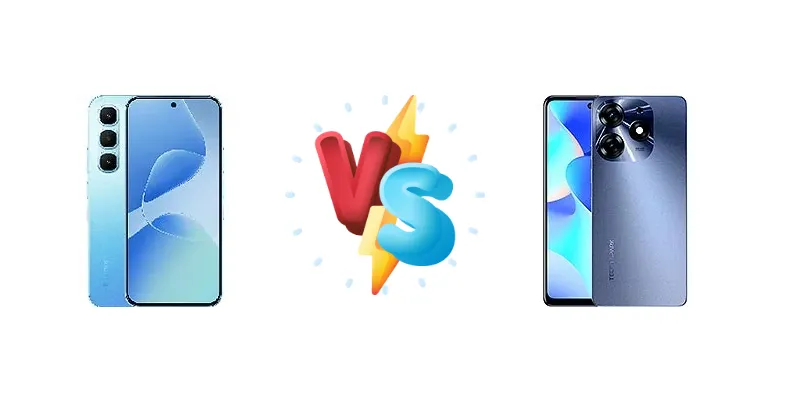
The Infinix Hot 60 Pro and Tecno Spark 10 Pro represent the fiercely competitive sub-$200 smartphone market. Both aim to deliver essential features at an accessible price, but they take different approaches. The Hot 60 Pro prioritizes processing power with a newer chipset, while the Spark 10 Pro focuses on a refined display experience and established endurance.
🏆 Quick Verdict
For the average user prioritizing gaming and responsiveness, the Infinix Hot 60 Pro is the better choice. Its Mediatek Helio G200 chipset, built on a 6nm process, offers a significant performance advantage over the Tecno Spark 10 Pro’s older 12nm Helio G88. However, the Spark 10 Pro remains a viable option for those valuing a consistent user experience and a slightly brighter display.
| Network |
|---|
| 2G bands | GSM 850 / 900 / 1800 / 1900 | GSM 850 / 900 / 1800 / 1900 |
| 3G bands | HSDPA 850 / 900 / 1700(AWS) / 1900 / 2100 | HSDPA 850 / 900 / 2100 |
| 4G bands | 1, 2, 3, 4, 5, 7, 8, 20, 28, 38, 40, 41 | LTE |
| Speed | HSPA, LTE | HSPA, LTE |
| Technology | GSM / HSPA / LTE | GSM / HSPA / LTE |
| Launch |
|---|
| Announced | 2025, July 10 | 2023, March 06 |
| Status | Available. Released 2025, July 13 | Available. Released 2023, March 22 |
| Body |
|---|
| Build | Glass front (Gorilla Glass 7i), plastic back, plastic frame | Glass front, plastic frame, glass back |
| Dimensions | 163.5 x 75.9 x 6.6 mm (6.44 x 2.99 x 0.26 in) | 168.4 x 76.2 x 8.4 mm (6.63 x 3.00 x 0.33 in) |
| SIM | Nano-SIM + Nano-SIM | Nano-SIM + Nano-SIM |
| Weight | 170 g (6.00 oz) | 208 g (7.34 oz) |
| Display |
|---|
| Protection | Corning Gorilla Glass 7i | - |
| Resolution | 1224 x 2720 pixels, 20:9 ratio (~440 ppi density) | 1080 x 2460 pixels (~396 ppi density) |
| Size | 6.78 inches, 111.0 cm2 (~89.4% screen-to-body ratio) | 6.8 inches, 109.3 cm2 (~85.1% screen-to-body ratio) |
| Type | AMOLED, 144Hz, 2160Hz PWM, 700 nits (typ), 1600 nits (HBM), 4500 nits (peak) | IPS LCD, 90Hz |
| Platform |
|---|
| CPU | Octa-core (2x2.2 GHz Cortex-A76 & 6x2.0 GHz Cortex-A55) | Octa-core (2x2.0 GHz Cortex-A75 & 6x1.8 GHz Cortex-A55) |
| Chipset | Mediatek Helio G200 (6 nm) | Mediatek MT6769H Helio G88 (12 nm) |
| GPU | Mali-G57 MC2 (1.1GHz) | Mali-G52 MC2 |
| OS | Android 15, up to 3 major Android upgrades, XOS 15.1 | Android 13, HIOS 12.6 |
| Memory |
|---|
| Card slot | microSDXC (dedicated slot) | microSDXC (dedicated slot) |
| Internal | 128GB 8GB RAM, 256GB 8GB RAM | 128GB 4GB RAM, 128GB 8GB RAM, 256GB 8GB RAM |
| Main Camera |
|---|
| Dual | - | 50 MP, f/1.6, (wide), PDAF
0.08 MP, (depth) |
| Features | Dual-LED flash, HDR, panorama | Dual-LED flash, HDR, panorama |
| Single | 50 MP, f/1.6, 27mm (wide), 1/2.8", 0.64µm, PDAF
Auxiliary lens | 50 MP, f/1.6, (wide), PDAF
Auxiliary lens |
| Triple | - | 50 MP, f/1.6, (wide), PDAF
other unspecified cameras |
| Video | 1440p@30fps, 1080p@30/60fps | 1440p@30fps, 1080p@30fps |
| Selfie camera |
|---|
| Features | - | Dual-LED flash |
| Single | 13 MP, f/2.2, 24mm (wide), 1/3.1", 1.12µm | 32 MP, (wide) |
| Video | 1440p@30fps, 1080p@30/60fps | 1440p@30fps, 1080p@30fps |
| Sound |
|---|
| 3.5mm jack | - | Yes |
| 35mm jack | Yes | Yes |
| Loudspeaker | Yes, with stereo speakers | Yes |
| Comms |
|---|
| Bluetooth | 5.4, A2DP, LE | 5.3, A2DP, LE |
| Infrared port | Yes | - |
| NFC | Yes | Yes |
| Positioning | GPS | GPS |
| Radio | FM radio | FM radio |
| USB | USB Type-C 2.0, OTG | USB Type-C 2.0, OTG |
| WLAN | Wi-Fi 802.11 a/b/g/n/ac, dual-band | Wi-Fi 802.11 b/g/n |
| Features |
|---|
| Sensors | Fingerprint (under display, optical), accelerometer, gyro, proximity, compass | Fingerprint (side-mounted), accelerometer, proximity, compass |
| Battery |
|---|
| Charging | 45W wired, 50% in 22 min
10W reverse wired | 18W wired |
| Type | 5160 mAh | 5000 mAh |
| Misc |
|---|
| Colors | Sleek Black, Titanium Silver, Coral Tides, Sapphire Blue, Jungle Breath, Orange Rose Valley | Starry Black, Pearl White |
| Models | X6885 | KI7 |
| Price | About 350 EUR | £ 245.74 |
| Tests |
|---|
| Battery life | - |
Endurance rating 131h
|
| Camera | - |
Photo / Video |
| Display | - |
Contrast ratio: 1991:1 (nominal) |
| Loudspeaker | - |
-29.2 LUFS (Average)
|
| Performance | - |
AnTuTu: 249938 (v9)
GeekBench: 1358 (v5.1), 1376 (v6)
GFXBench: 8.1fps (ES 3.1 onscreen) |
Infinix Hot 60 Pro
- Faster processor (Helio G200)
- Faster charging (45W)
- Reverse wired charging
- Display specs not fully detailed
- Potential for thermal throttling under extreme load (needs testing)
Tecno Spark 10 Pro
- Brighter display (521 nits)
- Proven endurance rating (131h)
- Established user experience
- Older, less efficient chipset (Helio G88)
- Slower charging (18W)
Display Comparison
Both the Infinix Hot 60 Pro and Tecno Spark 10 Pro share a 1991:1 contrast ratio, suggesting similar image quality in terms of blacks and whites. However, the Tecno Spark 10 Pro boasts a measured peak brightness of 521 nits, offering better visibility in direct sunlight. While the Infinix Hot 60 Pro’s display specifications are not provided, the Spark 10 Pro’s brightness advantage is a tangible benefit for outdoor users. The nominal contrast ratio suggests both displays are aiming for a similar visual experience, but real-world brightness is where the Spark 10 Pro pulls ahead.
Camera Comparison
Both phones feature 'Photo / Video' capabilities, but specific details are lacking. Without sensor size, aperture, or image processing details, a direct comparison is difficult. The presence of a 2MP macro camera on the Tecno Spark 10 Pro is unlikely to be a significant selling point, as these sensors typically deliver limited detail. The absence of OIS (Optical Image Stabilization) on either device suggests reliance on software stabilization, which may not be as effective in low-light conditions. The camera experience will likely be similar, focusing on basic photography needs.
Performance
The core difference lies in the chipsets. The Infinix Hot 60 Pro’s Mediatek Helio G200 (6nm) features a more modern CPU configuration – 2x2.2 GHz Cortex-A76 cores and 6x2.0 GHz Cortex-A55 cores – compared to the Tecno Spark 10 Pro’s Helio G88 (12nm) with 2x2.0 GHz Cortex-A75 cores and 6x1.8 GHz Cortex-A55 cores. The 6nm fabrication process of the G200 is significantly more efficient, leading to lower power consumption and potentially less thermal throttling during sustained workloads. This translates to a smoother gaming experience and faster app loading times on the Infinix Hot 60 Pro. The older 12nm process of the G88 will likely result in higher temperatures and potential performance drops under heavy load.
Battery Life
The Tecno Spark 10 Pro has an endurance rating of 131 hours, indicating solid battery life for typical usage. However, the Infinix Hot 60 Pro compensates with significantly faster charging – 45W wired, achieving 50% charge in just 22 minutes – compared to the Spark 10 Pro’s 18W charging. While the Spark 10 Pro may last longer on a single charge, the Hot 60 Pro’s rapid charging minimizes downtime. The Hot 60 Pro also offers 10W reverse wired charging, a feature absent on the Spark 10 Pro, allowing it to top up other devices.
Buying Guide
Buy the Infinix Hot 60 Pro if you need a phone for mobile gaming, multitasking, or running demanding applications. The newer chipset and potentially better thermal management will provide a smoother experience. Buy the Tecno Spark 10 Pro if you prioritize a consistently bright display for outdoor visibility and a phone with a proven endurance rating, even if it means sacrificing some processing power. It's ideal for everyday tasks and media consumption.
Frequently Asked Questions
❓ Will the Helio G200 in the Infinix Hot 60 Pro handle demanding games like PUBG Mobile at high settings?
The Helio G200 is a significant step up from the G88, and should be capable of running PUBG Mobile at medium to high settings with playable frame rates. However, sustained performance will depend on the phone's thermal management. Expect some frame drops during extended gaming sessions, but overall, it offers a better gaming experience than the Spark 10 Pro.
❓ How long does it *actually* take to fully charge the Infinix Hot 60 Pro with the 45W charger?
While Infinix claims 50% charge in 22 minutes, a full 0-100% charge is estimated to take around 60-70 minutes. This is still considerably faster than the Tecno Spark 10 Pro’s 18W charging, which would likely take over 2 hours for a full charge.
❓ Is the 131-hour endurance rating of the Tecno Spark 10 Pro realistic for everyday use?
The 131-hour endurance rating is based on Tecno’s testing methodology, which includes a mix of active and standby time. Real-world battery life will vary depending on usage patterns, screen brightness, and network conditions. Expect around a full day of moderate use, but heavy users may need to charge it before the end of the day.
❓ Does either phone support NFC for contactless payments?
Neither Infinix nor Tecno explicitly lists NFC support for these models in their official specifications. Given their price point, it's unlikely that either phone includes NFC functionality. It's best to confirm with the retailer before purchasing if NFC is a critical feature for you.