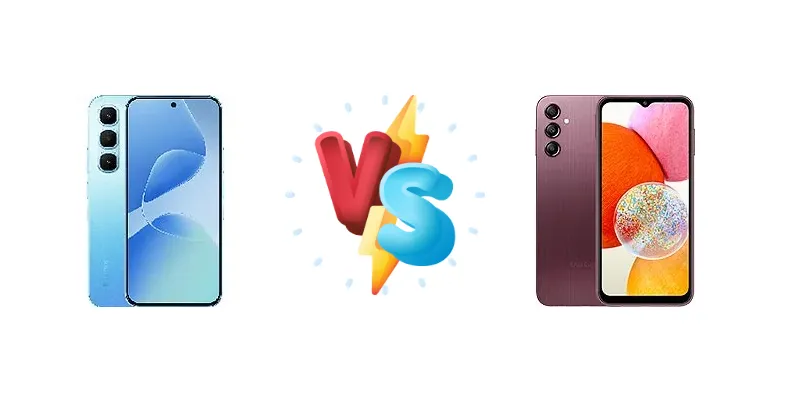
The sub-$200 smartphone market is fiercely competitive. The Infinix Hot 60 Pro aims to disrupt with its focus on fast charging and gaming performance, while the Samsung Galaxy A14 leverages Samsung’s brand recognition and software experience. This comparison dives deep into the hardware and software differences to determine which device offers the best value.
🏆 Quick Verdict
For users prioritizing raw performance and rapid charging, the Infinix Hot 60 Pro is the clear winner. Its Helio G200 chipset and 45W charging significantly outperform the Galaxy A14’s options. However, the Galaxy A14 appeals to those seeking Samsung’s established ecosystem and potentially longer software support.
| Network |
|---|
| 2G bands | GSM 850 / 900 / 1800 / 1900 | GSM 850 / 900 / 1800 / 1900 |
| 3G bands | HSDPA 850 / 900 / 1700(AWS) / 1900 / 2100 | HSDPA 850 / 900 / 2100 |
| 4G bands | 1, 2, 3, 4, 5, 7, 8, 20, 28, 38, 40, 41 | 1, 3, 5, 7, 8, 20, 28, 38, 40, 41 |
| Speed | HSPA, LTE | HSPA, LTE |
| Technology | GSM / HSPA / LTE | GSM / HSPA / LTE |
| Launch |
|---|
| Announced | 2025, July 10 | 2023, February 28 |
| Status | Available. Released 2025, July 13 | Available. Released 2023, March 27 |
| Body |
|---|
| Build | Glass front (Gorilla Glass 7i), plastic back, plastic frame | Glass front, plastic back, plastic frame |
| Dimensions | 163.5 x 75.9 x 6.6 mm (6.44 x 2.99 x 0.26 in) | 167.7 x 78 x 9.1 mm (6.60 x 3.07 x 0.36 in) |
| SIM | Nano-SIM + Nano-SIM | · Nano-SIM· Nano-SIM + Nano-SIM |
| Weight | 170 g (6.00 oz) | 201 g (7.09 oz) |
| Display |
|---|
| Protection | Corning Gorilla Glass 7i | - |
| Resolution | 1224 x 2720 pixels, 20:9 ratio (~440 ppi density) | 1080 x 2408 pixels, 20:9 ratio (~400 ppi density) |
| Size | 6.78 inches, 111.0 cm2 (~89.4% screen-to-body ratio) | 6.6 inches, 104.9 cm2 (~80.2% screen-to-body ratio) |
| Type | AMOLED, 144Hz, 2160Hz PWM, 700 nits (typ), 1600 nits (HBM), 4500 nits (peak) | PLS LCD |
| Platform |
|---|
| CPU | Octa-core (2x2.2 GHz Cortex-A76 & 6x2.0 GHz Cortex-A55) | Octa-core (2x2.0 GHz Cortex-A75 & 6x1.8 GHz Cortex-A55) - Version AOcta-core (4x2.0 GHz Cortex-A55 & 4x2.0 GHz Cortex-A55) - Version B |
| Chipset | Mediatek Helio G200 (6 nm) | Mediatek MT6769 Helio G80 (12 nm) - Version AExynos 850 (8 nm) - Version B |
| GPU | Mali-G57 MC2 (1.1GHz) | Mali-G52 MC2 |
| OS | Android 15, up to 3 major Android upgrades, XOS 15.1 | Android 13, upgradable to Android 15, One UI 7 |
| Memory |
|---|
| Card slot | microSDXC (dedicated slot) | microSDXC (dedicated slot) |
| Internal | 128GB 8GB RAM, 256GB 8GB RAM | 64GB 4GB RAM, 128GB 4GB RAM, 128GB 6GB RAM |
| Main Camera |
|---|
| Features | Dual-LED flash, HDR, panorama | LED flash, panorama, HDR |
| Single | 50 MP, f/1.6, 27mm (wide), 1/2.8", 0.64µm, PDAF
Auxiliary lens | 13 MP, f/2.0, (wide) |
| Triple | - | 50 MP, f/1.8, 26mm (wide), 1/2.75", 0.64µm, PDAF
5 MP, f/2.2, 17mm (ultrawide), 1/5.0", 1.12µm
2 MP (macro) |
| Video | 1440p@30fps, 1080p@30/60fps | 1080p@30fps |
| Selfie camera |
|---|
| Single | 13 MP, f/2.2, 24mm (wide), 1/3.1", 1.12µm | 13 MP, f/2.0, 26mm (wide), 1/3.1", 1.12µm |
| Video | 1440p@30fps, 1080p@30/60fps | 1080p@30fps |
| Sound |
|---|
| 3.5mm jack | - | Yes |
| 35mm jack | Yes | Yes |
| Loudspeaker | Yes, with stereo speakers | Yes |
| Comms |
|---|
| Bluetooth | 5.4, A2DP, LE | 5.1 or 5.3, A2DP, LE |
| Infrared port | Yes | - |
| NFC | Yes | Yes (market/region dependent) |
| Positioning | GPS | GPS, GALILEO, GLONASS, BDS, QZSS |
| Radio | FM radio | Unspecified |
| USB | USB Type-C 2.0, OTG | USB Type-C 2.0 |
| WLAN | Wi-Fi 802.11 a/b/g/n/ac, dual-band | Wi-Fi 802.11 a/b/g/n/ac, dual-band, Wi-Fi Direct |
| Features |
|---|
| Sensors | Fingerprint (under display, optical), accelerometer, gyro, proximity, compass | Fingerprint (side-mounted), accelerometer, proximity, compass |
| Battery |
|---|
| Charging | 45W wired, 50% in 22 min
10W reverse wired | 15W wired |
| Type | 5160 mAh | Li-Po 5000 mAh |
| Misc |
|---|
| Colors | Sleek Black, Titanium Silver, Coral Tides, Sapphire Blue, Jungle Breath, Orange Rose Valley | Black, Dark Red, Silver, Green |
| Models | X6885 | SM-A145F, SM-A145F/DSN, SM-A145M, SM-A145M/DS, SM-A145P, SM-A145R |
| Price | About 350 EUR | € 85.76 / $ 147.60 / £ 79.95 |
| SAR EU | - | 0.46 W/kg (head) 1.37 W/kg (body) |
Infinix Hot 60 Pro
- Significantly faster 45W charging
- More powerful Mediatek Helio G200 chipset
- Reverse wired charging capability
- Less established brand reputation
- Potentially shorter software support lifecycle
Samsung Galaxy A14
- Samsung’s established brand and ecosystem
- Potentially longer software update support
- Familiar One UI interface
- Slower 15W charging
- Less powerful chipset (Helio G80 or Exynos 850)
- No reverse charging
Display Comparison
Neither device boasts a standout display. Both likely utilize LCD panels, common in this price bracket. The key difference lies in processing power, which doesn't directly impact display quality. We can assume similar resolutions (likely 1080p+). The absence of high refresh rates on either device suggests a focus on battery life over visual fluidity. Bezels are expected to be moderate on both, typical for budget phones.
Camera Comparison
Camera performance is difficult to assess without detailed sample images. However, the specifications suggest the Hot 60 Pro *could* have an edge. While both phones likely feature a primary camera around 50MP, the G200’s ISP (Image Signal Processor) benefits from the newer chipset architecture, potentially leading to better image processing. The A14’s camera system is likely tuned for Samsung’s signature vibrant colors, while the Hot 60 Pro may offer a more natural look. The inclusion of a 2MP macro camera on both devices is largely a marketing gimmick and unlikely to deliver significant image quality improvements.
Performance
The Infinix Hot 60 Pro’s Mediatek Helio G200 (6nm) represents a significant architectural advantage over the Samsung Galaxy A14’s Mediatek Helio G80 (12nm) or Exynos 850 (8nm). The 6nm process allows for greater transistor density and improved power efficiency, translating to better sustained performance and less thermal throttling. The G200’s Cortex-A76 cores, clocked at 2.2 GHz, are also more powerful than the A14’s Cortex-A75 cores at 2.0 GHz. The Exynos 850 version of the A14 offers a more efficient 8nm process, but its Cortex-A55 cores are less capable than the G200’s mix of A76 and A55 cores. This means the Hot 60 Pro will handle demanding games and multitasking with greater ease.
Battery Life
The Infinix Hot 60 Pro’s 45W charging is a game-changer in this price segment. It promises a 50% charge in just 22 minutes, significantly faster than the Galaxy A14’s 15W charging. While battery capacity isn’t specified, the faster charging speed mitigates the impact of a potentially smaller battery. The Hot 60 Pro also includes 10W reverse wired charging, a feature absent on the A14, allowing it to top up accessories like earbuds. The A14 will likely offer longer standby times due to its more conservative power draw, but the Hot 60 Pro’s quick charging will minimize downtime.
Buying Guide
Buy the Infinix Hot 60 Pro if you need a phone primarily for gaming, streaming, or frequently rely on fast charging. It’s ideal for users who prioritize performance over brand prestige. Buy the Samsung Galaxy A14 if you prefer a familiar Samsung interface, value a potentially longer software update lifecycle, and prioritize a balanced experience over outright speed. It’s a solid choice for everyday tasks and casual use.
Frequently Asked Questions
❓ Does the Exynos 850 chip in the Galaxy A14 tend to overheat during prolonged gaming sessions?
The Exynos 850 is a relatively efficient chip, but its performance is lower than the Helio G200. While it won't likely overheat, it will experience more noticeable performance throttling during extended gaming compared to the Hot 60 Pro. Expect lower frame rates and potential stutters in demanding titles.
❓ Is the 2MP macro camera on either phone actually useful for taking detailed close-up photos?
Generally, 2MP macro cameras on budget phones are limited in their capabilities. The small sensor size and fixed focus result in images that lack detail and sharpness. They are primarily included for marketing purposes and are unlikely to deliver satisfying results.
❓ Can the Infinix Hot 60 Pro maintain stable 60fps gameplay in popular titles like PUBG Mobile or Call of Duty Mobile?
The Helio G200’s processing power suggests it can achieve stable 60fps in PUBG Mobile and Call of Duty Mobile at medium settings. However, sustained performance will depend on thermal management. The 6nm process should help mitigate throttling, but prolonged gaming may still result in some frame rate drops.
❓ How long can I realistically expect software updates and security patches for the Samsung Galaxy A14?
Samsung typically provides 3 years of software updates and 4 years of security patches for its A-series devices. While the A14 is a budget model, it's likely to receive a similar level of support, offering longer-term security and feature enhancements compared to the Infinix Hot 60 Pro.