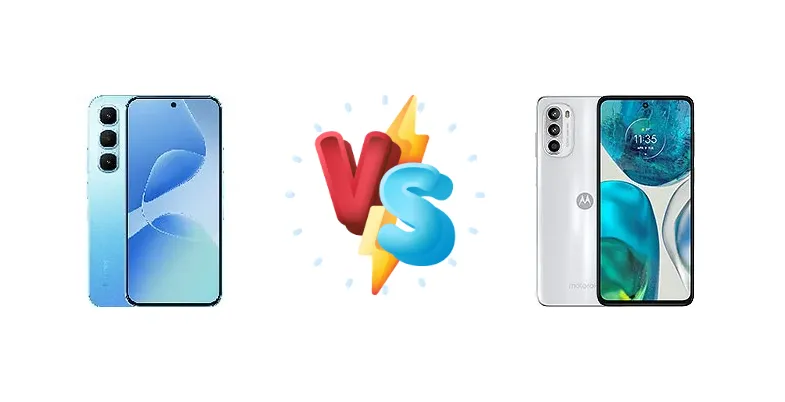
The sub-$200 smartphone market is fiercely competitive. The Infinix Hot 60 Pro and Motorola Moto G52 represent two distinct approaches: the Infinix prioritizes raw processing power for gaming, while the Motorola aims for a more balanced experience with a focus on efficiency and a refined software experience. This comparison dissects their key differences to help you choose the right device.
🏆 Quick Verdict
For users prioritizing gaming and fast charging, the Infinix Hot 60 Pro is the clear winner. Its Mediatek Helio G200 chipset offers a performance edge, and the 45W charging significantly reduces downtime. However, the Motorola Moto G52 provides a more polished, all-around experience for everyday tasks and benefits from Qualcomm's optimized power efficiency.
| Network |
|---|
| 2G bands | GSM 850 / 900 / 1800 / 1900 | GSM 850 / 900 / 1800 / 1900 |
| 3G bands | HSDPA 850 / 900 / 1700(AWS) / 1900 / 2100 | HSDPA 850 / 900 / 1700(AWS) / 1900 / 2100 |
| 4G bands | 1, 2, 3, 4, 5, 7, 8, 20, 28, 38, 40, 41 | LTE |
| Speed | HSPA, LTE | HSPA, LTE |
| Technology | GSM / HSPA / LTE | GSM / HSPA / LTE |
| Launch |
|---|
| Announced | 2025, July 10 | 2022, April 12 |
| Status | Available. Released 2025, July 13 | Available. Released 2022, April 20 |
| Body |
|---|
| Build | Glass front (Gorilla Glass 7i), plastic back, plastic frame | - |
| Dimensions | 163.5 x 75.9 x 6.6 mm (6.44 x 2.99 x 0.26 in) | 160.1 x 74.5 x 8 mm (6.30 x 2.93 x 0.31 in) |
| SIM | Nano-SIM + Nano-SIM | Nano-SIM + Nano-SIM |
| Weight | 170 g (6.00 oz) | 169 g (5.96 oz) |
| | - | Water-repellent design |
| Display |
|---|
| Protection | Corning Gorilla Glass 7i | - |
| Resolution | 1224 x 2720 pixels, 20:9 ratio (~440 ppi density) | 1080 x 2400 pixels, 20:9 ratio (~402 ppi density) |
| Size | 6.78 inches, 111.0 cm2 (~89.4% screen-to-body ratio) | 6.6 inches, 103.6 cm2 (~86.9% screen-to-body ratio) |
| Type | AMOLED, 144Hz, 2160Hz PWM, 700 nits (typ), 1600 nits (HBM), 4500 nits (peak) | AMOLED, 90Hz |
| Platform |
|---|
| CPU | Octa-core (2x2.2 GHz Cortex-A76 & 6x2.0 GHz Cortex-A55) | Octa-core (4x2.4 GHz Kryo 265 Gold & 4x1.9 GHz Kryo 265 Silver) |
| Chipset | Mediatek Helio G200 (6 nm) | Qualcomm SM6225 Snapdragon 680 4G (6 nm) |
| GPU | Mali-G57 MC2 (1.1GHz) | Adreno 610 |
| OS | Android 15, up to 3 major Android upgrades, XOS 15.1 | Android 12, planned upgrade to Android 13 |
| Memory |
|---|
| Card slot | microSDXC (dedicated slot) | microSDXC (uses shared SIM slot) |
| Internal | 128GB 8GB RAM, 256GB 8GB RAM | 64GB 4GB RAM, 128GB 4GB RAM, 128GB 6GB RAM, 256GB 6GB RAM |
| Main Camera |
|---|
| Features | Dual-LED flash, HDR, panorama | LED flash, HDR, panorama |
| Single | 50 MP, f/1.6, 27mm (wide), 1/2.8", 0.64µm, PDAF
Auxiliary lens | - |
| Triple | - | 50 MP, f/1.8 (wide), 1/2.76", 0.64µm, PDAF
8 MP, f/2.2, 118˚ (ultrawide), 1/4.0", 1.12µm
2 MP (macro) |
| Video | 1440p@30fps, 1080p@30/60fps | 1080p@30fps |
| Selfie camera |
|---|
| Single | 13 MP, f/2.2, 24mm (wide), 1/3.1", 1.12µm | 16 MP, f/2.5, (wide), 1.0µm |
| Video | 1440p@30fps, 1080p@30/60fps | 1080p@30fps |
| Sound |
|---|
| 3.5mm jack | - | Yes |
| 35mm jack | Yes | Yes |
| Loudspeaker | Yes, with stereo speakers | Yes, with stereo speakers |
| Comms |
|---|
| Bluetooth | 5.4, A2DP, LE | 5.0, A2DP, LE |
| Infrared port | Yes | - |
| NFC | Yes | Yes (market/region dependent) |
| Positioning | GPS | GPS, GLONASS, GALILEO |
| Radio | FM radio | Unspecified |
| USB | USB Type-C 2.0, OTG | USB Type-C 2.0 |
| WLAN | Wi-Fi 802.11 a/b/g/n/ac, dual-band | Wi-Fi 802.11 a/b/g/n/ac, dual-band, Wi-Fi Direct |
| Features |
|---|
| Sensors | Fingerprint (under display, optical), accelerometer, gyro, proximity, compass | Fingerprint (side-mounted), accelerometer, gyro, proximity, compass |
| Battery |
|---|
| Charging | 45W wired, 50% in 22 min
10W reverse wired | 30W wired |
| Type | 5160 mAh | Li-Po 5000 mAh |
| Misc |
|---|
| Colors | Sleek Black, Titanium Silver, Coral Tides, Sapphire Blue, Jungle Breath, Orange Rose Valley | Charcoal Gray, Porcelain White |
| Models | X6885 | XT2221-1, XT2221-2 |
| Price | About 350 EUR | About 470 EUR |
Infinix Hot 60 Pro
- Faster 45W charging for quicker top-ups
- Potentially higher gaming performance with Helio G200
- More powerful CPU cores (Cortex-A76)
- Potential for more thermal throttling under sustained load
- Software experience may be less refined than Motorola
Motorola Moto G52
- More efficient Snapdragon 680 chipset
- Potentially longer battery life due to efficiency
- Cleaner, more streamlined software experience (typically Motorola)
- Slower 30W charging
- Lower peak CPU performance compared to the Infinix
Display Comparison
Neither device boasts a flagship-level display. While specific display specs (resolution, panel type) are missing, the focus here is on performance. Both utilize 6nm chipsets, suggesting similar power efficiency considerations in display design. The absence of high refresh rates on either device indicates a cost-saving measure, prioritizing battery life over visual fluidity. Bezels are likely comparable given the price point, and color accuracy will likely be standard for this segment.
Camera Comparison
Without detailed camera specs, a direct comparison is limited. However, the market segment suggests both phones will rely on software processing to enhance image quality. The absence of information regarding sensor size or OIS suggests neither device will excel in low-light photography. The focus will likely be on providing acceptable image quality in good lighting conditions. Any additional cameras (ultra-wide, macro) are likely to be of limited utility, serving primarily as marketing features.
Performance
The core difference lies in the chipsets. The Infinix Hot 60 Pro’s Mediatek Helio G200, with its 2x2.2 GHz Cortex-A76 cores, aims for peak performance, potentially offering a noticeable advantage in demanding games. However, the Motorola Moto G52’s Qualcomm Snapdragon 680, featuring 4x2.4 GHz Kryo 265 Gold cores, benefits from Qualcomm’s established optimization and efficient architecture. While the clock speeds are higher on the Moto G52’s prime cores, the G200’s Cortex-A76 cores are generally more powerful than the Kryo 265 Gold. The G200’s 6nm process node is shared with the Snapdragon 680, suggesting comparable efficiency, but the architectural differences will dictate real-world thermal performance under sustained load. The Infinix is geared towards bursts of power, while the Motorola aims for consistent, reliable performance.
Battery Life
The Motorola Moto G52’s 30W charging is a significant advantage over the Infinix Hot 60 Pro’s 45W charging. While the Infinix boasts faster wattage, the Snapdragon 680’s efficiency could translate to longer overall battery life. The 50% charge in 22 minutes claim for the Infinix is impressive, but the Moto G52’s optimized power management may result in a more consistent user experience throughout the day. The actual battery capacity of both devices is unknown, but the charging speed difference is a key differentiator.
Buying Guide
Buy the Infinix Hot 60 Pro if you need a phone primarily for mobile gaming, frequently stream video content, and value the convenience of extremely fast charging. Buy the Motorola Moto G52 if you prefer a smooth, reliable daily driver with a focus on battery life, a cleaner software experience, and a more balanced feature set for general use.
Frequently Asked Questions
❓ Will the Infinix Hot 60 Pro’s Helio G200 overheat during extended gaming sessions?
The Helio G200 is a capable chipset, but its peak performance may lead to thermal throttling during prolonged gaming. While the 6nm process helps, sustained high loads could result in reduced clock speeds to manage heat. The Motorola Moto G52’s Snapdragon 680 is designed for efficiency and is less likely to experience significant throttling.
❓ Is the 30W charging on the Motorola Moto G52 slow compared to the Infinix Hot 60 Pro’s 45W?
While 45W is faster on paper, the Snapdragon 680’s power efficiency means the Moto G52 may reach a full charge in a comparable timeframe, and potentially offer better overall battery life. The difference in charging speed will be most noticeable when topping up the battery quickly.
❓ Which phone is better for multitasking and everyday use?
The Motorola Moto G52 is better suited for everyday multitasking and general use. The Snapdragon 680’s optimized architecture provides a smoother, more consistent experience for browsing, social media, and running multiple apps simultaneously. The Infinix Hot 60 Pro prioritizes peak performance, which is more beneficial for gaming than everyday tasks.