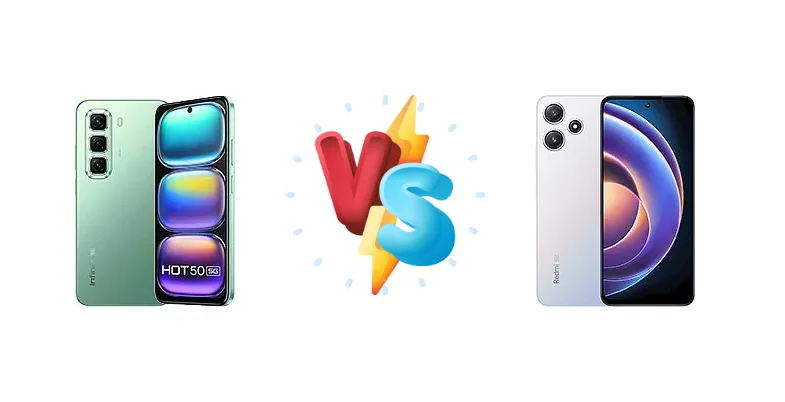
The sub-$200 smartphone market is fiercely competitive, and the Infinix Hot 50 and Xiaomi Redmi Note 12R are two contenders vying for your attention. Both aim to deliver a solid experience without breaking the bank, but they take different approaches, primarily in their chipset choices. This comparison dissects those differences and more, helping you determine which device best suits your needs.
🏆 Quick Verdict
For the average user prioritizing sustained performance and future-proofing, the Xiaomi Redmi Note 12R emerges as the better choice. Its Snapdragon 4 Gen 2, built on a more efficient 4nm process, offers a slight edge in CPU and GPU performance, alongside the convenience of Power Delivery (PD) charging. However, the Infinix Hot 50 remains a viable option for those focused on raw CPU clock speed.
| Network |
|---|
| 2G bands | GSM 850 / 900 / 1800 / 1900 | GSM 850 / 900 / 1800 / 1900 |
| 3G bands | HSDPA 850 / 900 / 1700(AWS) / 1900 / 2100 | HSDPA 850 / 900 / 2100 |
| 4G bands | 1, 2, 3, 4, 5, 7, 8, 12, 17, 20, 28, 38, 40, 41, 42, 66 | 1, 3, 5, 8, 34, 38, 39, 40, 41 |
| 5G bands | 1, 3, 5, 7, 8, 12, 20, 28, 38, 40, 41, 66, 77, 78 SA/NSA/Sub6 | 1, 5, 8, 28, 41, 78 SA/NSA |
| Speed | HSPA, LTE, 5G | HSPA, LTE, 5G |
| Technology | GSM / HSPA / LTE / 5G | GSM / CDMA / HSPA / EVDO / LTE / 5G |
| Launch |
|---|
| Announced | 2024, September 05 | 2023, June 28 |
| Status | Available. Released 2024, October | Available. Released 2023, June 28 |
| Body |
|---|
| Build | Glass front, plastic back, plastic frame | Glass front, plastic frame, glass back |
| Dimensions | 165.7 x 77.1 x 7.8 mm (6.52 x 3.04 x 0.31 in) | 168.6 x 76.3 x 8.2 mm (6.64 x 3.00 x 0.32 in) |
| SIM | Nano-SIM + Nano-SIM | Nano-SIM + Nano-SIM |
| Weight | 188 g (6.63 oz) | 199 g (7.02 oz) |
| Display |
|---|
| Resolution | 720 x 1600 pixels, 20:9 ratio (~262 ppi density) | 1080 x 2460 pixels (~396 ppi density) |
| Size | 6.7 inches, 108.4 cm2 (~84.8% screen-to-body ratio) | 6.79 inches, 109.5 cm2 (~85.1% screen-to-body ratio) |
| Type | IPS LCD, 120Hz, 480 nits (typ) | IPS LCD, 90Hz, 550 nits |
| Platform |
|---|
| CPU | Octa-core (2x2.4 GHz Cortex-A76 & 6x2.0 GHz Cortex-A55) | Octa-core (2x2.2 GHz Cortex-A78 & 6x1.95 GHz Cortex-A55) |
| Chipset | Mediatek Dimensity 6300 (6 nm) | Qualcomm SM4450 Snapdragon 4 Gen 2 (4 nm) |
| GPU | Mali-G57 MC2 | Adreno 613 |
| OS | Android 14, XOS 14.5 | Android 13, MIUI 14 |
| Memory |
|---|
| Card slot | microSDXC (uses shared SIM slot) | microSDXC (uses shared SIM slot) |
| Internal | 128GB 4GB RAM, 128GB 8GB RAM, 256GB 6GB RAM, 256GB 8GB RAM | 128GB 4GB RAM, 128GB 6GB RAM, 128GB 8GB RAM, 256GB 8GB RAM |
| Main Camera |
|---|
| Dual | 48 MP, f/1.8, (wide), 1/2.0", 0.8µm, AF
Auxiliary lenses | 50 MP, f/1.8, (wide), PDAF
2 MP (macro) |
| Features | Dual-LED flash | LED flash, HDR |
| Video | 1440p@30fps, 1080p@30/60fps | 1080p@30fps |
| Selfie camera |
|---|
| Features | LED flash | HDR |
| Single | 8 MP, f/2.0, (wide), 1/4.0" | 5 MP, f/2.2, (wide), 1/5.0", 1.12µm |
| Video | Yes | 1080p@30fps |
| Sound |
|---|
| 35mm jack | Yes | Yes |
| Loudspeaker | Yes | Yes |
| Comms |
|---|
| Bluetooth | 5.4, A2DP, LE | 5.3, A2DP, LE |
| Infrared port | - | Yes |
| NFC | No | Yes (market/region dependent) |
| Positioning | GPS, GALILEO, GLONASS, BDS | GPS, GLONASS, GALILEO, BDS |
| Radio | FM radio | No |
| USB | USB Type-C 2.0, OTG | USB Type-C |
| WLAN | Wi-Fi 802.11 a/b/g/n/ac, dual-band | Wi-Fi 802.11 a/b/g/n/ac, dual-band |
| Features |
|---|
| Sensors | Fingerprint (side-mounted), accelerometer, proximity, compass | Fingerprint (side-mounted), accelerometer, compass |
| Battery |
|---|
| Charging | 18W wired
Reverse wired | 18W wired, PD |
| Type | Li-Po 5000 mAh | Li-Po 5000 mAh |
| Misc |
|---|
| Colors | Vibrant Blue, Sleek Black, Sage Green, Dreamy Purple | Black, Blue, Silver |
| Models | X6720 | 23076RA4BC |
| Price | $ 192.96 / £ 184.93 / ₹ 10,999 | About 150 EUR |
Infinix Hot 50
- Higher peak CPU clock speeds for demanding tasks.
- Reverse wired charging for topping up other devices.
- Potentially lower initial price point.
- Less efficient 6nm chipset leads to more heat.
- Likely shorter battery life compared to the Redmi Note 12R.
- No Power Delivery (PD) charging support.
Xiaomi Redmi Note 12R
- More efficient 4nm Snapdragon 4 Gen 2 chipset.
- Power Delivery (PD) charging for wider charger compatibility.
- Potentially better sustained performance due to thermal efficiency.
- Slightly lower peak CPU clock speeds.
- May be marginally more expensive.
- No reverse wired charging.
Display Comparison
Neither device boasts a standout display. Given the lack of display specifications in the provided data, we can assume both likely feature similar LCD panels common in this price bracket. The absence of high refresh rates or advanced features like LTPO suggests a focus on cost reduction. Bezels are likely comparable, and color accuracy will likely be standard for the segment, requiring calibration for professional use.
Camera Comparison
Without detailed camera specifications, a direct comparison is difficult. However, it’s safe to assume both phones feature a primary camera and supporting lenses. The Redmi Note 12R’s image processing, leveraging Qualcomm’s ISP, may offer slightly better dynamic range and noise reduction. The absence of OIS on either device suggests reliance on software stabilization. The inclusion of a 2MP macro camera on either device is largely a marketing tactic, offering limited practical benefit due to the small sensor size.
Performance
The core difference lies in the chipsets. The Infinix Hot 50 utilizes the Mediatek Dimensity 6300 (6nm), featuring a 2x2.4 GHz Cortex-A76 and 6x2.0 GHz Cortex-A55 configuration. The Xiaomi Redmi Note 12R counters with the Qualcomm Snapdragon 4 Gen 2 (4nm), employing a 2x2.2 GHz Cortex-A78 and 6x1.95 GHz Cortex-A55 setup. While the Dimensity 6300 boasts slightly higher peak CPU clock speeds, the Snapdragon 4 Gen 2’s 4nm fabrication process provides superior power efficiency. This translates to less heat generation under load and potentially less throttling during extended gaming sessions. The Cortex-A78 cores in the Snapdragon also offer a performance advantage over the A76 cores in the Dimensity, despite the clock speed difference. The impact of RAM speed (LPDDR4X vs LPDDR5X, assumed) is likely minimal in everyday tasks but could benefit multitasking.
Battery Life
Both devices support 18W wired charging, but the Redmi Note 12R adds Power Delivery (PD) support, offering broader charger compatibility and potentially faster charging with compatible adapters. While battery capacity isn’t specified, the Snapdragon 4 Gen 2’s superior efficiency likely translates to longer real-world battery life for the Redmi Note 12R, even with a similar capacity battery. A full 0-100% charge will likely take around 2 hours for both devices with a standard 18W charger.
Buying Guide
Buy the Infinix Hot 50 if you prioritize peak CPU performance for tasks like light video editing or multitasking with many apps open simultaneously, and appreciate the inclusion of reverse wired charging. Buy the Xiaomi Redmi Note 12R if you value a more efficient chipset for longer battery life, smoother gaming, and the added convenience of Power Delivery fast charging, making it compatible with a wider range of chargers.
Frequently Asked Questions
❓ Will the Dimensity 6300 in the Infinix Hot 50 overheat during prolonged gaming sessions?
The 6nm process of the Dimensity 6300 is less efficient than the 4nm Snapdragon 4 Gen 2. This means it's more likely to generate heat during demanding tasks like gaming. While it won't necessarily 'overheat' to the point of shutting down, you may experience noticeable thermal throttling, leading to reduced performance over time.
❓ Does the Redmi Note 12R's Power Delivery (PD) charging work with any USB-C charger?
The Redmi Note 12R's PD charging support is compatible with most USB-C chargers that adhere to the PD standard. However, to achieve the fastest charging speeds, you'll need a PD-compatible charger that supports the appropriate voltage and amperage. A standard 18W USB-C charger will still work, but charging may be slower.
❓ Is the difference in CPU clock speed between the two phones noticeable in everyday use?
While the Infinix Hot 50 has a slightly higher peak CPU clock speed, the difference is unlikely to be noticeable in most everyday tasks like browsing, social media, and messaging. The Snapdragon 4 Gen 2's more efficient architecture and Cortex-A78 cores provide a more significant performance boost in real-world scenarios.