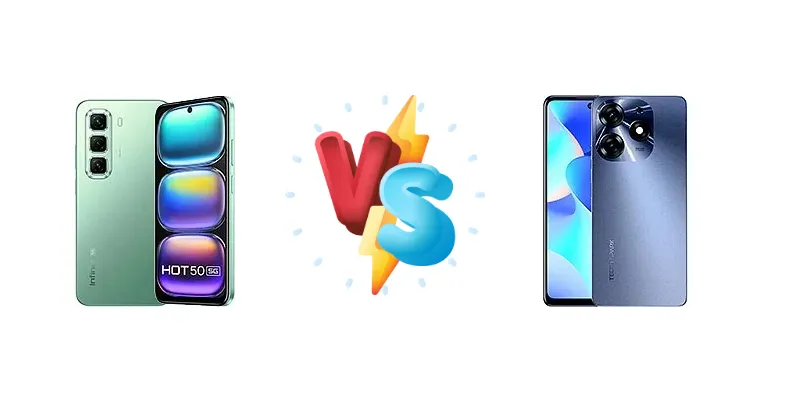
The Infinix Hot 50 and Tecno Spark 10 Pro represent compelling options in the ultra-competitive budget smartphone space. Both aim to deliver essential features at a low price point, but they take different approaches to achieving this. The Hot 50 prioritizes newer chipset technology, while the Spark 10 Pro focuses on a refined display experience and established reliability. This comparison dissects their key differences to determine which phone best suits your needs.
🏆 Quick Verdict
For most users, the Infinix Hot 50 emerges as the better choice. Its Mediatek Dimensity 6300 chipset offers a significant performance uplift over the Tecno Spark 10 Pro’s Helio G88, translating to smoother multitasking and a more enjoyable gaming experience. While both offer similar battery endurance and charging speeds, the Hot 50’s modern architecture provides a future-proofed advantage.
| Network |
|---|
| 2G bands | GSM 850 / 900 / 1800 / 1900 | GSM 850 / 900 / 1800 / 1900 |
| 3G bands | HSDPA 850 / 900 / 1700(AWS) / 1900 / 2100 | HSDPA 850 / 900 / 2100 |
| 4G bands | 1, 2, 3, 4, 5, 7, 8, 12, 17, 20, 28, 38, 40, 41, 42, 66 | LTE |
| 5G bands | 1, 3, 5, 7, 8, 12, 20, 28, 38, 40, 41, 66, 77, 78 SA/NSA/Sub6 | - |
| Speed | HSPA, LTE, 5G | HSPA, LTE |
| Technology | GSM / HSPA / LTE / 5G | GSM / HSPA / LTE |
| Launch |
|---|
| Announced | 2024, September 05 | 2023, March 06 |
| Status | Available. Released 2024, October | Available. Released 2023, March 22 |
| Body |
|---|
| Build | Glass front, plastic back, plastic frame | Glass front, plastic frame, glass back |
| Dimensions | 165.7 x 77.1 x 7.8 mm (6.52 x 3.04 x 0.31 in) | 168.4 x 76.2 x 8.4 mm (6.63 x 3.00 x 0.33 in) |
| SIM | Nano-SIM + Nano-SIM | Nano-SIM + Nano-SIM |
| Weight | 188 g (6.63 oz) | 208 g (7.34 oz) |
| Display |
|---|
| Resolution | 720 x 1600 pixels, 20:9 ratio (~262 ppi density) | 1080 x 2460 pixels (~396 ppi density) |
| Size | 6.7 inches, 108.4 cm2 (~84.8% screen-to-body ratio) | 6.8 inches, 109.3 cm2 (~85.1% screen-to-body ratio) |
| Type | IPS LCD, 120Hz, 480 nits (typ) | IPS LCD, 90Hz |
| Platform |
|---|
| CPU | Octa-core (2x2.4 GHz Cortex-A76 & 6x2.0 GHz Cortex-A55) | Octa-core (2x2.0 GHz Cortex-A75 & 6x1.8 GHz Cortex-A55) |
| Chipset | Mediatek Dimensity 6300 (6 nm) | Mediatek MT6769H Helio G88 (12 nm) |
| GPU | Mali-G57 MC2 | Mali-G52 MC2 |
| OS | Android 14, XOS 14.5 | Android 13, HIOS 12.6 |
| Memory |
|---|
| Card slot | microSDXC (uses shared SIM slot) | microSDXC (dedicated slot) |
| Internal | 128GB 4GB RAM, 128GB 8GB RAM, 256GB 6GB RAM, 256GB 8GB RAM | 128GB 4GB RAM, 128GB 8GB RAM, 256GB 8GB RAM |
| Main Camera |
|---|
| Dual | 48 MP, f/1.8, (wide), 1/2.0", 0.8µm, AF
Auxiliary lenses | 50 MP, f/1.6, (wide), PDAF
0.08 MP, (depth) |
| Features | Dual-LED flash | Dual-LED flash, HDR, panorama |
| Single | - | 50 MP, f/1.6, (wide), PDAF
Auxiliary lens |
| Triple | - | 50 MP, f/1.6, (wide), PDAF
other unspecified cameras |
| Video | 1440p@30fps, 1080p@30/60fps | 1440p@30fps, 1080p@30fps |
| Selfie camera |
|---|
| Features | LED flash | Dual-LED flash |
| Single | 8 MP, f/2.0, (wide), 1/4.0" | 32 MP, (wide) |
| Video | Yes | 1440p@30fps, 1080p@30fps |
| Sound |
|---|
| 3.5mm jack | - | Yes |
| 35mm jack | Yes | Yes |
| Loudspeaker | Yes | Yes |
| Comms |
|---|
| Bluetooth | 5.4, A2DP, LE | 5.3, A2DP, LE |
| NFC | No | Yes |
| Positioning | GPS, GALILEO, GLONASS, BDS | GPS |
| Radio | FM radio | FM radio |
| USB | USB Type-C 2.0, OTG | USB Type-C 2.0, OTG |
| WLAN | Wi-Fi 802.11 a/b/g/n/ac, dual-band | Wi-Fi 802.11 b/g/n |
| Features |
|---|
| Sensors | Fingerprint (side-mounted), accelerometer, proximity, compass | Fingerprint (side-mounted), accelerometer, proximity, compass |
| Battery |
|---|
| Charging | 18W wired
Reverse wired | 18W wired |
| Type | Li-Po 5000 mAh | 5000 mAh |
| Misc |
|---|
| Colors | Vibrant Blue, Sleek Black, Sage Green, Dreamy Purple | Starry Black, Pearl White |
| Models | X6720 | KI7 |
| Price | $ 192.96 / £ 184.93 / ₹ 10,999 | £ 245.74 |
| Tests |
|---|
| Battery life | - |
Endurance rating 131h
|
| Camera | - |
Photo / Video |
| Display | - |
Contrast ratio: 1991:1 (nominal) |
| Loudspeaker | - |
-29.2 LUFS (Average)
|
| Performance | - |
AnTuTu: 249938 (v9)
GeekBench: 1358 (v5.1), 1376 (v6)
GFXBench: 8.1fps (ES 3.1 onscreen) |
Infinix Hot 50
- More powerful Mediatek Dimensity 6300 chipset
- 6nm process for better efficiency
- Potentially better future-proofing
- Display specifications are largely unknown
- Camera details are lacking
Tecno Spark 10 Pro
- Brighter display (521 nits)
- Proven reliability and established user base
- Good battery endurance
- Older and less powerful Helio G88 chipset
- 12nm process is less efficient
- Limited performance headroom
Display Comparison
Both the Infinix Hot 50 and Tecno Spark 10 Pro share a 1991:1 contrast ratio, suggesting similar image quality in terms of blacks and whites. However, the Tecno Spark 10 Pro boasts a measured peak brightness of 521 nits, offering a slightly more visible screen outdoors. While both displays are nominally similar, the Hot 50’s panel specifications are not provided, making a direct comparison difficult. The lack of high refresh rate support on either device suggests they are geared towards casual users rather than demanding gamers.
Camera Comparison
Both devices feature 'Photo / Video' capabilities, but lack specific details regarding sensor size, aperture, or image stabilization. Given the budget nature of these phones, it’s likely both rely on similar, relatively basic camera setups. Without further information, it’s difficult to assess a clear winner. The presence of a 2MP macro camera on the Spark 10 Pro is unlikely to significantly enhance the photography experience, as these sensors typically lack the detail and dynamic range needed for compelling macro shots.
Performance
The core difference lies in the chipsets. The Infinix Hot 50’s Mediatek Dimensity 6300 (6nm) is a clear upgrade over the Tecno Spark 10 Pro’s Mediatek Helio G88 (12nm). The 6nm process node of the Dimensity 6300 translates to better power efficiency and reduced thermal throttling during sustained workloads. The Hot 50’s CPU configuration – 2x2.4 GHz Cortex-A76 & 6x2.0 GHz Cortex-A55 – also outperforms the Spark 10 Pro’s 2x2.0 GHz Cortex-A75 & 6x1.8 GHz Cortex-A55, offering faster application loading and smoother multitasking. This architectural advantage makes the Hot 50 the superior choice for users who frequently game or use resource-intensive applications.
Battery Life
Both the Infinix Hot 50 and Tecno Spark 10 Pro achieve an endurance rating of 131 hours, indicating comparable battery life under typical usage scenarios. Both also support 18W wired charging, suggesting similar charging speeds. While the Hot 50’s chipset is more efficient, the identical endurance rating suggests the Spark 10 Pro compensates with a potentially larger battery capacity (though this is unconfirmed). The 18W charging, while adequate, isn’t particularly fast by today’s standards, requiring approximately 2-3 hours for a full charge.
Buying Guide
Buy the Infinix Hot 50 if you prioritize performance for gaming and demanding apps, and want a device built on a more modern process node for improved efficiency. Buy the Tecno Spark 10 Pro if you value a slightly brighter display with a proven track record and are less concerned with pushing the limits of mobile gaming or intensive multitasking. The Spark 10 Pro is a solid all-rounder, but the Hot 50 offers more headroom for future software updates and app demands.
Frequently Asked Questions
❓ Will the Infinix Hot 50 handle demanding games like PUBG Mobile smoothly?
The Mediatek Dimensity 6300 in the Hot 50 is significantly more capable than the Helio G88 in the Spark 10 Pro. While it won't deliver flagship-level performance, it should provide a playable experience in PUBG Mobile at medium settings. Expect some frame drops during intense firefights, but overall, it will be a more enjoyable gaming experience than on the Spark 10 Pro.
❓ Is the 18W charging on either phone considered fast charging in 2024?
No, 18W charging is relatively slow by 2024 standards. Many phones now offer 33W, 65W, or even faster charging speeds. Both the Infinix Hot 50 and Tecno Spark 10 Pro will take approximately 2-3 hours to fully charge from 0 to 100%. This isn't a dealbreaker, but it's something to consider if you prioritize quick top-ups.
❓ How does the Dimensity 6300's 6nm process affect real-world usage compared to the Helio G88's 12nm?
The 6nm process used in the Dimensity 6300 is significantly more efficient than the 12nm process of the Helio G88. This means the Hot 50 will consume less power for the same tasks, resulting in longer battery life and less heat generation. Less heat also means less performance throttling during extended gaming sessions or demanding app usage.