
Infinix Hot 50 vs Nokia G42: A Deep Dive into Budget 5G Performance
| Phones Images | |||||
|---|---|---|---|---|---|
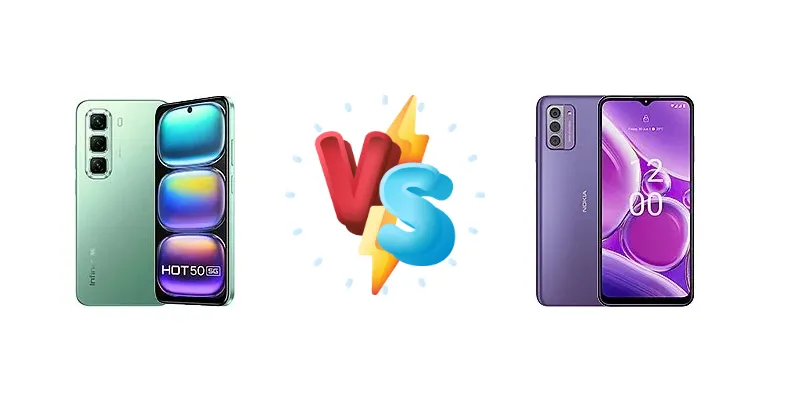
|
🏆 Quick Verdict
For most users, the Infinix Hot 50 emerges as the stronger contender. Its Mediatek Dimensity 6300, built on a more efficient 6nm process, provides a noticeable performance edge over the Snapdragon 480+ in the Nokia G42, making it better suited for multitasking and light gaming. While the Nokia G42 offers slightly faster 20W charging, the Hot 50’s overall performance advantage is more impactful.
| PHONES | ||
|---|---|---|
| Phone Names | Infinix Hot 50 | Nokia G42 |
| Network | ||
|---|---|---|
| 2G bands | GSM 850 / 900 / 1800 / 1900 | GSM 850 / 900 / 1800 / 1900 |
| 3G bands | HSDPA 850 / 900 / 1700(AWS) / 1900 / 2100 | HSDPA 850 / 900 / 1700(AWS) / 1900 / 2100 |
| 4G bands | 1, 2, 3, 4, 5, 7, 8, 12, 17, 20, 28, 38, 40, 41, 42, 66 | 1, 2, 3, 4, 5, 7, 8, 12, 17, 13, 20, 28, 38, 39, 40, 41, 66 |
| 5G bands | 1, 3, 5, 7, 8, 12, 20, 28, 38, 40, 41, 66, 77, 78 SA/NSA/Sub6 | 1, 2, 3, 5, 7, 8, 28, 40, 41, 66, 77, 78 SA/NSA |
| Speed | HSPA, LTE, 5G | HSPA, LTE, 5G |
| Technology | GSM / HSPA / LTE / 5G | GSM / HSPA / LTE / 5G |
| Launch | ||
|---|---|---|
| Announced | 2024, September 05 | 2023, June 28 |
| Status | Available. Released 2024, October | Available. Released 2023, June 28 |
| Body | ||
|---|---|---|
| Build | Glass front, plastic back, plastic frame | Glass front, plastic back, plastic frame |
| Dimensions | 165.7 x 77.1 x 7.8 mm (6.52 x 3.04 x 0.31 in) | 165 x 75.8 x 8.6 mm (6.50 x 2.98 x 0.34 in) |
| SIM | Nano-SIM + Nano-SIM | · Nano-SIM· Nano-SIM + Nano-SIM |
| Weight | 188 g (6.63 oz) | 193.8 g (6.84 oz) |
| Display | ||
|---|---|---|
| Protection | - | Corning Gorilla Glass 3 |
| Resolution | 720 x 1600 pixels, 20:9 ratio (~262 ppi density) | 720 x 1612 pixels, 20:9 ratio (~269 ppi density) |
| Size | 6.7 inches, 108.4 cm2 (~84.8% screen-to-body ratio) | 6.56 inches, 103.4 cm2 (~82.7% screen-to-body ratio) |
| Type | IPS LCD, 120Hz, 480 nits (typ) | IPS LCD, 90Hz, 450 nits (typ), 560 nits (peak) |
| Platform | ||
|---|---|---|
| CPU | Octa-core (2x2.4 GHz Cortex-A76 & 6x2.0 GHz Cortex-A55) | Octa-core (2x2.2 GHz Kryo 460 & 6x1.8 GHz Kryo 460) |
| Chipset | Mediatek Dimensity 6300 (6 nm) | Qualcomm SM4350-AC Snapdragon 480+ 5G (8 nm) |
| GPU | Mali-G57 MC2 | Adreno 619 |
| OS | Android 14, XOS 14.5 | Android 13, upgradable to Android 14 |
| Memory | ||
|---|---|---|
| Card slot | microSDXC (uses shared SIM slot) | microSDXC |
| Internal | 128GB 4GB RAM, 128GB 8GB RAM, 256GB 6GB RAM, 256GB 8GB RAM | 128GB 4GB RAM, 128GB 6GB RAM, 256GB 8GB RAM |
| Main Camera | ||
|---|---|---|
| Dual | 48 MP, f/1.8, (wide), 1/2.0", 0.8µm, AF Auxiliary lenses | - |
| Features | Dual-LED flash | LED flash, HDR, panorama |
| Triple | - | 50 MP, f/1.8, (wide), AF 2 MP (macro) Auxiliary lens |
| Video | 1440p@30fps, 1080p@30/60fps | 1080p@30fps |
| Selfie camera | ||
|---|---|---|
| Features | LED flash | - |
| Single | 8 MP, f/2.0, (wide), 1/4.0" | 8 MP |
| Video | Yes | Yes |
| Sound | ||
|---|---|---|
| 35mm jack | Yes | Yes |
| Loudspeaker | Yes | Yes |
| Comms | ||
|---|---|---|
| Bluetooth | 5.4, A2DP, LE | 5.1, A2DP, LE |
| NFC | No | Yes (market/region dependent) |
| Positioning | GPS, GALILEO, GLONASS, BDS | GPS, GLONASS, GALILEO, BDS |
| Radio | FM radio | FM radio |
| USB | USB Type-C 2.0, OTG | USB Type-C 2.0, OTG |
| WLAN | Wi-Fi 802.11 a/b/g/n/ac, dual-band | Wi-Fi 802.11 a/b/g/n/ac/6, dual-band |
| Features | ||
|---|---|---|
| Sensors | Fingerprint (side-mounted), accelerometer, proximity, compass | Fingerprint (side-mounted), accelerometer, proximity, compass |
| Battery | ||
|---|---|---|
| Charging | 18W wired Reverse wired | 20W wired, PD3.0, QC3 |
| Type | Li-Po 5000 mAh | Li-Po 5000 mAh |
| Misc | ||
|---|---|---|
| Colors | Vibrant Blue, Sleek Black, Sage Green, Dreamy Purple | Gray, Purple, Red |
| Models | X6720 | - |
| Price | $ 192.96 / £ 184.93 / ₹ 10,999 | $ 545.00 / £ 124.99 |
Infinix Hot 50
- More powerful processor (Dimensity 6300)
- More efficient 6nm process
- Potentially better thermal management
- Slower charging speed (18W)
- Software update commitment may be shorter than Nokia
Nokia G42
- Faster charging (20W with PD3.0/QC3)
- Stronger software update guarantee from Nokia
- Cleaner Android experience
- Less powerful processor (Snapdragon 480+)
- Less efficient 8nm process
Display Comparison
Neither device boasts a standout display. Both likely utilize LCD panels, common in this price bracket. The key difference lies under the hood. While specific display specs are missing, the focus should be on real-world usability. Expect 60Hz refresh rates on both. The absence of high refresh rates isn’t unusual at this price point, but impacts smoothness during scrolling. Bezels are likely comparable, and color accuracy will be adequate for general consumption, but not professional work.
Camera Comparison
Camera performance is likely to be similar, with both phones targeting the budget segment. Without detailed sensor information, it’s safe to assume both will feature a primary sensor paired with auxiliary lenses of limited utility. Image processing will be the differentiating factor, and Nokia generally offers more natural-looking images, while Infinix tends towards more saturated colors. Expect decent performance in good lighting conditions, but struggles in low light. The absence of Optical Image Stabilization (OIS) on either device will exacerbate low-light issues.
Performance
The core battleground is the chipset. The Infinix Hot 50’s Mediatek Dimensity 6300 (6nm) holds a significant advantage over the Nokia G42’s Qualcomm Snapdragon 480+ (8nm). The 6nm process node translates to better power efficiency and thermal management, meaning the Hot 50 is less likely to throttle under sustained load. The Dimensity 6300’s CPU configuration – 2x2.4 GHz Cortex-A76 & 6x2.0 GHz Cortex-A55 – offers a higher peak clock speed and more powerful core architecture compared to the Snapdragon 480+'s 2x2.2 GHz Kryo 460 & 6x1.8 GHz Kryo 460. This will result in snappier app launches and smoother multitasking. While both are octa-core, the architectural differences favor the Infinix.
Battery Life
The Nokia G42’s 20W charging with PD3.0 and QC3 support is a slight advantage over the Infinix Hot 50’s 18W charging. This translates to potentially faster 0-100% charge times, though the difference won’t be dramatic. However, the Dimensity 6300’s superior power efficiency could offset the charging speed difference, resulting in comparable real-world battery life. Both phones will likely offer a full day of moderate use, but heavy gaming or video streaming will drain the battery faster.
Buying Guide
Buy the Infinix Hot 50 if you prioritize performance for everyday tasks and occasional gaming, and value a more modern chipset architecture. Buy the Nokia G42 if you specifically need a phone with guaranteed software updates (a Nokia strength) and prefer a slightly faster charging solution, even if it means sacrificing some processing power. The Nokia G42 also appeals to users who prefer a cleaner Android experience.