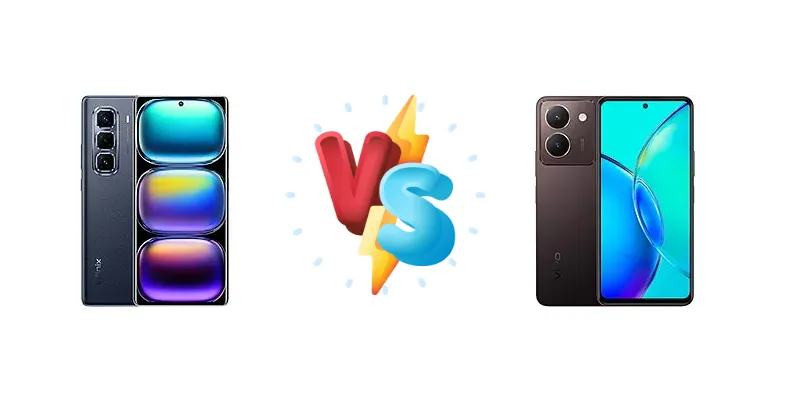
The Infinix Hot 50 Pro+ and vivo Y27s represent compelling options in the crowded budget 4G smartphone market. While both aim to deliver essential features at an accessible price point, they diverge in their core hardware choices, particularly in chipset and charging technology. This comparison dissects these differences to determine which device offers the best value for your money.
🏆 Quick Verdict
For the average user prioritizing sustained performance and longer battery life, the Infinix Hot 50 Pro+ emerges as the stronger contender. Its Mediatek Helio G100 chipset, coupled with a measured 10:54h active use battery score, provides a more robust experience than the vivo Y27s' Snapdragon 680, despite the latter's faster 44W charging.
| Network |
|---|
| 2G bands | GSM 850 / 900 / 1800 / 1900 | GSM 850 / 900 / 1800 / 1900 |
| 3G bands | HSDPA 850 / 900 / 1700(AWS) / 1900 / 2100 | HSDPA 850 / 900 / 2100 |
| 4G bands | 1, 2, 3, 4, 5, 7, 8, 20, 28, 38, 40, 41 | 1, 3, 5, 7, 8, 20, 28, 38, 40, 41 |
| Speed | HSPA, LTE | HSPA, LTE |
| Technology | GSM / HSPA / LTE | GSM / HSPA / LTE |
| Launch |
|---|
| Announced | 2024, October 20 | 2023, November 07 |
| Status | Available. Released 2024, November | Available. Released 2023, November 07 |
| Body |
|---|
| Build | Glass front, plastic back, plastic frame | Glass front, plastic frame, plastic back |
| Dimensions | 164.1 x 74.4 x 6.8 mm (6.46 x 2.93 x 0.27 in) | 164.1 x 76.2 x 8.2 mm (6.46 x 3.00 x 0.32 in) |
| SIM | Nano-SIM + Nano-SIM | Nano-SIM + Nano-SIM |
| Weight | 162 g (5.71 oz) | 192 g (6.77 oz) |
| Display |
|---|
| Protection | Corning Gorilla Glass | - |
| Resolution | 1080 x 2436 pixels (~393 ppi density) | 1080 x 2388 pixels (~395 ppi density) |
| Size | 6.78 inches, 109.9 cm2 (~90.0% screen-to-body ratio) | 6.64 inches, 106.8 cm2 (~85.4% screen-to-body ratio) |
| Type | AMOLED, 1B colors, 120Hz, 2160Hz PWM, 550 nits (typ), 1300 nits (peak) | IPS LCD, 90Hz, 650 nits (peak) |
| Platform |
|---|
| CPU | Octa-core (2x2.2 GHz Cortex-A76 & 6x2.0 GHz Cortex-A55) | Octa-core (4x2.4 GHz Kryo 265 Gold & 4x1.9 GHz Kryo 265 Silver) |
| Chipset | Mediatek Helio G100 (6 nm) | Qualcomm SM6225 Snapdragon 680 4G (6 nm) |
| GPU | Mali-G57 MC2 | Adreno 610 |
| OS | Android 14, up to 1 major Android upgrades, XOS 14.5 | Android 13, Funtouch 13 |
| Memory |
|---|
| Card slot | microSDXC (dedicated slot) | microSDXC (dedicated slot) |
| Internal | 128GB 8GB RAM, 256GB 8GB RAM | 128GB 8GB RAM, 256GB 8GB RAM |
| Main Camera |
|---|
| Dual | 50 MP, f/1.6, 27mm (wide), 1/2.8", AF
Auxiliary lenses | 50 MP, f/1.8, (wide), PDAF
Auxiliary lens |
| Features | Dual-LED flash, panorama | Dual-LED dual-tone flash, HDR, panorama |
| Video | 1440p@30fps, 1080p@30/60fps | 1080p@30fps |
| Selfie camera |
|---|
| Features | LED flash | - |
| Single | 13 MP, f/2.2, (wide), 1/3.06" | 8 MP, f/2.0, (wide) |
| Video | Yes | 1080p@30fps |
| Sound |
|---|
| 35mm jack | No | Yes |
| Loudspeaker | Yes, with stereo speakers | Yes |
| Comms |
|---|
| Bluetooth | Yes | 5.0, A2DP, LE |
| NFC | Yes, 360˚ | Yes (market/region dependent) |
| Positioning | GPS | GPS, GLONASS, GALILEO, BDS, QZSS |
| Radio | FM radio | No |
| USB | USB Type-C 2.0, OTG | USB Type-C 2.0, OTG |
| WLAN | Wi-Fi 802.11 a/b/g/n/ac, dual-band | Wi-Fi 802.11 a/b/g/n/ac, dual-band |
| Features |
|---|
| Sensors | Fingerprint (under display, optical), accelerometer, gyro, proximity, compass | Fingerprint (side-mounted), accelerometer, gyro, proximity, compass |
| Battery |
|---|
| Charging | 33W wired, 50% in 26 min
10W reverse wired
Bypass charging | 44W wired |
| Type | 5000 mAh | Li-Ion 5000 mAh |
| Misc |
|---|
| Colors | Sleek Black, Titanium Grey, Dreamy Purple | Burgundy Black, Garden Green |
| Models | X6880 | V2322 |
| Price | About 190 EUR | About 140 EUR |
Infinix Hot 50 Pro+ 4G
- Longer battery life (10:54h active use)
- Brighter display (1190 nits)
- Potentially better performance with Helio G100
- Slower charging speed (33W vs 44W)
- Limited camera information
vivo Y27s
- Faster charging speed (44W)
- Qualcomm Snapdragon chipset
- Potentially better software optimization (Qualcomm ecosystem)
- Likely shorter battery life
- Less powerful CPU architecture
- Limited camera information
Display Comparison
Both devices lack detailed display specifications in the provided data, but the Infinix Hot 50 Pro+ boasts a significantly brighter display at 1190 nits. This peak brightness advantage translates to superior visibility outdoors under direct sunlight, a crucial benefit for users frequently exposed to bright environments. Without knowing the panel technology (IPS, AMOLED) or refresh rate of either device, it's difficult to assess color accuracy or smoothness, but the brightness difference is a clear win for the Infinix.
Camera Comparison
The provided data doesn't offer sufficient detail for a meaningful camera comparison. Both phones likely feature multi-camera setups, but without knowing sensor sizes, apertures, or image processing algorithms, it's impossible to determine which delivers superior image quality. The prevalence of 2MP macro lenses on budget phones suggests both devices may include one, but these typically offer limited practical value. A deeper analysis would require sample photos and detailed camera specifications.
Performance
The core performance difference lies in the chipsets. The Infinix Hot 50 Pro+ utilizes the Mediatek Helio G100 (6nm), featuring a dual-cluster CPU configuration with 2x2.2 GHz Cortex-A76 cores and 6x2.0 GHz Cortex-A55 cores. This architecture prioritizes peak performance for tasks like gaming. Conversely, the vivo Y27s employs the Qualcomm Snapdragon 680 (6nm) with 4x2.4 GHz Kryo 265 Gold cores and 4x1.9 GHz Kryo 265 Silver cores. While the Snapdragon 680's Gold cores have a higher clock speed, the Helio G100's Cortex-A76 cores are generally more efficient and offer better single-core performance. This suggests the Infinix will handle demanding applications more smoothly. The 6nm fabrication process on both chips contributes to improved power efficiency, but the Helio G100's architecture gives it an edge.
Battery Life
The Infinix Hot 50 Pro+ shines in battery performance, achieving an impressive 10:54h of active use. While the vivo Y27s' battery capacity is unknown, the Infinix's score indicates excellent power efficiency. The charging speeds differ significantly: the Infinix supports 33W wired charging (50% in 26 minutes) and 10W reverse wired charging, while the vivo Y27s offers 44W wired charging. The vivo's faster charging is a convenience, but the Infinix's longer battery life may negate the need for frequent top-ups. The Infinix also offers bypass charging, allowing it to be powered directly from the charger while still being used, which can reduce battery wear over time.
Buying Guide
Buy the Infinix Hot 50 Pro+ 4G if you need a phone capable of handling demanding apps and longer gaming sessions without significant throttling, and if maximizing battery life is a priority. Buy the vivo Y27s if you prioritize the convenience of faster charging and prefer Qualcomm's Snapdragon ecosystem, even if it means slightly less raw processing power and potentially shorter battery endurance.
Frequently Asked Questions
❓ Does the Mediatek Helio G100 in the Infinix Hot 50 Pro+ experience significant thermal throttling during extended gaming sessions?
While the Helio G100 is a capable chipset, sustained performance can be affected by thermal throttling. However, the 6nm fabrication process helps mitigate this issue compared to older, larger node chipsets. The Infinix Hot 50 Pro+'s thermal management system will ultimately determine how well it handles prolonged gaming, but it's generally expected to offer a playable experience for most mobile games.
❓ How does the 44W charging on the vivo Y27s compare to the 33W charging on the Infinix Hot 50 Pro+ in real-world usage?
The vivo Y27s' 44W charging will undoubtedly be faster, reducing the time spent plugged into the wall. However, the Infinix Hot 50 Pro+'s superior battery life (10:54h active use) means you may not need to charge it as frequently, potentially minimizing the impact of the slower charging speed. The convenience of faster charging is valuable, but the Infinix prioritizes longevity.
❓ Is the 10W reverse wired charging on the Infinix Hot 50 Pro+ useful for charging accessories like earbuds?
Yes, the 10W reverse wired charging is a convenient feature for topping up accessories like wireless earbuds or smartwatches. While it's not a fast charging solution, it can provide a small boost when you're away from a power outlet and need to quickly replenish the battery of a smaller device.