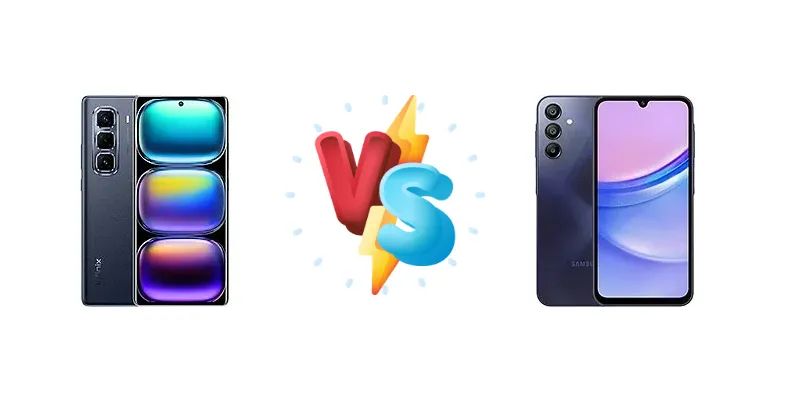
The Infinix Hot 50 Pro+ and Samsung Galaxy A15 represent compelling options in the crowded budget smartphone market. Both leverage Mediatek’s Helio series to deliver a balance of performance and affordability, but they diverge significantly in areas like display brightness and battery endurance, making the choice dependent on individual priorities.
🏆 Quick Verdict
For the average user prioritizing all-day battery life, the Samsung Galaxy A15 is the clear winner, offering over 4 hours of additional active use. However, if a brighter display is crucial, particularly for outdoor visibility, the Infinix Hot 50 Pro+’s 1190 nits peak brightness provides a noticeable advantage.
| Network |
|---|
| 2G bands | GSM 850 / 900 / 1800 / 1900 | GSM 850 / 900 / 1800 / 1900 |
| 3G bands | HSDPA 850 / 900 / 1700(AWS) / 1900 / 2100 | HSDPA 850 / 900 / 2100 |
| 4G bands | 1, 2, 3, 4, 5, 7, 8, 20, 28, 38, 40, 41 | 1, 3, 5, 7, 8, 20, 28, 38, 40, 41 |
| Speed | HSPA, LTE | HSPA, LTE |
| Technology | GSM / HSPA / LTE | GSM / HSPA / LTE |
| Launch |
|---|
| Announced | 2024, October 20 | 2023, December 11 |
| Status | Available. Released 2024, November | Available. Released 2023, December 16 |
| Body |
|---|
| Build | Glass front, plastic back, plastic frame | Glass front, plastic back, plastic frame |
| Dimensions | 164.1 x 74.4 x 6.8 mm (6.46 x 2.93 x 0.27 in) | 160.1 x 76.8 x 8.4 mm (6.30 x 3.02 x 0.33 in) |
| SIM | Nano-SIM + Nano-SIM | · Nano-SIM· Nano-SIM + Nano-SIM |
| Weight | 162 g (5.71 oz) | 200 g (7.05 oz) |
| Display |
|---|
| Protection | Corning Gorilla Glass | - |
| Resolution | 1080 x 2436 pixels (~393 ppi density) | 1080 x 2340 pixels, 19.5:9 ratio (~396 ppi density) |
| Size | 6.78 inches, 109.9 cm2 (~90.0% screen-to-body ratio) | 6.5 inches, 103.7 cm2 (~84.3% screen-to-body ratio) |
| Type | AMOLED, 1B colors, 120Hz, 2160Hz PWM, 550 nits (typ), 1300 nits (peak) | Super AMOLED, 90Hz, 800 nits (HBM) |
| Platform |
|---|
| CPU | Octa-core (2x2.2 GHz Cortex-A76 & 6x2.0 GHz Cortex-A55) | Octa-core (2x2.2 GHz Cortex-A76 & 6x2.0 GHz Cortex-A55) |
| Chipset | Mediatek Helio G100 (6 nm) | Mediatek Helio G99 (6 nm) |
| GPU | Mali-G57 MC2 | Mali-G57 MC2 |
| OS | Android 14, up to 1 major Android upgrades, XOS 14.5 | Android 14, up to 4 major Android upgrades, One UI 7 |
| Memory |
|---|
| Card slot | microSDXC (dedicated slot) | microSDXC (uses shared SIM slot) |
| Internal | 128GB 8GB RAM, 256GB 8GB RAM | 128GB 4GB RAM, 128GB 6GB RAM, 128GB 8GB RAM, 256GB 6GB RAM, 256GB 8GB RAM |
| Main Camera |
|---|
| Dual | 50 MP, f/1.6, 27mm (wide), 1/2.8", AF
Auxiliary lenses | - |
| Features | Dual-LED flash, panorama | LED flash, panorama, HDR |
| Triple | - | 50 MP, f/1.8, 26mm (wide), 1/2.8", 0.64µm, PDAF
5 MP, f/2.2, 17mm (ultrawide), 1/5.0", 1.12µm
2 MP (macro) |
| Video | 1440p@30fps, 1080p@30/60fps | 1080p@30fps |
| Selfie camera |
|---|
| Features | LED flash | - |
| Single | 13 MP, f/2.2, (wide), 1/3.06" | 13 MP, f/2.0, 26mm (wide), 1/3.06", 1.12µm |
| Video | Yes | 1080p@30fps |
| Sound |
|---|
| 35mm jack | No | Yes |
| Loudspeaker | Yes, with stereo speakers | Yes |
| Comms |
|---|
| Bluetooth | Yes | 5.3, A2DP, LE |
| NFC | Yes, 360˚ | Yes (market/region dependent) |
| Positioning | GPS | GPS, GALILEO, GLONASS, BDS, QZSS |
| Radio | FM radio | FM radio (market/region dependent) |
| USB | USB Type-C 2.0, OTG | USB Type-C 2.0 |
| WLAN | Wi-Fi 802.11 a/b/g/n/ac, dual-band | Wi-Fi 802.11 a/b/g/n/ac, dual-band, Wi-Fi Direct |
| Features |
|---|
| Sensors | Fingerprint (under display, optical), accelerometer, gyro, proximity, compass | Fingerprint (side-mounted), accelerometer, compass |
| Battery |
|---|
| Charging | 33W wired, 50% in 26 min
10W reverse wired
Bypass charging | 25W wired |
| Type | 5000 mAh | 5000 mAh |
| Misc |
|---|
| Colors | Sleek Black, Titanium Grey, Dreamy Purple | Brave Black, Optimistic Blue, Magical Blue, Personality Yellow |
| Models | X6880 | SM-A155F, SM-A155F/DSN, SM-A155M, SM-A155M/DS, SM-A155P, SM-A155R |
| Price | About 190 EUR | € 168.99 / $ 125.00 / £ 113.00 |
| SAR EU | - | 0.42 W/kg (head) 1.29 W/kg (body) |
Infinix Hot 50 Pro+ 4G
- Significantly brighter display for outdoor use
- Faster 33W wired charging
- Includes 10W reverse wired charging
- Substantially shorter battery life
- Limited information on camera capabilities
Samsung Galaxy A15
- Exceptional battery life for all-day use
- More efficient power management
- Likely better software support (Samsung's track record)
- Dimmer display, less visible in sunlight
- Slower 25W charging
Display Comparison
The Infinix Hot 50 Pro+ boasts a significantly brighter display, reaching a measured 1190 nits compared to the Galaxy A15’s 808 nits. This 322-nit difference translates to superior readability under direct sunlight. While both utilize LCD panels, the higher peak brightness of the Infinix is a substantial advantage for outdoor users. We lack data on panel technology (IPS, TFT) or refresh rates, but the brightness difference is the defining factor here. Color accuracy and viewing angles are assumed to be comparable given the price bracket.
Camera Comparison
Without detailed camera specifications beyond the main sensors, a direct comparison is limited. Both phones likely target similar image processing styles geared towards social media sharing. The absence of information regarding sensor size, aperture, or optical image stabilization (OIS) makes it difficult to assess image quality differences. It’s reasonable to assume both phones will include a suite of computational photography features, but the effectiveness will depend on Mediatek’s ISP capabilities within each chipset.
Performance
Both devices are powered by Mediatek Helio G series chipsets featuring the same CPU core configuration: a dual-core Cortex-A76 setup paired with six Cortex-A55 cores, both clocked at 2.2 GHz and 2.0 GHz respectively. However, the Galaxy A15 utilizes the Helio G99, while the Hot 50 Pro+ employs the Helio G100, both fabricated on a 6nm process. While the core architecture is identical, subtle differences in GPU performance and power efficiency within the G99 and G100 could exist, but are unlikely to be dramatically noticeable in everyday tasks. The lack of RAM specifications prevents a deeper analysis of multitasking capabilities.
Battery Life
The Samsung Galaxy A15 dominates in battery life, achieving an active use score of 15:28h, significantly outperforming the Infinix Hot 50 Pro+’s 10:54h. This nearly 5-hour difference is substantial and highlights the A15’s superior power efficiency. While the Hot 50 Pro+ offers faster 33W charging (50% in 26 minutes) and reverse wired charging, the A15’s longer runtime is likely more valuable for most users. The A15’s 25W charging is slower, but the larger battery capacity mitigates the need for frequent top-ups.
Buying Guide
Buy the Infinix Hot 50 Pro+ 4G if you frequently use your phone outdoors or in brightly lit environments and prioritize a vibrant, easily visible display. Buy the Samsung Galaxy A15 if you need a phone that can reliably last a full day – and then some – on a single charge, and value long-term battery health over peak display performance.
Frequently Asked Questions
❓ Does the Mediatek Helio G99 in the Galaxy A15 throttle under sustained gaming loads?
While the Helio G99 is a capable chipset, prolonged gaming sessions may lead to some thermal throttling. However, the 6nm process and Samsung’s thermal management should mitigate this to a reasonable extent, allowing for enjoyable gaming experiences without complete performance collapse. The Hot 50 Pro+'s G100 may perform similarly.
❓ Is the 33W charging on the Infinix Hot 50 Pro+ significantly faster in real-world use than the Galaxy A15’s 25W charging?
The Infinix Hot 50 Pro+ charges from 0-50% in 26 minutes, offering a faster initial charge. However, the Galaxy A15’s larger battery means it will still provide a longer overall usage time despite the slower charging speed. The difference is most noticeable for quick top-ups, but the A15’s endurance is more impactful for daily use.
❓ How does the software experience differ between the Infinix Hot 50 Pro+ and the Samsung Galaxy A15?
Samsung’s One UI is generally considered more polished and feature-rich than Infinix’s XOS. Samsung also has a better track record for software updates and security patches, offering longer-term support for its devices. This is a significant advantage for users who prioritize software longevity.